
Probal DasGupta, (Juggernaut, 2020). pp. 296.
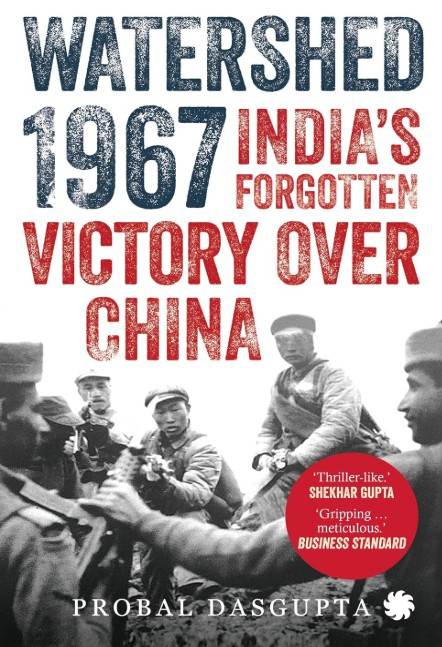
Some victories fade not because they were small, but because they were inconvenient to remember. Probal DasGupta’s Watershed 1967: India’s Forgotten Victory Over China corrects one such omission, and does so with the pace of a thriller and the rigour of serious military history.
The book resurrects the September 1967 fights at Nathu La and Cho La, high-altitude skirmishes on the Sikkim border where Indian troops, guided by commanders such as Sagat Singh, Bishan Singh and P.S. Dagar, delivered a decisive check to the People’s Liberation Army. Set only five years after the trauma of 1962, yet these clashes have been left out of India’s public memory, overshadowed first by the humiliation of 1962 and then by the 1965 war with Pakistan. DasGupta’s main achievement is making clear why that absence matters: 1967 is presented as the moment India’s Army shook off the psychological burden of 1962 and proved, on much the same terrain against the same rival, that deterrence and determination could hold.
What makes the book work is that it does not remain in the trenches. DasGupta interweaves the battlefield story with the diplomatic and intelligence manoeuvring of the time, espionage, political brinkmanship and the tense arithmetic in Delhi and Beijing, allowing the reader to see not only what happened on those ridgelines but also why it had to happen when it did. The result is a page-turner while remaining meticulously sourced, a rare combination in Indian military historiography, which has long been a comparatively thin field next to the voluminous literature on 1962 or 1965.
There is also a contemporary charge running through the book. DasGupta suggests that the confidence forged at Nathu La and Cho La is the same institutional memory that has shaped India’s posture in more recent standoffs at Doklam, Depsang and Chumar. In an era when the India-China border is once again a live strategic concern, recovering this history isn’t a nostalgic exercise; it’s a reminder that India’s military relationship with China has not been one uninterrupted story of caution since 1962, but one punctuated by moments of hard-won parity.
In an era when the India-China border is once again a live strategic concern, recovering this history isn’t a nostalgic exercise; it’s a reminder that India’s military relationship with China has not been one uninterrupted story of caution since 1962, but one punctuated by moments of hard-won parity.
For readers of strategic affairs, Watershed 1967 is valuable precisely because it resists triumphalism even as it tells a story of triumph. DasGupta is careful to note the cost—roughly a hundred lives—and the absence of territorial gain, framing the real prize instead as restored self-esteem and a subsequent decade of relative peace on that frontier. That honesty, paired with narrative craft, is what elevates this from a niche military account to essential reading for anyone trying to understand the deeper roots of India’s China policy today.


