
Abstract: Traditional military prepositioning relies on large, fixed depots or contracted sealift ships; these concentrate valuable materiel into a small number of targets vulnerable to precision strikes in a Western Pacific conflict. This paper argues that surviving high-intensity conflict requires shifting prepositioned sustainment from physical hardening toward economic denial. Suppose a distributed architecture, designated as the Agile Maritime Array (AMA), that embeds military containers within the vast excess capacity of commercial shipping already transiting regional trade lanes, supplemented by dispersed hardened land nodes. The system derives survivability from three properties: dispersion reduces the payoff of striking any single node, movement complicates targeting, and commingling with commercial freight creates ambiguity between military and civilian cargo. Using a kinetic model of missile penetration, hit, and lethality probabilities alongside a game-theoretic targeting analysis, we show that equalising the missile cost per TEU across storage venues forces an adversary to expend disproportionate munitions for modest attrition. Findings indicate that dispersion, mobility, and cost imposition together outperform concentration or hardening alone in sustaining forces during the opening weeks of conflict.
Problem statement: With transit times measured in weeks, forward-posture may be a vulnerability in a war’s opening phase. Therefore, planners must structure stock so that no single strike can meaningfully degrade it.
So what?: Any distant power seeking to operate militarily in the Western Pacific must fund and train its forces to an Agile Maritime Array construct, or risk having its prepositioned sustainment destroyed before it can be brought to bear.
Disclaimer
To maintain this piece at an UNCLASS level, several assumptions are made regarding specific theatre requirements, weapon effectiveness, and force structures. The assumptions may change some specific calculations, but do not change the findings that drive the AMA framework.

Introduction & Policy Question
In military logistics, stockpiling and prepositioning serve distinct but complementary missions. Stockpiling is a long-term reserve, designed to guarantee national defence and essential civilian needs during a crisis. It builds resilience by maintaining critical raw materials in the National Defence Stockpile and focuses on strategic depth: ensuring the U.S. can sustain and replenish, even after years of attrition.[1] Prepositioning (PREPO), by contrast, is about speed, readiness, and agility. Equipment and supplies are staged “afloat” on Military Sealift Command ships or “ashore” in forward bases.[2] It reduces reliance on foreign transport networks, provides commanders with immediate operational assurance, and sustains the early phases of conflict.[3]
The resurgence of high-intensity conflict in Europe highlights the limitations of the “just in time” logistics model.[4] Decades of lean supply chains and outsourced logistics left many forces underprepared for sustained operations, as evidenced by the high consumption of ammunition and equipment in Ukraine. European allies now emphasise strengthening national production capabilities and enhancing multinational logistics cooperation. Programmes such as the Multinational Ammunition Warehouse Initiative illustrate the focus on coordinated stockpiles and supply chains.[5] Countries like Poland and South Korea demonstrate the value of national arsenal models that can mass-produce essential hardware without relying on exports, offering a blueprint for rapid response and collective defence.[6]
Any significant conflict in the Western Pacific (WESTPAC) requires ample prepositioning. Transportation times to move material from the U.S. West Coast will be unacceptably long in the early days of a conflict. Further, local sources of supply are limited by production capacity, competing customer bases, and the enemy’s ability to hold such sources at kinetic risk.[7] The three-island chain framework remains a useful construct for understanding the logistical constraints.
| Island Chain | Key Territories | Approx. Distance from China | U.S. Alignment |
| First | Japan, Taiwan, Philippines | 160–900 km | All U.S.-aligned (Japan, PH treaty allies; Taiwan partner) |
| Second | Guam, Northern Marianas, Palau, Micronesia, Bonin Islands | 2,000–3,000 km | All under U.S. sovereignty or SOFA |
| Third | Hawaii, Wake, Australia, New Zealand | 3,500–8,000 km | Entirely U.S. or allied territory |
Strategic Problem
The distances separating U.S. industrial production and theatre logistics hubs mean that supplies often require weeks to reach warfighters. Yet modern conflicts can escalate in a matter of days. Combat units will consume ammunition, fuel, engineering materials, repair parts, and medical supplies long before large-scale resupply can arrive. Prepositioned material, therefore, is key to bridging the gap between the onset of hostilities and the establishment of sustained logistics flows.
The criticality of prepositioning has intensified as global supply chains have become dangerously brittle. COVID-19 supply chain failures and the rapid munitions consumption in Ukraine demonstrate that production and transportation networks cannot surge at the tempo required to sustain early-stage, high-intensity conflict.
The Pacific Island chains create a tension between accessibility and survivability. Sites closer to likely combat areas enable rapid distribution of supplies but fall within the range of precision munitions. Distant locations offer greater protection but lengthen delivery timelines. Traditional fixed logistics architectures are increasingly vulnerable to precision interdiction.
From an adversary’s perspective, striking concentrated supply nodes offers an asymmetric return on investment, where a modest expenditure of munitions can trigger a cascading operational collapse. Solving this problem requires a distribution architecture that systemically devalues individual nodes.
Existing Frameworks of Prepositioning & Protection Concepts
Crisis demand and combined logistics constraints will destroy any semblance of just-in-time logistics. Initial movements will be outpaced by the speed of an emergent crisis, and the sustainment tail of any significant operation will be constrained by distance and capacity. PREPO is the most effective method for ensuring that forces have access to the materiel required to engage the enemy and sustain the fight.
Traditional PREPO most often follows the large, fixed depot model.[8] These sites tend to be resource-efficient. A well-known example of this is the (former) Red Hill Bulk Fuel Storage Facility in Hawaii. From a protection perspective. Such well-established sites like these tend to be the best defended.
A second approach leverages protection through dispersion.[9] Separating stores across multiple locations increases the cost to kill. Exquisite weapons are costly in terms of money and capability expenditure. Using these high-demand, low-density weapons for a smaller impact is thought to change an enemy’s targeting calculus. One can see this in the NATO shift from large Theatre Logistics Bases to less-dense Logistics Support Areas that seek to disperse material far enough apart to make it impossible for a single attack to destroy a critical mass.[10] These disbursed operations also leverage commercial warehousing locations. Another well-recognised example is the Marine Corps Prepositioning Stores, distributed among an expansive cave system along the Norwegian coast.[11] These sites are more easily concealed, and the smaller volume of material can be moved more easily between sites, providing an element of unpredictability.
The Military Sealift Command (MSC) offers a third option for services. MSC maintains ships loaded with material ready to be moved into place. Their best-known example is the Maritime Prepositioning Squadron 2, located at Diego Garcia, which holds Army, Air Force, and Marine Corps materiel packed on cargo carriers and ready to deploy.[12] The remoteness of Diego Garcia makes an undetected approach difficult, and ships can quickly disperse in times of crisis, thus complicating any targeting of the materiel by malign forces. From a protection perspective, the remote area provides some conventional distance-based protection, but with today’s weaponry, the ships may not be able to disperse in time if surprised by a standoff enemy. Given notice, however, the mobile and dispersed nature of the proposed material provides a measure of protection.
A fourth, under-utilised option is PREPO using excess capacity in commercial shipping. While the volume of materiel supporting combat operations in the Western Pacific is huge, it pales in comparison to the volume of containers used for commerce at sea. On any given day, SeaVision tracks ~4,310 ships between Malacca, 180E, Darwin, and 39N, with 25% being container ships and 90% either container, cargo, or tankers.[13] Placing a handful of containers across many ships would exploit pockets of vacant capacity with limited impact on commercial cargo. This approach takes advantage of the significant commercial traffic in the Western Pacific.
U.S. Customs and Border Patrol operates a vast network of data, international partners, monitoring equipment, and agents to inspect suspicious cargo, and still cannot assess every piece of cargo entering the country. The existence of such a gap makes it even more difficult to identify and target ships transporting US PREPO.[14]
| PREPO Type | Protection Options | Pro/Con |
| Large Fixed Sites | ● Multi-tiered Air Defence ● Hardened Facilities ● Perimeter Security Forces | ● Cost-effective (Economy of Scale) (+) ● 1-Stop Shop (+) ● Attractive target (-) |
| Dispersed Locations | ● Dispersion ● Concealment ● Limited mobility ● Commercial site security | ● Location flexibility (+) ● Leverage existing infrastructure (+) ● Challenging inventory management (-) |
| At Sea | ● Mobility ● Military escort (possible) | ● High capacity (+) ● Flexible placement on globe (+) ● Expensive (-) |
The Agile Maritime Array Concept
In a WESTPAC fight, the U.S. will face an adversary with well-established, short supply chains and an industrial base that has produced munitions at scale for years. Furthermore, the early stages of any fight will likely favour the aggressor. The U.S.’s ability to respond will rest on having material on hand when needed, not 8 weeks or more later.
We propose the Agile Maritime Array (AMA), a distributed prepositioning architecture that leverages commercial maritime capacity to eliminate economically attractive logistics targets. Moving away from the high-value vulnerability of concentrated supplies in a small number of depots, the Array integrates containers into a resilient network of hardened land-based sites, dispersed commercial hubs, and marginal excess capacity aboard merchant vessels already transiting regional shipping lanes. By weaving these disparate nodes into a unified logistics architecture, the system shatters the effectiveness of adversary precision strikes through dispersion and ambiguity, ensuring that sustainment remains assailable.
The core insight of the AMA is that the scale of commercial maritime traffic in the Western Pacific provides a latent sustainment capacity that vastly exceeds the logistical requirements of military operations. With thousands of container ships traversing major trade routes, even a small fraction of unused cargo capacity on these vessels represents a logistics reservoir far more expansive than any dedicated military prepositioning fleet. By distributing tailored inventories of containers aboard commercial ships, we create a persistent, moving sustainment field.
This provides three forms of protection: dispersion, movement, and ambiguity. Dispersion reduces the payoff associated with attacking any single location.[15] Movement complicates targeting because ships constantly change position.[16] Finally, ambiguity makes it difficult to distinguish military cargo from the enormous volume of commercial freight.[17]
The AMA preserves and enhances operational responsiveness. When combined with forward storage at selected land sites, the system ensures that a significant portion of materiel can be delivered within days while the remainder follows in subsequent waves. This approach falls largely within existing regulatory frameworks. Further, Jones Act limitations are not restrictive to intra-theatre WESTPAC movements.[18] As the concept relies on existing infrastructure and commercial capacity, implementation requires relatively modest institutional change compared with building new bases or fleets of dedicated prepositioning ships.
This transforms the survivability of prepositioned logistics from a problem of physical protection to one of economic denial. By distributing material so widely that destroying any portion would require a disproportionate expenditure of precision munitions, the system shifts the attacker’s cost-benefit calculation. Instead of presenting a small number of lucrative targets, the logistics network becomes a diffuse and resilient array of supplies spread across the maritime common.
Operational Model
Any PREPO structure must navigate several competing priorities and limitations. The military perspective will prioritise immediate access to material; material now is worth more than material later. Delayed access increases the risk of delivery disruptions and places strain on lines of communication that must move combat forces forward and internally displaced persons (IDPs) away. The strain of congested logistics will compete with the challenges of contested logistics.
Stock on the ground is also a messaging tool. Strategic and political leadership must balance deterrence messaging with the risk that a military buildup may force premature escalation. A flexible PREPO system is required to permit leaders to adjust the ratio of visible to covert material. The calculus driving distribution will take place at the political level.
At the operational level of war, one must ask: How should material be protected, and how does the volume of material held affect an enemy’s targeting calculations? The force required to destroy a volume of material is calculated for several site options. It is recommended to distribute PREPO across several sites to give commanders the best access to the material while imposing the highest cost on an enemy attempting to disrupt it.
A kinetic module assesses an enemy’s ability to reliably destroy a PREPO site. It is essential to understand the anticipated volume of weaponry to be deployed against US or allied forces, the weapons’ accuracy, the ability to intercept, and the targetability of PREPO sites.
Variables for this module are:
Pki = Single-shot kill probability when a missile is aimed at site i.
Pk = Ppenetrate x P hit | penetrate X P lethal | hit.
Ppenetrate is a function of an enemy munition’s ability to evade defensive measures and is the probability that a single warhead will reach the target environment. Sites are protected by either High defence, consisting of 3 layers (Aegis/SM-6 (0.7 effectiveness), THAAD (0.75 effectiveness), and Patriot (0.6 effectiveness)) of defence; Medium defence with endpoint only (0.6 effectiveness), and No defence. Ppenetrate is the product of (1-effectiveness) of all layers
Phit|penetration is the probability that the weapon with a circular error probability CEP (meters) and a target circle with a radius rt(meters) will hit a target. Assuming a bivariate normal error distribution, rt represents the functional size of the target (building, open storage, tank farm).
Phit|penetration and where
Lethality, or the likelihood that a hit will destroy the target, depends on the target’s armament. For hardened bunkers, including subterranean fuel farms, we use a value of 0.25. Softer targets, such as Open yards and storage, will have a value of 0.7, while fragile targets, such as above-ground fuel farms and ships, will have a value of 0.95.
The final part of the kinetic module determines the number of missiles required to generate ~.6 Pk. It is useful to know how many munitions would be required to destroy a certain target with at least a 60% probability (Pk60). Understanding the multi-independent-missile formula as Pk60=(1-(1-Pk)n), where n is the number of missiles used.
Based on these assumptions, we predict the following Pk rates, the number of missiles required to reach a combined Pk60, and the subsequent survivability rates for each PREPO site examined.
| Site Type | Protection | Penetration | Hit | Lethal | Pk | Survivability | ~60% Kill # |
| Hardened | Heavy | 0.0255 | 0.07395 | 0.25 | 0.0005 | 0.9995 | 1,943 |
| Hardened | Medium | 0.4 | 0.07395 | 0.25 | 0.0074 | 0.9926 | 123 |
| Open Yard | Heavy | 0.0255 | 0.8532 | 0.7 | 0.0152 | 0.9848 | 60 |
| Open Yard | Medium | 0.4 | 0.8532 | 0.7 | 0.2389 | 0.7611 | 3 |
| Open Yard | None | 1.0 | 0.8532 | 0.7 | 0.5972 | 0.4028 | 1 |
| Fuel Farm | Heavy | 0.0255 | 0.26434 | 0.95 | 0.0064 | 0.9936 | 143 |
| Fuel Farm | Medium | 0.4 | 0.26434 | 0.95 | 0.1004 | 0.8996 | 9 |
| Fuel Farm | None | 1.0 | 0.26434 | 0.95 | 0.2511 | 0.7489 | 3 |
| Ship | Medium | 0.4 | 0.1588 | 0.95 | 0.0603 | 0.9397 | 15 |
| Ship | None | 1.0 | 0.1588 | 0.95 | 0.1509 | 0.8491 | 6 |
The movement and location module examines the time required to deliver PREPO material. While the kinetic module examined the type of storage, this section examines the placement. For mobile maritime shipping, we will examine existing shipping routes to estimate the likely distance of materials to a required port.
Terrestrial
Storage within the first two island chains is assumed to be in place and ready for distribution to forces. Third island chain locations are mapped to the closest first or second chain islands.
| 3rd Chain Island | 1st/2nd Chain Island | Distance (km) | Days to Sail |
| Australia | Palau | 2,235 | 2.3 |
| Hawaii | Guam | 6,119 | 6.4 |
| Wake Island | Guam | 2,418 | 2.5 |
| American Samoa | Guam | 5,800 | 6.0 |
Third-chain locations fall within a reasonable sailing distance to deliver goods to the fight in the early stages. While our AMA approach would not take advantage of these sites during a crisis escalation, they remain low-cost options for near-forward storage that could be transferred forward or to sea as required.
Maritime Discussion
Two types of maritime prepositioning are considered. The traditional prepositioning, where the Military Sealift Command contracts an entire vessel. These vessels have significant capacity and are not constrained by defined routes. Given a week to ten days of increasing tensions, we assume that these ships can be placed within a two-day sail of any given location (U.S. Navy, n.d.).
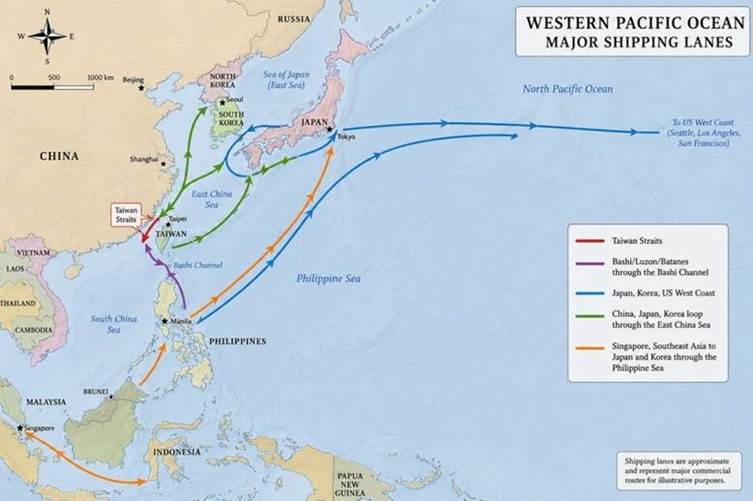
The novel option of leveraging high-density shipping routes operating in the region. These have more limited available space, and their routes are defined. Balancing these constraints is the high number of ships in the region, making identifying and targeting any specific ship challenging. Five of the most developed routes, with the closest point to a U.S. base or allied location, include:
1. Taiwan Strait N–S (Intra-Asia coastal) — PRC coast ↔ SE Asia through the Taiwan Strait (fsail = 0.6).
2. Bashi/Luzon TP (Far East ↔ USWC via Bashi) — Americas–East Asia services passing the Bashi Channel (fsail = 0.75).
3. Japan/Korea ↔ USWC (Great-circle) — arcs far east of Taiwan (fsail = 0.75).
4. NE Asia Trunk (CN–JP–KR loop) — East China Sea loop, generally north of Taiwan (fsail = 0.6).
5. SEA ↔ NEA via Philippine Sea — some intra-Asia services east of Taiwan (fsail = 0.65).
P(within R | lane) = fsail x provides the probability that a ship will be within a given distance from a location. For this example, we are using the closest first or second island chain island as a point and d=CPA to the island and R=distance we are testing for, D = round trip route distance, and L(R,d) = the path length inside the defined circle, and finally fsail is the per cent of time a ship is at sea and not in port. Initial assessments were made for each of the five routes, covering distances of P(1920), P(6720), and P(13,440) kilometres, to approximate the distance required to sail in 2, 7, and 14 days, given a speed of 40km/h.
| Route | Closest Chain Island | CPA (km) | P(1920 km) | P(6720 km) | P(13440 km) |
| Taiwan Strait N–S (Intra-Asia coastal) | Taiwan (West/Taiwan Strait coast) — 1st Chain | ≈ 80 km | 0.27 | 0.94 | 1.00 |
| Bashi / Luzon TP (Far East ↔ USWC via Bashi Channel) | Luzon / Batanes (northern Luzon archipelago) — 1st Chain | ≈ 150 km | 0.15 | 0.52 | 1.00 |
| Japan/Korea ↔ US West Coast (great-circle trunk) | Okinawa / Ryukyu (Yonaguni/Okinawa area) — 1st Chain | ≈ 900 km | 0.14 | 0.57 | 1.00 |
| NE Asia trunk (China ⇄ Japan ⇄ Korea loop, East China Sea) | Okinawa (Ryukyu) — 1st Chain | ≈ 650 km | 0.43 | 1.00 | 1.00 |
| SEA ↔ NEA via Philippine Sea (Singapore/SE Asia ↔ Japan/Korea via Philippine Sea) | Palau / Yap (western edge of Second Chain / Micronesia) — 2nd Chain | ≈ 350 km | 0.23 | 0.82 | 1.00 |
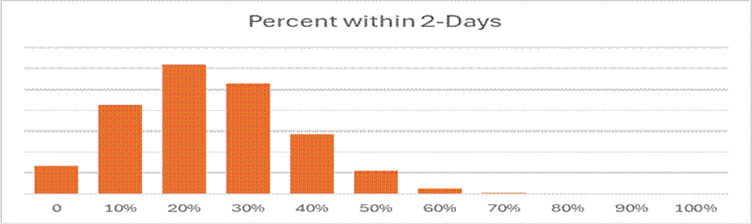
Dispersion among ships on the various routes will permit a certain percentage of material to be within the defined sailing time. A Monte Carlo simulation shows a high likelihood that 20 to 30 per cent of material will be within a two-day sail, with most of the remaining material within seven days.
An Economic Module examines costs from two perspectives. The first is a cost-to-kill ratio. While we have examined the number of missiles required to kill a site, the more appropriate measure is cost to kill a TEU defined as K$=.
For example, if we assume that an enemy will need 60 missiles to kill a highly protected open yard holding 120 TEUs, then the cost-to-kill for that site is 1:2. While available capacity will impose limitations, the equalised cost-to-kill metric provides planners with a rational framework.
As a cascading order of PREPO, planners should utilise:
1. Hardened & heavily protected sites up to the storage capacity. The cost to kill is orders of magnitude higher than any other venue.
2. Open Yards with Heavy Protection should be limited to 120 TEU per site—and only if distant from the prior category. This provides a cost to kill equal to one missile expended to destroy 2 TEU (at the Pk0.6 level).
3. Marginal capacity on commercial shipping accounts for the remaining TEU/Material. No more than 12 TEU should be located on any given ship to keep the cost to kill equal to the previous sites.
4. Fully contracted shipping should be avoided. While they have a higher survivability than medium- or highly-defended unhardened sites, the high volume of material they hold makes them attractive targets from a cost-to-kill perspective. For a relatively small container ship of 2,000 TEU, a single missile would destroy 133 TEU.
Targeting Model (Game Theory)
Consider a simple attacker/defender game. The defender controls a set of storage venues (indexed by i), contracted commercial ships, container ships, and a mix of highly, lightly, and undefended island sites. At each venue, the adversary can aim missiles with a known per-missile probability of kill, pi. The defender chooses how many TEUs, ni to store at each venue. The attacker then chooses how many missiles mito allocate to each venue, subject to a total missile budget M, to maximise expected TEUs destroyed.
If a missile aimed at venue i kills the venue (and all TEUs stored there) with probability pi, then after firing mi missiles at that venue, the probability the site is destroyed is Pi (kill)=1−(1−pi )mi
Expected TEUs destroyed at i are therefore Ei(mi)=ni[1−(1−pi)mi]
The defender’s problem is choosing the ni so that the attacker faces no obvious bargains. A natural criterion is to equalise the missiles per TEU at a 60 per cent site-kill probability across all venues. Let m60,i be the number of missiles needed to reach a 60 per cent probability of killing site i:
1−(1−pi)m60,i = 0.6 ⇒ m50,i = ≈
The defender places more stock in safer venues (low pi , e.g., contracted ships at sea) and very little stock in high-pi venues (e.g., undefended island yards), until every site has roughly the same missile cost per TEU.
From the defender’s perspective, this “missiles-per-TEU equalisation” is attractive because it directly flattens the attacker’s incentive landscape. Combined with the exploitation of marginal commercial capacity at sea, which naturally has very low per-shot kill probabilities, this distribution forces a peer adversary to expendhundreds to thousands of missiles to inflict only modest attrition on prepositioned stocks. In the context of “logistics under pressure,” such a design buys time in the opening weeks of a conflict, preserving operational endurance while the industrial base and follow-on sealift surge into theatre.
Cost-to-Hold
Multiple commercial freight indices show sustained declines in container shipping prices since the COVID-era peak, suggesting that long-term contracted capacity can likely be secured at historically favourable rates.
Demand Sizing & Logistics Time-Distance
Time Phased Force Deployment Data (TPFDD) for each OPLAN will outline the specific units and capabilities required to conduct the fight. COCOM logisticians must calculate sustainment lead time to determine how long forces must operate before the logistics flow can deliver ongoing sustainment. For orders of magnitude, this paper assumes that four light infantry divisions will be required to operate in the Western Pacific for up to two months before sustainment flows are established.
| Class of Supply | Planning Factor (per soldier/day) | Total Weight (tonnes for 30 days) | Estimated TEUs (Range) | Notes |
| Class I (Subsistence, water) | ~11kg (dry/unit rations + water) | ~5,625 tonnes | 250 – 500 | Water is critical in warm weather. MREs and bulk water are dense cargo. |
| Class III (Fuel) | Highly variable, mostly bulk | ~3,000-5,000 tonnes | 50 – 100 (for containerised storage/smaller drums) | Most fuel is transported in bulk tankers, not standard TEUs, but a small portion might be containerised in drums. |
| Class V (Ammunition) | ~11 – 23 Kgs (High Intensity) | ~5,625 – 11,250 tonnes | 1,000 – 2,000+ | Ammunition is a major weight component and requires packing and handling. |
| Other Classes (II, IV, VI, VII, VIII, IX, X) | Variable | ~2,000 – 4,000 tonnes | 200 – 400+ | Includes equipment, repair parts, medical supplies, etc. |
| Total Estimated TEUs | ~16,000 – 26,000+ tonnes | 1,500 – 3,000+ | Total range based on cargo density and operational needs. |
Legal & Diplomatic Authorities
The prepositioning of military materiel is fundamentally supported by existing statutory authorities. Under 10 U.S.C. § 2631 (the Military Cargo Preference Act), the Department of War is mandated to use U.S.-flagged commercial bottoms for the sea-based transport of military supplies. Although this appears to limit the ability to use the full scope of shipping within the WESTPAC, waiver options under the law permit non-U.S. shipping. This framework extends to the leasing of “space and services” required for prepositioned war reserve materiel (PWRM). By utilising a Space Charter or Liner Parcel agreement, the Department of War can maintain strategic depth consistent with the authorisation thresholds of 10 U.S.C. § 2401, which reserve congressional notification for long-term (5+ years) vessel control agreements. This approach treats the commercial vessel as a mobile, sea-based warehouse where the procured service, storage, maintenance, and climate control are mission-essential logistics requirements.
The feasibility of this model rests on supply chain funding. The funding required to secure these commercial services typically originates from the Defence Working Capital Funds (DWCF) or specific O&M accounts. Because these are structured as service contracts for readiness rather than capital asset acquisitions, they are appropriately funded through Operations and Maintenance (O&M) accounts. This approach aligns with OMB Circular A-11, as the government does not assume ownership risk but instead procures logistics services to ensure theatre-entry readiness.
Once a commercial vessel carrying DoD materiel exits U.S. territorial waters, the legal framework shifts from domestic statutes to the established network of international treaties and host-nation agreements. A key legal consideration is the jurisdictional distinction known as the “Sovereignty Gap”: unlike a commissioned US Navy ship, a commercial vessel under a space charter does not inherently enjoy sovereign immunity. Under the United Nations Convention on the Law of the Sea (UNCLOS), while these vessels enjoy “Innocent Passage,” they remain subject to the coastal state’s jurisdiction. This underscores the importance of a Status of Forces Agreement (SOFA) or Visiting Forces Agreement (VFA) as instruments of agreement that recognise contracted commercial space as “official U.S. property.”
The diplomatic strength of prepositioning is grounded by the specific “access” agreements in place with regional partners. In the Indo-Pacific, Enhanced Defence Cooperation Agreements (EDCA) or Mutual Logistics Support Agreements (MLSA) are the enablers for “afloat storage.” These bilateral treaties provide the legal “invite” that allows the Department of War to preposition materiel in foreign ports. Even within this treaty framework, there remains a reputational and escalation risk. Prepositioning on commercial vessels can be perceived by adversaries as “stealth militarisation,” creating political friction for host nations. The legal viability of prepositioning “beyond the water’s edge” is as much a matter of diplomatic negotiation as it is maritime law.
Key Findings
The analysis demonstrates that a distributed prepositioning architecture built around the AMA can alter the cost-exchange dynamics of logistics targeting in the Western Pacific.
First, dispersion, combined with layered survivability, sharply reduces the effectiveness of precision strikes. Second, commercial maritime traffic provides a scale of distributed storage that exceeds traditional military prepositioning capacity. Third, geographic dispersion does not preclude operational responsiveness. Finally, when prepositioned materiel is distributed to equalise the missile expenditure required to destroy each container, the adversary’s targeting incentives are fundamentally altered.
Taken together, these findings indicate that survivability in contested logistics environments can be achieved not through concentration or hardening alone, but through a deliberate combination of dispersion, mobility, and economic denial.
Implementation
Implementation of the AMA relies on integrating existing commercial logistics capacity into military prepositioning frameworks rather than building new infrastructure. The concept is enabled by three core components: contracted commercial cargo capacity, access to dispersed land-based storage, and real-time inventory visibility across a distributed network.
The Department of War can leverage established contracting mechanisms, such as space charters and liner parcel agreements, to secure container capacity aboard commercial vessels operating in WESTPAC shipping lanes. The Array requires the selective use of land-based nodes to anchor the distributed network. These include a limited number of hardened sites for high-value or maintenance-intensive materiel, supplemented by commercial warehouse space and dispersed storage locations near key operational ports. These nodes provide staging, consolidation, and redistribution points.
Effective implementation depends on tracking and inventory management. Existing commercial logistics systems already provide high-fidelity container tracking across global supply chains. Integrating these systems into military logistics planning enables commanders to maintain visibility of widely dispersed materiel and rapidly identify, prioritise, and route supplies as operational requirements evolve.
Initial implementation can proceed incrementally. Pilot programmes should place small quantities of prepositioned materiel aboard commercial vessels on high-density regional routes, paired with exercises that train units to locate, retrieve, and distribute cargo. These efforts will validate assumptions regarding access, tracking, and responsiveness while identifying operational friction points.
Over time, the network can scale by expanding contracted shipping capacity, formalising access agreements with regional partners, and developing a limited number of hardened nodes to support specialised materiel. This phased approach allows the AMA to mature within existing systems while minimising upfront cost and institutional disruption.
Risks, Limitations, & Further Research
Like any concept, this has several limitations. From a strategic perspective, prepositioning entails political risk, intelligence leaks, host-nation pushback, supply chain fragility, and legal exposure. While these are items for consideration, they are beyond the scope of this research. The biggest limitation is modelling limitations driven by data quality. While the calculations are sound and justify all recommendations, a review of the assumptions on issues such as weapons effectiveness should be conducted. There are no indicators to anticipate that changes to the underlying numbers will undermine the approach’s logic. However, we acknowledge that the optimal PREPO volume at various sites will need to be adjusted.
As numbers are refined, this concept should be war-gamed in conjunction with large PACOM exercises, and any pilot trials should feed data back into the calculation to validate and refine the model.
[1] J. S. Thomason, “From National Defense Stockpile (NDS) to Strategic Materials Security Program (SMSP): Evidence and Analytic Support” (Washington, DC: Institute for Defense Analyses, 2010).
[2] M. S. Woodhurst, “Department of Defense Pre-positioning Programs: A Springboard for Deployments” (U.S. Army Command and General Staff College, Fort Leavenworth, KS, 2004).
[3] M. S. Woodhurst, “Department of Defense Pre-positioning Programs: A Springboard for Deployments” (U.S. Army Command and General Staff College, Fort Leavenworth, KS, 2004).
[4] M. Delaporte, “NATO Military Stockpiles Policy: Reversing the Just in Time Logic,” Eurosatory, May 3, 2023, https://www.eurosatory.com/en/nato-military-stockpiles-policy-reversing-the-just-in-time-logic/; B. Martin, D. S. Barnett, and D. McCarthy, Russian Logistics and Sustainment Failures in the Ukraine Conflict: Status as of January 1, 2023 (Washington, DC: RAND, 2023).
[5] Army Technology, “NATO Opens First MAWI Location in Estonia,” Army Technology, March 24, 2022.
[6] S. Dee and K. Suman-Chauhan, “Missiles, Markets, and Mutual Interests: Poland and South Korea’s Evolving Defence-Industrial Cooperation” (Washington, DC: RAND, September 4, 2025).
[7] T. G. Weiss, “Learning from Military-Civilian Interactions in Peace Operations,” International Peacekeeping 6, no. 2 (1999): 112–28.
[8] M. S. Woodhurst, “Department of Defense Pre-positioning Programs: A Springboard for Deployments” (U.S. Army Command and General Staff College, Fort Leavenworth, KS, 2004).
[9] M. Hvizda, F. Bryan, A. Laufer, A. T. Evans, K. Gunness, and D. A. Ochmanek, “Disbursed, Disguised, and Degradable” (Washington, DC: RAND, May 22, 2025).
[10] C. Grigore, “Developing a NATO Capability—A Case Study: Joint Logistic Support Group,” Defense Resources Management in the 21st Century 18, no. 28 (2023): 125–33.
[11] D. Senger, “Marines Pull Equipment from Prepositioning Caves in Norway,” Marines.mil, 2025.
[12] U.S. Navy, “US Navy’s Military Sealift Command COMPSRON Two,” Military Sealift Command, 2025, https://www.msc.usff.navy.mil/Organization/MSC-Area-Commands/MSC-Far-East/Organization-MPSRON2/.
[13] U.S. Department of Transportation, Sea Vision (Washington, DC: U.S. Department of Transportation, 2025).
[14] Especially with a modicum of disinformation on shipping documents to disguise shippers in the event of a shipping firm data breach.
[15] I. Bowers and H. S. Hiim, “Measuring Military Competition in the 21st Century: Toward a Better Understanding of How Militaries Are Preparing for War,” Comparative Strategy (2025): 1–20.
[16] M. A. Hamilton, “Words Matter: Demystifying ‘Maneuver,’” Infantry (2024).
[17] S. Aftergood, Military Deception: A Handbook (Washington, DC: Federation of American Scientists, 2019).
[18] J. Frittelli, “Shipping Under the Jones Act: Legislative and Regulatory Background” (Washington, DC: U.S. Congress, 2019).


