
Louise I. Shelley, (Cambridge, U.K.: Cambridge University Press, 2014). pp. 370.
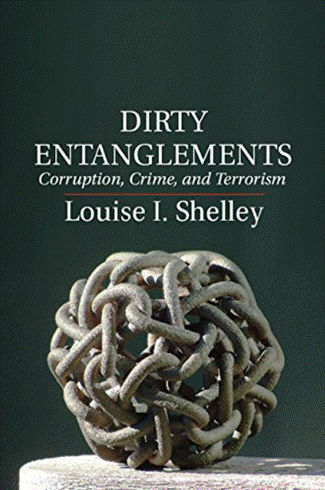
Louise Shelley’s Dirty Entanglements arrives as a landmark contribution to transnational security studies. Drawing on more than fifteen years of field research across six continents, Shelley, University Professor at George Mason University’s Schar School and founder of TraCCC, advances a deceptively simple but analytically powerful argument: corruption, organised crime, and terrorism are no longer discrete phenomena but constitute a mutually reinforcing system whose interactions fundamentally transform each component.
The book’s central theoretical contribution lies in repositioning corruption from background noise to an active causal variable. While Tamara Makarenko’s “crime-terror continuum” and Roy Godson’s work on political-criminal collaboration advanced earlier frameworks, they stopped short of integrating corruption in a systemic way. Shelley fills this gap by arguing, via a borrowing from quantum physics, that once these phenomena entangle, they can no longer be described as before, a substantive claim about causality, not merely rhetoric. The argument unfolds in two parts: Part I establishes the conceptual architecture; Part II applies it to drug trafficking, counterfeit economies, and WMD proliferation, analysing terrorist organisations as rational enterprises that employ diversification, supply chain management, and strategic alliance formation.
The book’s empirical richness is unmatched in the field. Case studies, including Hezbollah’s Lebanese Canadian Bank operation and Islamist inmates seizing control of a Kyrgyz prison’s criminal solidarity fund, anchor abstract claims in concrete operational reality. The framework also anticipates subsequent debates about ISIS as a proto-state economy, hybrid warfare finance, and kleptocracy in democratic systems. Shelley’s portrayal of terrorist groups as adaptive economic actors embedded in licit and illicit markets prefigured later research on ISIS’s hybrid governance structures and diversified revenue streams.
The framework also anticipates subsequent debates about ISIS as a proto-state economy, hybrid warfare finance, and kleptocracy in democratic systems.
The limitations merit candid acknowledgement. The concept of entanglement is never fully operationalised: Shelley provides no observable indicators to distinguish genuine systemic entanglement from a transactional alliance, thereby limiting its utility for comparative research. Case selection is methodologically underspecified and skews toward the former Soviet Union and post-attack detection, potentially overstating entanglement’s prevalence. Policy prescriptions, such as integrating anticorruption into counterterrorism strategy and investing in civil society, are broad relative to the diagnostic complexity. Specific analyses have also been partially superseded by cryptocurrency markets, darknet infrastructure, and COVID-era adaptations of illicit networks.
These caveats notwithstanding, Dirty Entanglements endures as a seminal contribution to the study of transnational security. Shelley’s insistence that corruption, organised crime, and terrorism operate as an interconnected system challenged conventional analytical boundaries and offered a more convincing account of contemporary illicit power structures. While aspects of its empirical discussion inevitably reflect the pre-2014 landscape, the book’s core theoretical insight has aged remarkably well. Combining global empirical reach with a genuinely original conceptual framework, Dirty Entanglements remains essential reading for anyone seeking to understand how criminal, political, and extremist actors intersect in the twenty-first century.


