
Abstract: Military documentation plays a central role in training and operational practice, yet its quality is rarely evaluated from the perspective of actual use. Documents tend to prioritise completeness and regulatory compliance over clarity. This results in materials that are information dense, cognitively demanding, and prone to misinterpretation, particularly under time pressure. This article proposes a conceptual framework that integrates eye-tracking research with generative large language models (LLMs) to support the assessment and improvement of military training documentation. The framework envisions eye-tracking data, including fixation durations, regression patterns, and pupil dynamics, collected from representative military personnel, as empirical ground truth for identifying specific structural and linguistic barriers in documents.
Problem statement: How can military training documentation be systematically improved using objective behavioural data, while preserving operational security and existing institutional workflows?
So what?: Military doctrine development units and training commands should integrate empirical eye-tracking research into the document design process. Research institutions should codify measurable readability principles and embed them into locally deployed AI tools. Instead of treating documentation as a purely formal requirement, armed forces should recognise usability as a component of operational readiness. This conceptual shift, from regulatory completeness to cognitive efficiency, requires collaboration between researchers, AI engineers, and doctrine authors.

Introduction
Today, operational effectiveness increasingly depends on personnel’s ability to work with complex, software-driven systems. New sensors, decision-support tools, and communication platforms appear much faster than organisational routines and training materials can be updated. Consequently, personnel are often required to interpret dense training manuals, doctrinal publications, and procedural documents under significant time pressure. These texts are shaped by long-standing traditions of precision, hierarchy, and regulation, which support accountability but can also make documents difficult to read and apply in practice.
Against this background, AI-based language technologies offer a potential means of improving military documentation. Large language models (LLMs) are already used in civilian sectors to simplify specialist texts, adapt materials to specific audiences, and support authors in redrafting complex passages. In principle, similar tools could help doctrine writers and instructors produce clearer manuals and procedures without compromising technical accuracy or legal requirements. The added value explored in this article lies in conceptualising how such capabilities might be embedded in a dedicated framework for assessing and improving military documents, rather than relying on generic, open-ended chat systems.
However, widespread direct use of general-purpose AI tools by military personnel cannot be taken for granted. Differences in digital literacy, established work habits, and varying levels of trust in novel technologies mean that experienced personnel may be reluctant to rely on open, rapidly evolving systems perceived as opaque or unreliable. Instead of expecting a rapid shift in everyday practices, it is more realistic to design AI-supported systems that operate within existing document-production workflows and present their recommendations in familiar forms to doctrine authors and trainers.
Documentation in the Armed Forces
Military documentation is a constant element of military practice, significant to both soldier training and the execution of tasks.[1], [2] In many contexts related to preparation and instruction, documents become the primary source of guidance. This applies mainly to doctrinal texts, training manuals, and procedural documentation. Although personnel and technical solutions evolve over time, such documents often remain in use for extended periods, shaping how knowledge is transferred and applied within military structures.[3]
Beyond training, military documentation provides a shared reference framework that supports coordinated and predictable action.[4], [5] Manuals, procedures and doctrinal publications help maintain continuity, even when organisational arrangements or personnel assignments change.[6]
The language and structure of military documents are deliberately formal. Precision is expected, and ambiguity is treated as a risk, as unclear or incomplete instructions may lead to errors, particularly under time pressure or stress.[7][8][9][10] As a result, authors tend to emphasise completeness and regulatory compliance, while considerations related to clarity and ease of use receive less attention.[11]
In addition to technical considerations, organisational culture also influences how military documentation is created. Although Western military doctrine emphasises the concept of Mission Command—which promotes initiative and decision-making at lower levels of command—in practice, organisations often attempt to minimise operational and legal risk by introducing increasingly detailed regulations and procedures. Over time, however, this approach produces documents that are extensive, information-dense, and difficult to read linearly.[12]
This problem is further intensified by the growing complexity of military systems and procedures.[13], [14], [15] Contemporary documentation increasingly combines procedural guidance with technical descriptions, system dependency and security-related constraints. Individual documents rarely function in isolation. Procedures often refer to other manuals, regulations or annexes, requiring the reader to consult multiple documents in parallel.[16] In practice, understanding a single procedure may therefore depend on navigating a chain of interrelated documents, which can obscure the overall meaning and significantly increase cognitive effort.[17], [18]
Despite the central role of documentation, its quality is rarely examined from the perspective of actual use.[19] Review processes focus primarily on doctrinal alignment and factual accuracy, while paying limited attention to how documents are read, interpreted, and, crucially, applied by their users.[20] In many cases, documents are effectively created to satisfy formal requirements, ensure internal consistency or align with higher-level regulations, rather than to support efficient end use. This results partly from institutional review procedures, which prioritise doctrinal compliance, traceability and accountability over usability and readability. As a consequence, materials may be internally correct and complete, yet insufficiently adapted to the needs and constraints of those who rely on them in practice.
As the complexity of military documentation increases, the limitations of traditional approaches to document design and evaluation become increasingly evident.[21], [22] The effectiveness of soldier training depends not only on the content of documents, but also on how information is structured, how relationships between documents are managed and to what extent materials are designed with the reader in mind. The lack of systematic reflection on how documentation functions in practice contributes to the continued use of materials that are formally correct, yet demanding, inefficient, and prone to misinterpretation in everyday use. This persistence can be explained by the fact that existing review and approval processes prioritise doctrinal correctness and procedural compliance, while offering limited mechanisms for evaluating usability or cognitive accessibility.
In practice, these difficulties have a very concrete dimension. Readability issues arise not only from information overload but also from deficiencies in document structure. While lower-level tactical manuals often prioritise structural simplicity, broader doctrinal and administrative documents frequently exhibit poorly distributed paragraphs, insufficient subdivision into sections, limited use of subheadings and an unclear information hierarchy. At the same time, the linguistic layer constitutes a significant barrier. Long, multi-clause sentences, extensive nominalisation and the use of highly formal or infrequent lexical constructions hinder rapid text processing. As a result, documents become difficult to scan visually, require linear reading, and impose a high cognitive burden, particularly under time pressure.[23] For example, doctrinal publications or multi-volume technical manuals often combine procedural guidance with detailed system descriptions, resulting in long, information-dense sections that are difficult to process quickly. Furthermore, this cognitive burden is often exacerbated by logistical challenges in the timely dissemination and internalisation of new operational information across the ranks.
Identifying such problems, however, requires tools that go beyond subjective judgment or general editorial principles.[24] To reliably examine how document structure and language affect the reading process, empirical methods are needed that capture actual user behaviour.[25] One of the most established techniques for this purpose is eye tracking, which enables objective and measurable analysis of text perception during reading.
Eye-Tracking with Documents
Current research on document perception relies on advanced video-based eye-tracking systems. While these are strictly research tools rather than everyday devices, they provide an objective methodology for analysing how users process complex information. By monitoring gaze position and the spatial relationship between the pupil centre and the corneal reflection, these systems enable a precise distinction between eye and head movements, which is essential for high measurement precision.[26], [27], [28]
In text document analysis, the reading process is a sequence of fixations and saccades. Fixations are periods of visual stabilisation during which information is acquired, while saccades are rapid shifts between words or lines. The primary scientific value of eye-tracking in military research lies in assessing mental workload. Increased cognitive difficulty is directly reflected in eye-movement patterns, such as extended fixation durations on ambiguous terms, an increased number of regressions (returning to previous sections), and changes in pupil diameter.[29], [30], [31]
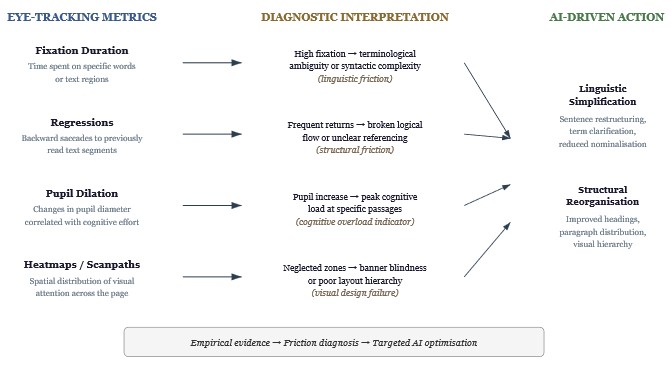
However, the ultimate goal of eye-tracking is not just observation, but document optimisation. By analysing global measures (total reading time) and local metrics (first-pass time in Regions of Interest), researchers can identify specific “frictions”, structural or linguistic barriers that disrupt the reader’s flow. Visualisations, such as heatmaps and scan paths, are no longer merely final outputs; they serve as a diagnostic map of a document’s failures. These data-driven insights allow for a shift from subjective editorial judgment to an objective redesign process. In this framework, eye-tracking provides the empirical evidence needed to pinpoint exactly where a document’s hierarchy or syntax fails the user, creating a dataset that can subsequently inform automated improvement models.[32], [33], [34], [35]
Applications of Artificial Intelligence in document processing
Recent advances in Large Language Models have enabled a transition from simple text generation to sophisticated document optimisation. While current studies highlight the ability of LLMs to reduce linguistic complexity—lowering readability indices from secondary to primary school levels in seconds, the next frontier lies in data-driven optimisation.[36], [37], [38]
The true potential of AI in this field enables the addressing of cognitive bottlenecks identified in empirical research. Studies utilising eye-tracking methodologies have successfully identified specific linguistic structures (e.g. non-canonical word order) that significantly increase processing time and cognitive load.[39]Parallel advancements in synthetic data generation and automated annotation demonstrate how AI can be leveraged to create vast, high-quality document datasets tailored for specific intelligence tasks.[40] Theoretically, integrating such diagnostic insights with generative capabilities could enable a specialised training loop in which the AI model is refined to eliminate specific friction patterns, creating materials “optimised by design”.
A critical distinction must be made regarding the scope of AI intervention: linguistic versus substantive (merit) correction. Especially in high-stakes military or medical contexts, the focus remains on linguistic and structural refinement to ensure clarity without altering the core technical meaning. While AI can significantly improve comprehensibility, human-in-the-loop (HITL) systems remain essential to mitigate risks such as hallucinations and the loss of critical information. By focusing AI on the ‘structural friction’ identified through objective research, defence organisations can produce documents that are not only formally correct but also cognitively accessible. This synergy between eye-tracking diagnostics and AI-driven synthesis represents a new paradigm in professional documentation management, moving beyond generic editing toward a scientifically validated user-centric design.[41], [42], [43]
The Concept of the AI Framework
In response to the challenges identified in earlier sections regarding the legibility of military documentation and the increasing cognitive load on personnel, a hybrid solution is proposed. This approach assumes that optimising training and operational materials cannot rely solely on subjective assessments by editors or instructors. Instead, it should be grounded in objective psychophysiological indicators, processed by AI systems.
Empiricism instead of Intuition
The proposed practice does not rely on general principles of ‘good style’ or universal rules of plain language but instead utilises empirical data. As demonstrated in the literature review, visual perception is a measurable process and parameters such as fixation time and saccade amplitude serve as direct markers of mental effort.[44], [45], [46] For an AI system to be effective in a specific military environment, it must be trained on context-specific data rather than generic internet datasets.
A key element of this approach is the use of data from eye-tracking studies conducted on a representative sample of military personnel. The behaviour patterns recorded while reading actual instructions and procedures constitute the empirical foundation for system development.
The primary focus is placed on the following aspects:
- Anomalies in eye movement: Places where there is a sharp increase in the number of regressions (returns of gaze), which signals an error in the logical structure of the sentence or terminological ambiguity;
- Heatmaps: Analysis of areas that are systematically ignored by users despite their substantive importance (the phenomenon of banner blindness or poor formatting); and
- Pupil dynamics: Changes in pupil diameter in correlation with specific text fragments, indicating moments of highest cognitive load.
The material collected through this process enables a transition from theoretical discussions about ‘readability’ to precise identification of syntactic and visual constructions that hinder knowledge acquisition.
From Graph to Algorithm
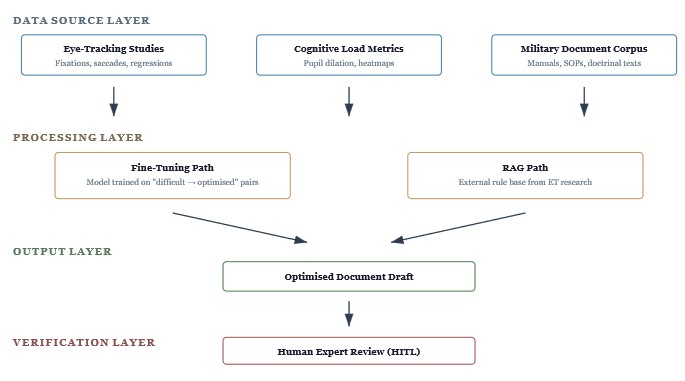
Collecting eye-tracking data alone is insufficient without effective implementation in the editing process. A two-pronged approach is proposed for utilising the collected metrics to guide the operation of LLMs.
The first path is fine-tuning (model retraining). The optimisation criterion here is derived from eye-tracking studies. Thanks to this, the model learns to recognise patterns that caused longer reaction times in the studies and automatically suggests alternative formulations. The model stops ‘guessing’ what is readable and instead replicates the structure of texts that achieved the best comprehension results in empirical tests (e.g., shorter fixation times on keywords).
The second, more flexible method utilises the Retrieval-Augmented Generation (RAG) technique. In this scenario, the AI system not only generates text but also accesses an external knowledge base containing codified rules derived from research, such as the following rule: in high-priority procedural sections, paragraphs should not exceed five lines. When a document is submitted for verification, the system analyses it and applies the appropriate design principles tailored to the document type. RAG enables dynamic updating of the rule base without requiring costly and time-consuming retraining of the entire model, which is essential in the rapidly evolving context of military regulations.
AI Integration into the Creative Process and Standardisation
In the context of the aforementioned resistance among military personnel to new technologies, it is crucial that this tool is not perceived as a ‘black box’ that replaces humans, but rather as a transparent support system that augments their capabilities, serving as a true force multiplier. Currently available models, such as the Llama 4 family, the Mistral series, or specialised variants of commercial models, have sufficient semantic capabilities to understand the military context.
Implementing such a system enables unprecedented standardisation. Most armed forces possess extensive historical documentation, including regulations and instructions that are substantively accurate but outdated in form and challenging to comprehend. Manual rewriting of these resources is inefficient. The proposed system facilitates the automatic transformation of legacy documents into versions aligned with current cognitive standards.
It is a continuous process:
- Ingestion of the source document;
- Audit of compliance with eye-tracking patterns (detection of cognitive bottlenecks);
- Generation of a new version of the document using LLM; and
- Substantive verification by a human expert.
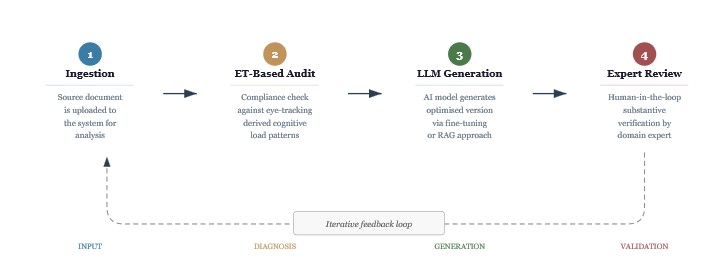
As a result, every document, regardless of its author, undergoes the same ‘quality filter,’ ensuring consistency and predictability of communication.
Limitations, Assumptions and Security Dilemmas
The implementation of AI-based systems in military structures faces a fundamental limitation: data security. Military documentation, even at lower classification levels, contains information about procedures, tactics, and equipment that cannot be disclosed to the outside world. In this context, a comparative analysis of two implementation models is necessary.
Online models (Cloud/SaaS): Cloud solutions (e.g. GPT-5, Claude) currently offer the highest quality of generated text, speed of operation and ease of integration (low barriers to entry). However, their architecture requires data to be transferred to external servers, often located outside national jurisdiction. In a military environment, this poses an unacceptable risk of data interception or use for training public models, potentially leading to the leakage of sensitive operational knowledge.
Local Models (On-premise/Local LLM): An alternative recommended as part of this solution is the use of ‘open’ models (such as Llama, Mistral, Qwen), which can be installed and operated directly on military infrastructure.
- Security: The system can operate in an environment completely isolated from the Internet (air-gapped), which eliminates the risk of data leakage. Full data sovereignty is maintained;
- Customisation: Local models allow for deeper interference in their structure and secure fine-tuning on classified documents, without fear that this knowledge will ‘leak’ to the publicly available base model; and
- Challenges: This approach involves higher initial costs (purchase of servers with GPU accelerators) and requires a competent technical team to maintain the machine learning operations (MLOps) infrastructure.
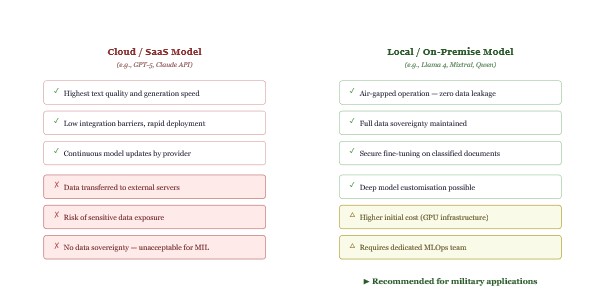
In summary, the proposed solution constitutes an advanced ecosystem in which biometric data from eye-tracking studies guide the AI generative process. Despite higher costs, selecting a local architecture appears to be the only viable option for secure digitisation and cognitive optimisation of documentation in the armed forces, while also ensuring robust, offline support for non-English languages. This approach reconciles tradition and formal requirements with contemporary knowledge of human perception, ultimately enhancing training effectiveness and operational safety.
Military Applications
The proposed approach has direct applicability in the military training and doctrinal environment, where documents play a central role in the transmission of knowledge, procedures and operational principles. In the armed forces, documentation is not merely a supplementary training aid but often constitutes its primary foundation. Manuals, regulations, procedures, and doctrinal publications remain in use for extended periods, even as technology and operational conditions evolve. As a result, issues related to readability, structure or clarity may lead to misinterpretation and increased cognitive load among users.
The proposed system can be applied at several levels within military organisations. Its primary use concerns the creation of new training and instructional documents. Authors and doctrine development teams could employ the tool as an intermediate verification step prior to formal approval. Analysis of eye-tracking data would enable the identification of sections that generate excessive cognitive effort, unclear procedural sequences, or visual elements that fail to guide user attention as intended.
A second important area of application involves the modernisation of existing documentation. Armed forces possess extensive collections of regulations and manuals that are substantively correct, yet difficult for contemporary personnel to use effectively. Manual revision of such materials is time-consuming and resource-intensive. In this context, an AI-supported system can function as a decision support tool, automatically highlighting passages that require simplification or structural reorganisation, while preserving full human oversight and responsibility for final content.
Another key benefit is document standardisation. Applying a unified readability assessment mechanism enables the introduction of consistent quality criteria across documents, regardless of their author, organisational unit, or purpose. This is particularly relevant in military structures, where consistency of communication and predictability of form contribute directly to operational safety and reliability.
From an implementation perspective, data security constitutes a fundamental consideration. Given the sensitive nature of military documentation, the local deployment of language models within secure defence infrastructure is the preferred option. Such an approach aligns with privacy-first principles and eliminates the need to transmit data to external service providers. Although this model involves higher initial costs, it enables long-term, secure and systematic improvement of training documentation.
Implications
The proposed framework has several implications for the responsible integration of AI into military training and doctrinal work. First, it offers a way to use generative models without assuming that all personnel are ready to engage directly with new, unfamiliar technologies such as chat-based large language models. Rather than expecting personnel to change their habits and interact with open-ended AI interfaces, the concept embeds AI capabilities within a dedicated document assessment tool. From the user’s perspective, this appears as a familiar process of submitting a draft and receiving structured, traceable comments, rather than as a requirement to “talk to an algorithm.”
Second, the framework suggests that investments in AI should be closely linked to empirical research on how soldiers and cadets actually read and use documents. Eye-tracking studies are not treated as isolated experiments, but as a source of operational knowledge that can be codified and reused. This creates a feedback loop between research, doctrine development, and everyday training practice: observations from the field inform the tool, and the tool, in turn, helps produce materials that are easier to work with in real conditions. Such an approach could also be extended in the future to support more interactive or adaptive training environments, for example, by incorporating engagement monitoring or elements of personalised learning.
Finally, the framework identifies a practical approach to developing AI capabilities under stringent security constraints. By relying on locally deployed models running within military infrastructure, it becomes possible to process sensitive documents without transferring them to external providers. This approach allows armed forces to retain full control over data, model updates, and access rights, while still benefiting from advances in language technology. In combination, these elements outline a gradual, low-friction path from proof-of-concept ideas to tools that can systematically support the production of clear, reliable documentation.
Conclusion
Starting from the observation that armed forces simultaneously drive and resist technological change, we focused on a domain in which innovation can be introduced without undermining established structures: the drafting and revision of manuals, procedures, and training materials. Rather than asking all personnel to adopt general-purpose chat-based tools, we proposed embedding generative models in a dedicated system that evaluates documents and provides structured feedback.
The framework combines three elements. First, it treats eye-tracking as empirical evidence of how readers navigate and process military documents. Second, it uses this evidence to guide the behaviour of language models, either through fine-tuning or rule-based prompting and retrieval, so that suggested revisions reflect real patterns of cognitive load and difficulty. Third, it assumes secure, local deployment of AI infrastructure, enabling the processing of sensitive materials within military networks.
As a conceptual contribution, the framework does not claim to solve all practical problems associated with documentation in the armed forces. Its purpose is to provide a structured starting point for future work: designing experimental studies, building prototypes and testing them in cooperation with doctrine development teams and training institutions. If developed further, such tools could help reduce cognitive overload, improve the clarity of instructions and support more efficient use of existing training time. In the longer term, this approach may contribute to a culture in which the usability of documentation is treated as a systematic, measurable dimension of military readiness.
[1] H. te Kulve and W. A. Smit, “Novel Naval Technologies: Sustaining or Disrupting Naval Doctrine,” Technological Forecasting and Social Change 77, no. 7 (September 2010): 999–1013, https://doi.org/10.1016/j.techfore.2010.03.005.
[2] Jason Andress and Steve Winterfeld, “Cyber Doctrine,” in Cyber Warfare (Waltham, MA: Elsevier, 2014), 53–82.
[3] H. te Kulve and W. A. Smit, “Novel Naval Technologies,” 999–1013.
[4] Ibid.
[5] Andress and Winterfeld, “Cyber Doctrine,” 53–82.
[6] Ibid.
[7] Jonathan Pfautz and Emilie Roth, “Using Cognitive Engineering for System Design and Evaluation: A Visualization Aid for Stability and Support Operations,” International Journal of Industrial Ergonomics 36, no. 5 (May 2006): 389–407, https://doi.org/10.1016/j.ergon.2006.01.004.
[8] K. Johnson, C. Morais, and E. Patelli, “Enhancing Procedure Quality: Advanced Language Tools for Identifying Ambiguity and High-Potential Violation Triggers,” Reliability Engineering and System Safety 264 (December 2025), https://doi.org/10.1016/j.ress.2025.111308.
[9] P. Lindhout, J. C. Kingston-Howlett, and B. J. M. Ale, “Controlled Readability of Seveso II Company Safety Documents, the Design of a New KPI,” Safety Science 48, no. 6 (July 2010): 734–46, https://doi.org/10.1016/j.ssci.2010.02.011.
[10] R. Weber, D. W. Aha, H. Muñoz-Ávila, and L. A. Breslow, “An Intelligent Lessons Learned Process,” in Foundations of Intelligent Systems: 12th International Symposium, ISMIS 2000, Charlotte, NC, USA, October 11–14, 2000, Proceedings (Berlin and Heidelberg: Springer, 2000), 358–67.
[11] Ibid.
[12] Lindhout, Kingston-Howlett, and Ale, “Controlled Readability,” 734–46.
[13] Andress and Winterfeld, “Cyber Doctrine,” 53–82.
[14] Johnson, Morais, and Patelli, “Enhancing Procedure Quality.”
[15] M. Zhang et al., “Command-Agent: Reconstructing Warfare Simulation and Command Decision-Making Using Large Language Models,” Defence Technology (2025), https://doi.org/10.1016/j.dt.2025.09.004.
[16] Leon Moonen and Amir R. Yazdanshenas, “Analyzing and Visualizing Information Flow in Heterogeneous Component-Based Software Systems,” Information and Software Technology 77 (September 2016): 34–55, https://doi.org/10.1016/j.infsof.2016.05.002.
[17] Pfautz and Roth, “Using Cognitive Engineering,” 389–407.
[18] H. Miton and J. C. Jackson, “Complex Technology Requires Cultural Innovations for Distributing Cognition,” Trends in Cognitive Sciences (February 2025).
[19] Lindhout, Kingston-Howlett, and Ale, “Controlled Readability,” 734–46.
[20] Moonen and Yazdanshenas, “Analyzing and Visualizing Information Flow,” 34–55.
[21] Zhang et al., “Command-Agent.”
[22] Miton and Jackson, “Complex Technology Requires Cultural Innovations.”
[23] Pfautz and Roth, “Using Cognitive Engineering,” 389–407.
[24] Ibid.
[25] Zhang et al., “Command-Agent.”
[26] L. Arnold et al., “A Systematic Literature Review of Eye-Tracking and Machine Learning Methods for Improving Productivity and Reading Abilities,” Applied Sciences 15, no. 6 (March 18, 2025): 3308, https://doi.org/10.3390/app15063308.
[27] S. Jacob et al., “Gaze-Based Interest Detection on Newspaper Articles,” in Proceedings of the 7th Workshop on Pervasive Eye Tracking and Mobile Eye-Based Interaction (New York: ACM, 2018), 1–7.
[28] C. Rigaud et al., “Semi-Automatic Text and Graphics Extraction of Manga Using Eye Tracking Information,” in 2016 12th IAPR Workshop on Document Analysis Systems (DAS) (2016), 120–25.
[29] D. Bačić and R. Henry, “Advancing Our Understanding and Assessment of Cognitive Effort in the Cognitive Fit Theory and Data Visualization Context: Eye Tracking-Based Approach,” Decision Support Systems 163 (December 1, 2022): 113862, https://doi.org/10.1016/J.DSS.2022.113862.
[30] C. Wu et al., “Eye-Tracking Metrics Predict Perceived Workload in Robotic Surgical Skills Training,” Human Factors 62, no. 8 (December 27, 2020): 1365–86, https://doi.org/10.1177/0018720819874544.
[31] D. Wendt, T. Brand, and B. Kollmeier, “An Eye-Tracking Paradigm for Analyzing the Processing Time of Sentences with Different Linguistic Complexities,” PLOS ONE 9, no. 6 (June 20, 2014): e100186, accessed February 9, 2026, https://pmc.ncbi.nlm.nih.gov/articles/PMC4065036/, https://doi.org/10.1371/JOURNAL.PONE.0100186.
[32] J. Falkowska, J. Sobecki, and M. Falkowski, “Utilization of Eye-Tracking Metrics to Evaluate User Experiences—Technology Description and Preliminary Study,” Sensors 25, no. 19 (October 1, 2025): 6101, accessed February 9, 2026, https://pmc.ncbi.nlm.nih.gov/articles/PMC12526729/, https://doi.org/10.3390/S25196101/S1.
[33] P. Bonifacci et al., “Eye-Movements in a Text Reading Task: A Comparison of Preterm Children, Children with Dyslexia and Typical Readers,” Brain Sciences 13, no. 3 (February 28, 2023): 425, https://doi.org/10.3390/brainsci13030425.
[34] D. D. Le et al., “An Eye Tracking-Based System for Capturing Visual Strategies in Reading of Children with Dyslexia,” in Proceedings of the 12th International Symposium on Information and Communication Technology (New York: ACM, 2023), 856–62.
[35] A. Ronconi et al., “Effects of Digital Reading With On-Screen Distractions: An Eye-Tracking Study,” Journal of Computer Assisted Learning 41 (2025): 13106, https://doi.org/10.1111/jcal.13106.
[36] T. Guidroz et al., “LLM-Based Text Simplification and Its Effect on User Comprehension and Cognitive Load,” May 4, 2025, accessed February 9, 2026, https://arxiv.org/abs/2505.01980v1.
[37] K. C. Marturi and H. H. Elwazzan, “LLM-Guided Planning and Summary-Based Scientific Text Simplification: DS@GT at CLEF 2025 SimpleText,” August 15, 2025, accessed February 9, 2026, http://arxiv.org/abs/2508.11816.
[38] A. Smirnova et al., “Text Simplification for Children: Evaluating LLMs Vis-à-Vis Human Experts,” in Conference on Human Factors in Computing Systems Proceedings (April 26, 2025), accessed February 9, 2026, https://dl.acm.org/doi/10.1145/3706599.3719889.
[39] Wu et al., “Eye-Tracking Metrics,” 1365–86.
[40] Wendt, Brand, and Kollmeier, “An Eye-Tracking Paradigm.”
[41] G. Sivaramakrishnan et al., “Assessing the Power of AI: A Comparative Evaluation of Large Language Models in Generating Patient Education Materials in Dentistry,” BDJ Open 11, no. 1 (June 18, 2025): 59, accessed February 9, 2026, https://www.nature.com/articles/s41405-025-00349-1, https://doi.org/10.1038/s41405-025-00349-1.
[42] C. A. Stephenson-Moe et al., “Assessing the Quality and Readability of Patient Education Materials on Chemotherapy Cardiotoxicity from Artificial Intelligence Chatbots: An Observational Cross-Sectional Study,” Medicine 104, no. 15 (April 11, 2025): e42135, accessed February 9, 2026, https://pmc.ncbi.nlm.nih.gov/articles/PMC11999455/, https://doi.org/10.1097/MD.0000000000042135.
[43] A. Vanka et al., “Guidelines for Patient-Centered Documentation in the Era of Open Notes: Qualitative Study,” JMIR Medical Education 11 (2025): e59301, accessed February 9, 2026, https://pmc.ncbi.nlm.nih.gov/articles/PMC11791454/, https://doi.org/10.2196/59301.
[44] Bačić and Henry, “Advancing Our Understanding,” 113862.
[45] Wendt, Brand, and Kollmeier, “An Eye-Tracking Paradigm.”
[46] A. Wolf and K. Ueda, “Contribution of Eye-Tracking to Study Cognitive Impairments Among Clinical Populations,” Frontiers in Psychology 12 (2021), https://doi.org/10.3389/FPSYG.2021.590986/FULL.


