
Abstract: Growing economic asymmetry between inexpensive offensive systems and costly defensive architectures is reshaping escalation dynamics in contemporary warfare. Focusing on the period from 2022 to the present, the analysis examines case studies from the Russia-Ukraine war, Iran’s regional strategy in the Middle East, and recent India-Pakistan crises in South Asia. Drawing on insights from strategic studies, defence economics, and military innovation literature, an analytical framework – the Escalation Cost Curve – is developed to explain how sustained cost-asymmetric attacks can strain defensive inventories, compress decision timelines, and potentially lower thresholds for escalation. Intended primarily for prolonged conventional, cost-intensive conflicts, the framework extends existing deterrence theories by specifying how economic strain, rather than military force alone, can shape strategic outcomes, while acknowledging that adaptation, target value, and alliance support moderate this relationship. Future warfare will increasingly be shaped by economic sustainability alongside technological superiority and military capability.
Problem statement: How do economic asymmetries between low-cost offensive systems and expensive defensive capabilities challenge traditional deterrence theory and reshape escalation dynamics?
So what?: Defence policymakers must understand how economic pressures, not just military outcomes, drive escalation. The Escalation Cost Curve provides a framework for recognising when inventory depletion and cost-imposition strategies may force adversaries toward escalation or retreat. Without this understanding, forces risk operational exhaustion in prolonged cost-asymmetric conflicts.

The Changing Economics of Combat
Military history is shaped by innovations that alter the offence-defence balance. Gunpowder, industrialisation, and nuclear weapons each transformed the cost and feasibility of warfare. Today, another transformation is unfolding — driven by AI, autonomous systems, and commercially available technologies — with a distinctive feature: the growing divergence between the cost of attack and the cost of defence.
This article examines this transformation across three contemporary theatres: the Russia-Ukraine war (2022–present) in Europe, Iran’s regional strategy in the Middle East, and recent India-Pakistan crises in South Asia. These cases illustrate different dimensions of cost asymmetry—industrial-scale attrition in Ukraine, layered cost imposition in the Middle East, and the intersection of economic strain with nuclear deterrence in South Asia. The analysis spans the period from 2022 to the near future, drawing on evidence from open-source intelligence, defence procurement records, and operational reporting through 2025–2026.
Offensive systems, particularly drones and loitering munitions, have become dramatically cheaper, while defensive systems have remained expensive. This does not mean expensive systems are obsolete. Advanced systems remain indispensable for high-value targets and deliver capabilities—precision, range, survivability, and lethality—that low-cost systems cannot replicate. However, the cost asymmetry is dynamic: as countermeasures improve, attackers adapt, and the cost-exchange ratio evolves over time.
The challenge is determining the optimal mix that balances operational effectiveness with economic sustainability. The Escalation Cost Curve captures this trade-off by specifying that over-reliance on expensive interceptors for every threat creates cumulative economic strain. This strain becomes strategically consequential when inventory depletion outpaces industrial replenishment, forcing defenders to choose between accepting risk and escalating the conflict.
The Cost-Exchange Ratio in Modern Warfare
Conceptual Foundation
The Escalation Cost Curve builds upon established scholarship on cost-imposition strategies, attrition theory, and defence economics. Andrew Marshall’s work on competitive strategies emphasised exploiting adversary cost structures to achieve strategic advantage — a logic now manifest in drone warfare.[1] Thomas Mahnken and T.X. Hammes have examined how asymmetric capabilities impose disproportionate costs on advanced militaries.[2] Lawrence Freedman’s analysis of escalation dynamics highlighted how economic exhaustion can become a pathway to strategic defeat.[3]
The Escalation Cost Curve extends these insights by specifying that cumulative economic pressure rather than military force alone can drive escalation. Unlike conventional escalation ladders that emphasise military actions, the framework captures how economic strain, operational tempo, and industrial capacity interact to shape strategic outcomes. The Escalation Cost Curve therefore extends classical deterrence theory by incorporating economic sustainability and industrial resilience as dynamic determinants of deterrence under conditions of prolonged conventional attrition.
Measuring the Asymmetry
The cost-exchange ratio — the ratio of defender interception cost to attacker system cost — is a foundational variable in assessing cost-imposing strategies. It is primarily measured as cost per engagement, though variable operational conditions heavily affect actual expenditures.[4] Sustained defence expenditures exceeding 10% of gross domestic product typically trigger long-term economic instability, although the exact breaking point depends on domestic production capabilities and existential survival imperatives.[5]
Defenders employ layered air defence architectures to manage this asymmetry. Anti-aircraft guns and machine guns form the first line, medium-range missile systems the second and high-end systems the apex defensive tier. This tiered approach seeks to minimise economic strain. However, attackers exploit the asymmetry by massing low-cost systems, forcing defenders to make difficult choices about which threats to engage and with what assets. Even unsuccessful attacks achieve strategic effects over time by gradually depleting interceptor inventories and straining defence budgets. This cumulative economic erosion, rather than any single kinetic engagement, serves as the primary mechanism through which cost asymmetry drives escalation dynamics.[6] The objective is therefore not to replace sophisticated defensive systems with cheaper alternatives, but to reserve high-end capabilities for high-value threats while employing cost-effective countermeasures wherever operationally feasible.
Cost-Imposition in Practice
Ukraine: Industrial-Scale Attrition
Russia’s Geran-2 drone campaign exemplifies cost-imposition strategy at scale. Mass-produced domestically at significant volume, these drones force Ukraine to employ a tiered defence: anti-aircraft guns and machine guns for the first line, medium-range systems for the second, and high-end systems only for emergencies or critical targets. The cost disparity is stark: a Geran-2 costs tens of thousands of dollars to produce, while interceptors can cost hundreds of thousands to millions.
Russia has significantly upgraded its strike drones since early 2025, increasing warhead size, installing artificial intelligence-enabled targeting systems, and integrating optical cameras that complicate interception efforts.[7] Ukraine has responded with cost-parity tactics, developing interceptor drones costing a fraction of the systems they target and scaling production significantly in 2025.[8] Both sides are adapting, demonstrating that cost asymmetry is dynamic and the economic contest continues.
Iran: Layered Cost-Imposition
Iran’s strategy combines inexpensive drones, cruise missiles, and ballistic missiles in layered attacks. By launching low-cost systems alongside more sophisticated missiles, Iran forces defenders to make difficult choices about which threats to engage and with what systems.[9] This approach exploits a fundamental dilemma: intercepting every threat with expensive systems is economically unsustainable over prolonged periods, yet accepting damage to high-value targets carries unacceptable strategic and political costs. Even when defences intercept the vast majority of incoming threats, the cumulative economic burden of sustained operations can degrade defensive capacity over time.[10]
Hybrid Saturation-Precision Warfare
Two operational logics shape contemporary conflict. Precision warfare emphasises strategic effects through targeted strikes against high-value objectives, prioritising accuracy and escalation control. Saturation warfare seeks to overwhelm defensive systems through quantity, generating more threats than defenders can engage.[11]
In several recent conflicts, these approaches have been combined. Saturation attacks exhaust defensive resources and expose vulnerabilities, which precision strikes then exploit against strategically significant targets. This hybrid model, sometimes described as “precise mass”, uses affordable systems to overwhelm defences, creating gaps that precision munitions exploit.[12] Its applicability varies with geography, force structure, and escalation control.
The Escalation Cost Curve
Conceptual Specification
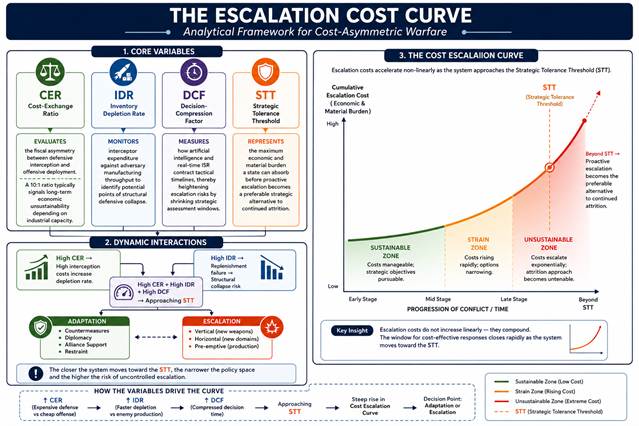
The Escalation Cost Curve defines the relationship between cumulative economic pressures imposed on a defender and the probability of escalation. It is intended primarily as an analytical framework for prolonged conventional cost-intensive conflicts, rather than a universal model of escalation.
The analytical framework is defined by the interaction of four critical variables. The Cost-Exchange Ratio (CER) evaluates the fiscal asymmetry between defensive interception and offensive deployment, where a 10:1 ratio typically signals long-term economic unsustainability depending on industrial capacity. This is compounded by the Inventory Depletion Rate (IDR), which monitors interceptor expenditure against adversary manufacturing throughput to identify potential points of structural defensive collapse. Operationally, the Decision-Compression Factor (DCF) measures how artificial intelligence and real-time ISR contract tactical timelines, thereby heightening escalation risks by shrinking strategic assessment windows. These factors culminate in the Strategic Tolerance Threshold (STT), representing the maximum economic and material burden a state can absorb before proactive escalation becomes a preferable strategic alternative to continued attrition.[13]
The Escalation Mechanism
The chain of events is as follows: cheap attacks drain expensive defences, depleting inventories and causing economic strain. This strain creates pressure toward escalation—but only under specific conditions. Escalation becomes more likely when CER is high, IDR outpaces replenishment, DCF compresses decision windows, and STT is approached. When these conditions are not met—when alliance support is available, when diplomatic channels are open, when cost-effective countermeasures emerge—adaptation rather than escalation is the more likely outcome.
Escalation can take three forms (Vertical, horizontal, and pre-emptive); each emerges from distinct strategic and economic conditions. Vertical escalation, characterised by the deployment of increasingly powerful weaponry to shift the cost balance, typically occurs when the Cost-Exchange Ratio (CER) becomes prohibitively high, and the defender nears their Strategic Tolerance Threshold (STT). Conversely, horizontal escalation involves widening the conflict to secondary domains or geographic regions and is frequently triggered when a defender can no longer sustain the economic or material costs of attrition within the primary theatre. Finally, pre-emptive escalation—the targeting of an adversary’s production facilities or launch sites—becomes a preferred course of action when a high Inventory Depletion Rate (IDR) threatens defensive collapse, and the defender identifies a tactical opportunity to disrupt the attacker’s underlying industrial base.[14]
Moderating Variables
Escalation is not inevitable. It may be avoided when political restraint prevails through diplomatic channels, international mediation or alliance support sustains the defender, cost-effective countermeasures emerge, or defensive adaptations neutralise the attacker’s advantages. These moderating factors can interrupt the escalation chain, buying time for alternatives to military confrontation.
Heuristic Note
The thresholds proposed above are heuristic indicators intended to stimulate further research. They are derived from observed patterns across multiple contemporary conflicts, combined with defence logistics planning norms and historical crisis decision-making timelines. They should be treated as provisional starting points for analysis rather than fixed determinants of escalation.
Implications for Deterrence and Force Structure
South Asia: Nuclear Overhang and Escalation Control
The Escalation Cost Curve has particular salience for South Asia, where nuclear deterrence coexists with active conventional competition. Both India and Pakistan have developed capabilities that reflect broader trends including precision strike systems, air defence architectures, and cost-effective offensive systems.[15]
The nuclear overhang complicates escalation dynamics in two ways. First, nuclear deterrence creates a ceiling on escalation, preventing the kind of total war that might resolve cost-asymmetric attrition. This may paradoxically prolong conflicts, as defenders cannot escalate horizontally to terminate economic pressure. Second, inventory depletion of conventional air defence systems could create perceived vulnerabilities that pressure decision-makers toward nuclear signalling or limited nuclear employment—though this pathway is contingent on regime type, alliance support, and the availability of alternative responses.[16]
Rather than implying a direct causal path, a more precise treatment separates conventional attrition, signalling behaviour, and nuclear threshold dynamics into distinct analytical steps: conventional attrition creates economic strain; economic strain may produce signalling behaviour; and signalling behaviour may, under specific conditions, lower the threshold for nuclear employment. This escalation ladder is probabilistic, not deterministic.[17]
Force Structure Implications
Defensive systems must maintain inventory levels matched to adversary production capacity. Mass production of offensive systems means defenders must plan for prolonged attrition, with stockpiles sized for sustained cost-asymmetric warfare. Industrial bases must support rapid surge production of critical interceptors, as slow production cycles create strategic vulnerability.[18]
Investment in low-cost alternatives—interceptor drones, directed-energy weapons, and electronic warfare—offers sustainable options against expensive kinetic interceptors. Ukraine’s low-cost interceptor drones demonstrate the viability of cost-parity tactics. Over-reliance on any single defensive architecture creates vulnerability, requiring a layered approach that combines expensive precision systems with cheap counter-drone capabilities.[19]
Strategic Risk Assessment
Defence planners face four interconnected risks. Inventory depletion can exhaust defensive systems when interceptors are expended faster than they can be replaced; maintaining strategic reserves and developing cost-effective countermeasures can mitigate this. Slow industrial replenishment creates vulnerability when production cannot keep pace with expenditure; investing in surge production capability and diversifying supply chains can address this. Cost-exchange asymmetry allows adversaries to impose unsustainable costs through cheap attacks; developing low-cost interception methods and selectively accepting risk can help manage this. AI-compressed decision timelines leave less time for deliberation; pre-delegated authorities and robust communication protocols can help prevent miscalculation.
Each risk reinforces the others, making integrated mitigation essential for strategic resilience.
Conclusion
The contemporary battlespace is increasingly defined by systemic compression, economic asymmetry, and hybrid warfare, where inexpensive offensive systems challenge traditional assumptions of military superiority and mass production threatens to overwhelm defensive architectures. The Escalation Cost Curve provides a conceptual lens for understanding how economic strain independent of military force can shape escalation trajectories in prolonged conventional conflicts. The framework does not contend that expensive systems are obsolete; they remain indispensable for high-value target defence. Rather, it identifies a critical risk: sustained reliance on costly interceptors against massed low-cost threats generates cumulative economic strain with potentially significant strategic consequences. Offered as a heuristic device rather than a deterministic model, its thresholds remain provisional, and its causal logic requires further empirical validation. For defence planners, the implications are evident: inventory sustainability must be assessed against adversary production capacity; industrial mobilisation must be strengthened; low-cost countermeasures must be prioritised; and economic sustainability must be integrated into operational planning. Without such measures, forces risk economic exhaustion and strategic failure even when tactical victories are achieved. Ultimately, effective deterrence in the drone age will depend as much on economic and industrial resilience as on military capability.
[1] Andrew W. Marshall, Long-Term Competition with the Soviets: A Framework for Strategic Analysis, R-862-PR (Santa Monica, CA: RAND Corporation, 1972).
[2] Thomas G. Mahnken, ed., Competitive Strategies for the 21st Century: Theory, History, and Practice (Stanford: Stanford University Press, 2012); T.X. Hammes, Technologies Converge and Power Diffuses: The Evolution of Small, Smart, and Cheap Weapons, Policy Analysis no. 786 (Washington, DC: Cato Institute, 2016).
[3] Lawrence Freedman, Strategy: A History (New York: Oxford University Press, 2013), 133–146.
[4] Laszlo Pokorny, The Economics of Asymmetric Attrition: A Quantitative Analysis of Low-Cost Drone Warfare in the Ukraine and Iranian Shahed Programs (2022-2026) (New Jersey: ICL Institute, 2026), Zenodo, https://doi.org/10.5281/zenodo.18919501.
[5] Mackenzie Eaglen, ed., Affording Defense: Investing in American Strength to Confront a More Dangerous World (Washington, DC: American Enterprise Institute, 2024), 45.
[6] Tom Karako and Shaan Shaikh, The Air and Missile Defense Review (Washington, DC: Center for Strategic and International Studies, 2024), 34–41.
[7] “Ukrainian Defence Intelligence: Russians Significantly Modernized Shahed and Gerbera Drones,” Militarnyi, May 20, 2026, mil.in.ua; “Ukraine’s Intelligence Reveals Stuffing of Modernized Russian Shahed with Camera and AI,” RBC-Ukraine, June 27, 2025, rbc.ua.
[8] National Security and Defense Council of Ukraine, “Results of Ukraine’s Defense Industry in 2025: Interceptor Drones,” January 2026, https://www.rnbo.gov.ua/; “Russia Increases Production of Shahed Drones to 6,000 Units per Month,” BGNES, August 24, 2025, https://www.bgnes.com/.
[9] Kateryna Bondar, “Unpacking Iran’s Drone Campaign in the Gulf: Early Lessons for Future Drone Warfare,” Center for Strategic and International Studies, March 10, 2026, csis.org.
[10] Bondar, “Unpacking Iran’s Drone Campaign.”
[11] John R. Hoehn, “Saturation Warfare in the 21st Century,” Parameters 54, no. 1 (2024): 67–82.
[12] Seth G. Jones, “The Drone Revolution,” International Security 48, no. 3 (Winter 2023/24): 112; T.X. Hammes, “The Future of Warfare: Small, Smart, Cheap and Many,” Joint Force Quarterly 95 (2019): 12–19.
[13] For analysis of these variables, see Mackenzie Eaglen, ed., Affording Defense: Investing in American Strength to Confront a More Dangerous World (Washington, DC: American Enterprise Institute, 2024), 45; Tom Karako and Shaan Shaikh, The Air and Missile Defense Review (Washington, DC: Center for Strategic and International Studies, 2024), 34–41; John R. Hoehn, “Saturation Warfare in the 21st Century,” Parameters 54, no. 1 (2024): 67–82; Atif Anwer Dar and Nadia Mehrukh, “Systemic Compression, Fragile Deterrence, and the Transformation of Warfare in the Twenty-First Century,” The Critical Review of Social Sciences Studies 3, no. 4 (2025); and Atif Anwer Dar, “How Technology Is Breaking Crisis Management In Nuclear South Asia,” Zenodo, April 22, 2026, zenodo.org.
[14] Thomas Schelling, Arms and Influence (New Haven: Yale University Press, 1966) on coercive bargaining and the manipulation of risk; Herman Kahn, On Escalation: Metaphors and Scenarios (New York: Praeger, 1965) on the escalation ladder and the distinction between vertical, horizontal, and pre-emptive escalation; Barry Posen, Inadvertent Escalation: Conventional War and Nuclear Risks (Ithaca: Cornell University Press, 1991) on how military vulnerability and the depletion of defensive assets can create pressures for escalation; Lawrence Freedman, Strategy: A History (New York: Oxford University Press, 2013) on economic exhaustion as a pathway to strategic defeat; and Steven J. Brams and D. Marc Kilgour, “Winding Down if Preemption or Escalation Occurs: A Game-Theoretic Analysis,” Journal of Conflict Resolution 31, no. 4 (1987): 547–572, on the game-theoretic dynamics of preemption and escalation.
[15] Christopher Clary, Four Days in May: The India-Pakistan Crisis of 2025 (Washington, DC: Stimson Center, 2025), 14.
[16] Barry Posen, Inadvertent Escalation: Conventional War and Nuclear Risks (Ithaca: Cornell University Press, 1991), 131–135; S. Paul Kapur, Dangerous Deterrent: Nuclear Weapons Proliferation and Conflict in South Asia (Stanford: Stanford University Press, 2007), 6–9.
[17] See Herman Kahn, On Escalation: Metaphors and Scenarios (New York: Praeger, 1965), 37–51, for the structural mechanics of segmented escalation steps; for how subjective perception renders such ladders probabilistic rather than deterministic, see Robert Jervis, Perception and Misperception in International Politics, new ed. (Princeton: Princeton University Press, 2017), 13–31.
[18] For the foundational theory on defense industrial elasticity, see Eliot A. Cohen, “The Mystique of U.S. Air Power,” Foreign Affairs 73, no. 1 (1994): 112–115; on how technological modernization shifts industrial production timelines, see Thomas G. Mahnken, Technology and the American Way of War Since 1945 (New York: Columbia University Press, 2008), 165–170; for modern empirical evidence regarding the specific depletion of air defense interceptors under asymmetric drone attrition, see Seth G. Jones, The Empty Bins Crisis: The Unready Defense Industrial Base (Washington, DC: Center for Strategic and International Studies, 2023), 14–19.
[19] For the foundational theory that over-reliance on a single material or technological architecture creates systemic battlefield vulnerability, see Stephen Biddle, Military Power: Explaining Victory and Defeat in Modern Battle (Princeton: Princeton University Press, 2004), 28–51; for the modern application of cost-parity tactics and low-cost drone interception strategies in Ukraine, see Jack Watling, The Arms of the Future: Technology and Close Combat in the Twenty-First Century (London: Bloomsbury Academic, 2024), 88–92.


