
Abstract: Beyond their socio-economic implications, disruptive technologies influence all instruments of state power, especially the military. Artificial intelligence (AI), Machine Learning (ML), and autonomous systems are transforming traditional ways of thinking, leadership concepts, and processes, necessitating new approaches to prepare military decision-makers at all levels of command for a complex, technology-driven environment. This article explores how these technologies are reshaping military decision-making and outlines why adapting education and processes is critical to maintaining operational effectiveness in future conflicts.
In most Western armed forces, the operational level of command serves as an interface between the tactical and military-strategic levels. It enables the translation of strategic objectives into tactical actions. In addition to its vertically hierarchical role, the operational level also performs a horizontal interface function with other state and non-state actors. These environmental systems (System of Systems), involving a wide range of actors, increase the complexity of the operational level of command.
Problem statement: If AI acquired the adaptive capability to integrate knowledge, experience, and creativity, would traditional conceptions of Operational Art as a core pillar of operational training be superseded, thus necessitating the revision or adaptation of existing processes?
So what?: Training in Operational Art is not yet systematically designed to develop AI competence. It must therefore be adapted to ensure that future leaders can critically and appropriately employ AI-supported analytical methods. The use of AI should be taught as an integral component of the operational decision-making process. In such training, the focus should be on experience-based, simulation-supported planning exercises with mandatory reflection phases to mitigate automation bias and strengthen independent judgment. Military education must integrate AI as a supporting element in operational training without diminishing the primacy of human decision-making.

Introduction
AI is a driver of the contemporary socio-economic transformation. Globally, state actors are increasingly seeking to harness the potential of these technologies to derive strategic advantage and enhance power projection. As a disruptive technology, AI affects all instruments of state power and exerts particularly significant influence in the military domain. It is attributed with the potential to trigger a fundamental military transformation, potentially culminating in a “military revolution”.[1] In this context, AI-based technologies are fundamentally reshaping established ways of thinking, concepts of leadership, and processes. This development underscores the need for training approaches that adequately prepare future military decision-makers at all levels for an increasingly complex, networked, and technology-driven operational environment.
Operational Art as a Defining Element of the Operational Level of Command
The operational level of command is pivotal in many military structures. It serves as an interface between the tactical and the military-strategic levels of command and enables the translation of strategic objectives into coherent tactical action.[2]
To fulfil this role, four essential tasks are assigned to the operational level of command and must be considered within the framework of operational planning: Joint Operations, joint planning and command across all domains; Combined Operations, the planning and conduct of multinational operations in cooperation with international armed forces; coordination with other state institutions in accordance through an Interagency Approach; and the application of a Comprehensive Approach, which includes cooperation with international organisations and non-governmental organisations.[3], [4]
The multitude of these tasks, together with integration into a complex environment of diverse actors and systems, generates a particular form of complexity at the operational level. This complexity does not necessarily exceed that of the strategic level, but differs in that it requires the continuous translation of strategic objectives into synchronised, executable action across domains, functions, and actors. The individual system elements are interconnected, mutually influence one another, and can generate unpredictable effects as a result of changes within the system. In addition, this complexity arises from limited information availability and from the difficult-to-predict behaviour of individual actors, which is highly context-dependent. Analytically, the operational environment is commonly structured using the PMESII framework (Political, Military, Economic, Social, Information, and Infrastructure).[5]
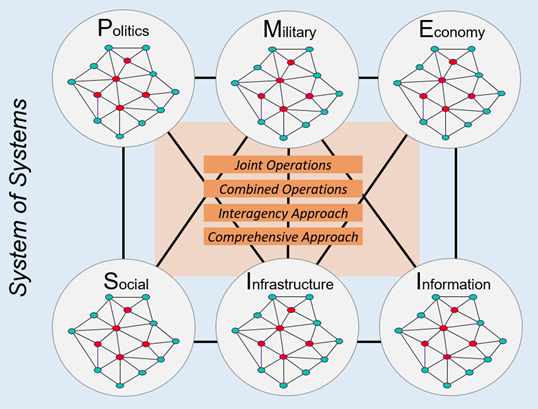
While the tactical level focuses on accomplishing a specific task, the operational level must design and synchronise (orchestrate) multiple lines of effort (operations) to achieve desired effects in support of the overall strategic objective. Reinforcing one line may generate local success but risk premature culmination elsewhere, while delaying action may preserve combat power but reduce operational tempo and initiative. The complexity lies in balancing these interdependent decisions within a dynamic, complex operational environment while maintaining coherence among the strategically defined ends, ways, and means.[7]
This complexity requires a unifying approach that integrates, sequences, and adapts actions through a conceptual framework.
Operational Art provides such a framework for assessing courses of action and risks and for developing coherent, comprehensible solutions to complex operational problems.[8] It encompasses the application of systematic methods to analyse and evaluate potential courses of action and is based on observation, logic, and the verification and falsification of assumptions within a specific social and political context. In addition to its scientific and methodological foundation, Operational Art also incorporates experience-based and artistic elements shaped by learning, socialisation, creativity, and judgment.[9]
In light of the foregoing, it becomes evident why the operational level of command differs from the tactical level of command and why Operational Art constitutes a distinctive feature of the operational level.
Operational Decision-Making Process
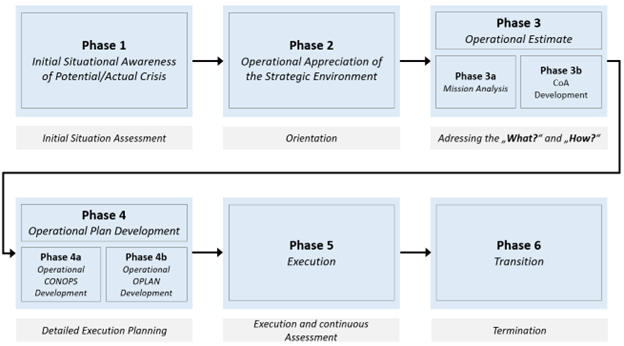
A military decision-making process is a structured, cognitive, and action-oriented framework for systematically developing solutions to military problems. It facilitates the attainment of military objectives by deriving, evaluating, and executing courses of action grounded in logical deduction.[10], [11] Regardless of the level of command, military decision-making processes follow a fundamentally similar sequence that encompasses situation assessment or information gathering, the development of courses of action, their evaluation and selection, and execution, followed by subsequent assessment.[12] This process facilitates selecting the course of action that provides the greatest operational advantage and the highest probability of success. The operational decision-making process in accordance with the Comprehensive Operations Planning Directive (COPD) is structured into six phases, each comprising several sub-steps. It is not merely a planning process in the narrow sense, but by its very nature a comprehensive decision-making process.[13]
The first phase of the COPD is intended to enable early identification of crisis situations and to gain a better understanding of the environment via information sharing and knowledge development. The second phase facilitates a consolidated overview of the strategic objectives and the desired end state. Furthermore, it supports the military-strategic level of command in developing military-strategic response options by providing operational advice.
In the third phase, the Operational Estimate, problem statements and objectives are defined in accordance with the Strategic Planning Directive. At this stage, various courses of action are developed, analysed, and evaluated against predefined decision criteria to select the option deemed most suitable for achieving the operational objectives. Central to these phases are the questions of what is to be done and how it is to be accomplished. All subsequent phases of the COPD are derived from the selected course of action. In the fourth phase, Operational Plan Development, the plan is developed in detail and synchronised across all relevant component commands.
The fifth phase (Execution) encompasses the operation’s execution and continuous assessment, while the sixth phase (Transition) addresses its termination.[14]
In Western militaries, Operational Art is the foundation for operational planning, assessment, and decision-making. The operational level of command is embedded in a highly complex environment involving numerous additional systems, which substantially amplify the complexity of its planning processes–albeit in a different form than the situational complexity encountered at the tactical level. The necessity to integrate these systems into the planning process fundamentally distinguishes the operational level from other levels of command and underpins the specific requirement for Operational Art in operational planning.
Applicability of Artificial Intelligence
AI can support or compensate for the scientific and artistic dimensions of Operational Art, enabling the selection of equivalent courses of action after the planning phase within a highly complex environment. Rapid advances in AI are being driven by interdisciplinary research. Its increasing integration across diverse processes is accelerating transformative change and generating substantial efficiency gains, including within the military domain.[16]
At its core, AI aims to functionally replicate human intelligence, particularly in perception, learning, adaptation, and pattern recognition. AI systems can sense their environment, generate courses of action, and select a favourable option based on predefined criteria.[17] In theory, integrating multiple AI technologies enables the representation of all stages of the decision-making process. The central challenge, however, lies in applying these capabilities under the complex, dynamic, and only partially predictable conditions of the operational environment, particularly with regard to learning and anticipatory capacity.[18]
Among the key AI technologies is Natural Language Processing, which enables the processing and analysis of large volumes of text-based information and can thus contribute to understanding the operational environment within the Comprehensive Understanding of the Operations Environment (CUOE). [19] In addition, Social Network Analysis and Graph-based Analyses enable the modelling of complex relational structures and causal interdependencies within a System of Systems.[20] Knowledge Representation and Reasoning, together with Expert Systems, enable the structured representation of knowledge and the derivation of logical inferences, with methods such as Fuzzy Logic being employed to account for uncertainty.[21], [22]
Machine Learning, Deep Learning, and Artificial Neural Networks extend these capabilities through their ability to learn and adapt.[23] They can identify patterns in data, generate predictions, and develop novel solutions; however, their effectiveness depends heavily on the quality, quantity, and representativeness of the training data.[24] Especially in dynamic environments, this dependency constitutes a significant limitation.[25] Despite substantial advances—particularly in the field of Deep Learning—the transparency and traceability of the internal decision-making processes of many models remain limited, which is why Explainable AI is gaining increasing importance.[26], [27]
An examination of selected AI technologies shows that current models are already capable of supporting decision-making processes by analysing large volumes of data, identifying patterns, and deriving courses of action.[28] Through the coordinated use of various AI methods, individual phases of the operational decision-making and planning process—including the Operational Estimate within the COPD framework—can be effectively supported.[29]
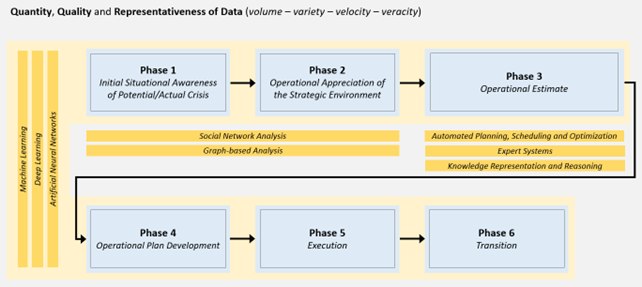
Nevertheless, the military applicability and performance of AI remain constrained by data availability, context dependence, and the inherent complexity of the operational environment.
The assertion that AI can only be understood as a powerful support instrument in operational planning is not merely a speculative claim, but neither is it conclusively established by empirical evidence. Current studies and military experimentation demonstrate that AI performs effectively in narrow, well-defined tasks such as analysing large volumes of data, identifying patterns, and deriving courses of action. However, they also underscore enduring constraints in addressing ambiguity, political context, adversarial deception, and ethnical judgement-factors intrinsic to decision-making at the operational level. The conclusion that AI is inherently incapable of assuming the full scope of the COPD risks overstates what can presently be known. It reflects the current state of technology and institutional caution rather than a definitive, future-proof limitation. The prospect of fully autonomous AI management of the planning process, therefore, remains unpredictable and may not be desirable in a military context.
Operational Art vs. Artificial Intelligence
The scientific aspects of Operational Art primarily encompass planning, the application of principles, and the use of knowledge. The science of planning can be understood as a methodically structured approach that describes how operational planning is conducted and how decisions are prepared.[31] It is based on traceable analyses, established methods, and defined rules, thereby exhibiting parallels to formal systems such as mathematics. Regardless of whether solutions are derived through human deductive analysis or through AI-driven data processing, the traceability and justifiability of results are central considerations. It is precisely in this regard that the limitations of current AI technologies become apparent, particularly Deep Learning methods, whose complex internal structures restrict the objective explainability and transparency of outcomes and often necessitate subsequent human interpretation or expert assessment.[32] Within Operational Art, principles and rules do not constitute static prescriptions but are applied situationally and concretised through judgment and interpretation. AI models can, in principle, represent such principles and apply them in a context-adaptive manner through learning and evaluation. Their effectiveness, however, remains contingent upon the quality of the underlying models, data, and evaluative logics.
In the context of Operational Art, knowledge can be classified as explicit or implicit. Explicit knowledge comprises codified content such as military regulations, doctrines, or historical experience.[33] In this domain, AI can provide significant added value, as it surpasses human capabilities in storing, analysing, and identifying patterns within large volumes of knowledge. However, limitations become evident in the contextual interpretation of this knowledge. Implicit knowledge, by contrast, emerges through experience, socialisation, and the practical activity of operational commanders and is strongly shaped by subjectivity.[34] This form of knowledge cannot be generated autonomously by AI and can, at best, only be approximated through extensive training.
The artistic elements of Operational Art encompass those human capabilities that enable effective decision-making in complex and dynamic environments. These include, in particular, contextual understanding, foresight, effectiveness and flexibility, experience, and creativity. Contextual understanding enables a deeper appreciation of the systemic complexity of the operational environment and recognition of non-obvious interdependencies.[35] Representing such understanding through AI requires highly complex models and entails the risk of ambiguity, which is unacceptable for operational decision-making. Foresight is based on anticipating potential developments and the reactions of system elements.[36] Although AI technologies are, in principle, capable of generating forecasts and responding to probabilistic assessments, their effectiveness is constrained by the inherent complexity of real-world operational environments.[37]
Effectiveness and flexibility require the ability to derive operational courses of action from strategic guidance, assess their prospects for success, and adapt them to changes in the situation. [38] While Machine Learning models can achieve limited autonomy in unfamiliar scenarios, the independent definition of appropriate objectives and selection criteria remains a central weakness.[39] Experience as an artistic attribute is based on the integration of theoretical knowledge with practical application. Despite significant advances in Machine Learning, current AI models do not achieve the flexibility, robustness, and adaptive capacity of biological learning systems.[40] Creativity is a fundamental human attribute grounded in expertise and the ability to generate novel concepts.[41] While AI can produce new combinations of existing patterns, it is not capable of independently generating fundamentally original innovations. However, innovation may not always be required if the task is merely to execute specific process steps to a “good enough” standard.
AI has made substantial progress across many cognitive and analytical domains; however, fundamental limitations persist. These include a lack of traceability and transparency, limited applicability in unfamiliar situations, insufficient contextual understanding, high demands on training data, and restricted innovative capacity.[42] These deficits illustrate that while AI can support individual aspects of Operational Art, it cannot fully replace human flexibility, judgment, and adaptability. Consequently, the established ways of thinking inherent to Operational Art will retain their central importance and necessity, particularly in operational training.
Artificial Intelligence in the Operational Planning Process
The current state of AI technologies indicates that they are, in principle, capable of representing a complete decision-making process. They can collect data, generate courses of action, evaluate these options, select a promising course of action, and support its implementation. Challenges arise in particular when multiple AI methods must be integrated and coordinated within a single process to solve complex problem sets. Especially at the operational level of command—characterised by a particularly high degree of complexity—such integration is unavoidable. This necessitates integrating diverse AI technologies, which, under current technological conditions, can be achieved only to a limited extent.
A more in-depth examination of the Operational Estimate as the core element of the operational planning process—particularly regarding the development and evaluation of courses of action—further highlights these challenges. Using the Centre of Gravity Analysis example, which aims to identify decisive influencing factors and derive appropriate points of leverage to achieve desired effects, current AI technologies fail to meet key requirements. In particular, the lack of contextual understanding, the limited ability to independently derive objectives, and the inability to generate creative solution approaches as artistic elements of Operational Art mean that AI is not presently capable of conducting such an analysis autonomously.[43]
An examination of Operational Design, the visual and conceptual framework for courses of action aimed at achieving an operational objective, further underscores these limitations. Current AI systems struggle in dynamic, nonlinear, and unpredictable environments—but so do humans, as evidenced by thousands of years of military history. The challenge is not uniquely artificial; it reflects the inherent difficulty of operating within complex systems. Moreover, the military context is shaped by a multitude of factors that cannot be reduced to purely technical or quantifiable variables. This requires the ability to derive robust conclusions from incomplete, contradictory, or uncertain information and to apply flexible and adaptive decision-making processes, as are necessary for modelling complex systems in uncertain environments.[44]
Thus far, AI lacks the capabilities needed to replace Operational Art in the operational planning process or to conduct it autonomously. Operational Art remains indispensable for comprehensively addressing the complexity of the operational level of command and for providing robust answers within the operational planning process as to how operational objectives can be achieved. In this context, a complete substitution of human leadership appears neither realistic nor desirable. Instead, future development efforts should prioritise the effective integration of humans and machines within the operational planning process. The aim must not be to replace Operational Art or the human as the central decision-maker, but to employ AI technologies in a targeted manner to support specific analytical tasks—particularly in areas where technological limitations can be meaningfully mitigated. AI’s strengths in processing large volumes of information within complex system structures should be deliberately exploited, while critical judgment, contextual understanding, and creative reasoning should remain firmly within the human domain.
This leads to the conclusion that the use of AI should be deliberately focused on selected sub-tasks that provide tangible support to the operational planning process. In particular, the integration of AI into the early phases of the COPD—especially for data-driven analysis, pattern recognition, and the anticipation of potential developments—appears both appropriate and beneficial. In addition, AI offers potential to alleviate the cognitive workload of human planners in the fourth phase of the COPD, for example, through AI-assisted structuring and auto-completion during the development of OPLANs. In light of these considerations, a fundamental alteration of existing processes (COPD) is currently neither necessary nor advisable.
Tensions and Implications for Training
The integration of AI into military systems poses complex challenges for armed forces that extend beyond purely technical considerations. While AI-based systems are increasingly recognised as essential tools for managing growing volumes of data and supporting military decision-making, significant ethical tensions and the resulting requirements for military training are simultaneously coming into focus. These tensions relate in particular to maintaining a balance between operational efficiency and the preservation of human judgment, the risk of cognitive overload or uncritical reliance on AI-enabled systems, and the necessity of systematically embedding AI competence across all relevant levels of military training.[45] At the same time, this debate cannot be confined to the assumptions of democratic societies with robust ethical oversight. It must also account for the strategic outlook of potential adversaries, some of whom may operate under very different political, legal, and normative conditions and may, therefore, be more willing to accept the risks associated with extensive AI delegation in pursuit of military advantage.
A primary driver of the use of AI in the military is the steadily increasing complexity of the modern battlespace. AI systems can process data from a wide range of sensors and information sources in near-real time, identify patterns, and establish correlations. Particularly at the strategic and operational levels of command, this can significantly enhance situational awareness and substantially reduce reaction times, for example, in the area of indications and warnings. At the same time, this capability entails the risk that human decision-makers may increasingly defer decisions to algorithmic recommendations. This, in turn, heightens the risk of so-called Automation Bias and a gradual erosion of critical judgment, especially under time pressure or in a highly dynamic operational environment.[46] Directly connected to this is the assurance of so-called “Meaningful Human Control” over AI systems. This principle, which plays a central role in the international debate on autonomous weapon systems, requires that humans remain decisively involved in all decision-relevant phases—particularly in the use of military force—and retain responsibility for those decisions.[47] This includes technical expertise and reflective competencies regarding bias, accountability structures, and potential failure modes of automated decision-support systems (AI capabilities in the domain of Operational Art). Such competencies are necessary to avoid both cognitive overload and blind trust in systems—namely, those situations in which system operators are either unable to comprehend the algorithm or defer to it without critical assessment.[48] Moreover, the implementation of AI must comply with international humanitarian law, in particular with the principles of distinction, proportionality, and military necessity.[49]
In this context, AI transforms military decision-making processes and has profound implications for the training of future operational-level leaders. Training must address all relevant aspects in an integrated manner, consistently placing human control over complex systems at the centre.[50]
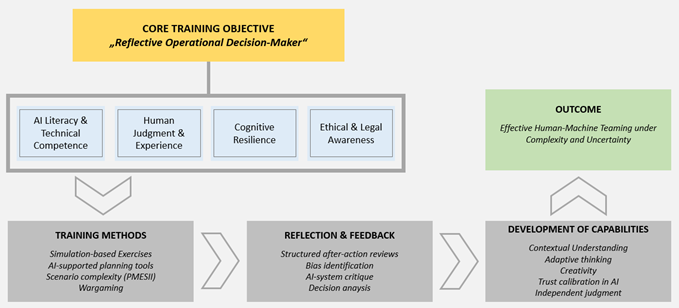
Operational Art and operational decision-making require capabilities such as contextual understanding, risk assessment, flexibility, and creativity within dynamic system environments. These competencies must be re-emphasised in the educational context, as AI technologies will increasingly support or partially assume traditional cognitive tasks. For operational-level training, this results in less need for technological excellence than in the challenge of developing a balanced relationship between technical competence and experience-based human judgment. Recent research on human–AI collaboration shows that effective performance depends on calibrated trust, situational awareness, and the integration of human judgment into AI-supported decision-making processes.[51] At the same time, contemporary studies highlight the persistent risk of automation bias—where users over-rely on AI outputs even in high-stakes contexts—potentially degrading human oversight and critical evaluation.[52] The risks of blind reliance on systems and of cognitive overload from complex technological systems necessitate targeted didactic approaches.[53] Reflective training concepts, therefore, gain particular importance. Following the planning and decision-making phases, structured reflection loops should be incorporated to systematically examine assumptions, system limitations, assessments, and decision-making errors. This approach strengthens judgment and promotes a responsible leadership ethos in the use of AI-enabled systems.[54], [55]
A key area of training lies in fostering digital competence and AI Literacy. AI-enabled adaptive learning platforms, simulation-based training environments, and intelligent tutoring systems can significantly enhance the effectiveness of military training by providing personalised learning pathways and realistic scenarios. In this way, complex analyses and decision-making processes can be repeatedly trained in protected environments and reflected upon through immediate, data-driven feedback.[56] In addition, analytical skills and the structured assessment of the operational environment are becoming increasingly important. Technologies such as Natural Language Processing and Social Network Analysis enable the extraction, structuring, and operational use of large volumes of information for assessment purposes.[57] The integration of AI into the operational education of future leaders of the Austrian Armed Forces, therefore, requires a methodically structured, consistently experience-based approach. The objective is not the technologisation of military leadership, but the development of reflective decision-makers who understand AI as a supporting tool and can employ it responsibly, critically, and in a context-appropriate manner.
Conclusion
AI is a disruptive technology; it affects all instruments of state power and is profoundly shaping dynamics in the military domain—military leaders must recognise this. Military decision-making processes and traditional concepts of command and leadership are being fundamentally influenced and, in part, transformed. Against the backdrop of increasing technological penetration and growing system complexity, military leaders must be prepared to operate in networked, data-driven, and highly dynamic environments. Operational Art, as the defining characteristic of the operational level of command, is both a scientific and an artistic-experience-based approach. It combines systematic planning, analysis, and logic with contextual understanding, experience, judgment, and creativity. The operational decision-making process, as defined by the COPD, provides the structural framework for preparing, assessing, and implementing operational decisions. The Operational Estimate constitutes the core of this process, serving as the basis for analysing complex problems and developing courses of action. The analysis demonstrates that this central stage is where the demands on Operational Art are most pronounced, as complex systems, contradictory information, and uncertainty must be addressed in an integrated manner. With regard to the capabilities of current AI technologies across the decision-making process, it can be stated that AI—through methods such as Natural Language Processing, Graph-based Analyses, Expert Systems, and Machine Learning and Deep Learning—is, in principle, capable of supporting individual steps of the decision-making process. The added value of AI becomes especially evident in processing large volumes of data, pattern recognition, and supporting analytical subtasks within complex system environments analogous to the operational context. At the same time, clear limitations are identified. Current AI systems lack autonomous contextual understanding, exhibit deficiencies in result traceability, are highly dependent on the quality and availability of training data, and possess only limited innovative capacity. These constraints become particularly apparent when compared to the artistic elements of Operational Art. Capabilities such as contextual understanding, flexibility, the independent derivation of objectives, the creative generation of courses of action, experience-based judgment, and moral-ethical responsibility cannot be substituted by AI. It follows that AI cannot replace Operational Art within the operational planning process but must instead be understood as a supporting tool. Fully autonomous execution of operational planning by AI appears, at present, to face substantial technical limitations; moreover, its desirability is contingent upon unresolved ethical, legal, and operational considerations. Potential adversaries may operate under different normative constraints and may be more willing to accept the risks associated with extensive AI delegation in pursuit of operational advantage. This creates a potential asymmetry between restraint and effectiveness that must be addressed in doctrine and training. The value added by AI lies primarily in supporting selected analytical sub-tasks, for example, in the early phases of COPD through data-driven analysis, pattern recognition, and the anticipation of potential developments, as well as in later phases through structural support in the preparation of extensive planning documents. By contrast, a fundamental modification of existing planning processes is not required.
In particular, fostering creativity and adaptive thinking within hierarchical, doctrine-driven institutions such as military academies poses a structural tension. While these institutions are traditionally designed to ensure standardisation, discipline, and procedural reliability, the demands of complex and unpredictable operational environments increasingly require flexibility, critical reflection, and intellectual autonomy. Accordingly, training approaches must move beyond purely procedural instruction toward experience-based, simulation-driven learning environments that incorporate uncertainty, ambiguity, and reflective practice. Creativity and judgment may not be directly “teachable” in a formal sense, but they can be cultivated through exposure to complex scenarios, iterative decision-making, and structured reflection on failure and uncertainty. For training at the operational level of command, this results in a dual requirement: on the one hand, the systematic development of AI competence and Digital Literacy is necessary; training in human judgment, experience, creativity, and reflective capability within the framework of Operational Art remains central. In summary, maintaining the relevance of Operational Art in an increasingly technology-driven environment requires not a transformation of operational processes, but a rebalancing of education, training, and leadership development. The objective is not technological substitution, but the development of reflective practitioners capable of integrating AI as a tool while retaining responsibility for decision-making in complex operational environments.
[1] M. C. Fissel, The Military Revolution and Revolutions in Military Affairs (Berlin: De Gruyter Studies in Military History, 2023), 24.
[2] Bundesministerium für Landesverteidigung und Sport, DVBH Operative Führung (Vienna, 2017), 25.
[3] Bundesministerium für Landesverteidigung und Sport, DVBH Operative Führung (Vienna, 2017), 26–30.
[4] NATO, AJP-1 Allied Joint Doctrine, Edition F (NSO, 2022), 1–16.
[5] NATO, AJP-5 Allied Joint Doctrine for the Planning of Operations, Edition B (NSO, 2024), 5.
[6] Created by the author.
[7] Landesverteidigungsakademie, Lehrskriptum Prinzipien der Strategie (Vienna, 2022), 11–12.
[8] NATO, AJP-5 Allied Joint Doctrine for the Planning of Operations, Edition B (NSO, 2024), 1–3.
[9] Milan Vego, “On Operational Leadership,” Joint Force Quarterly 77 (2015): 2–5, https://ndupress.ndu.edu/Joint-Force-Quarterly/Joint-Force-Quarterly-77/Article/581882/on-operational-leadership/.
[10] Bundesministerium für Landesverteidigung und Sport, DVBH Taktisches Führungsverfahren (Vienna, 2012), 92.
[11] Supreme Headquarters Allied Powers Europe, Comprehensive Operations Planning Directive, version 3.1 (SHAPE, 2023), 4–65.
[12] Matteo Morelli, Maria Casagrande, and Giuseppe Forte, “Decision Making: A Theoretical Review,” Integrative Psychological and Behavioral Science 56 (2022): 611–15, https://doi.org/10.1007/s12124-021-09669-x .
[13] Bundesministerium für Landesverteidigung und Sport, DVBH Operative Führung (Vienna, 2017), 99.
[14] Supreme Headquarters Allied Powers Europe, Comprehensive Operations Planning Directive, version 3.1 (SHAPE, 2023), 224–27.
[15] Created by the author.
[16] Bundesministerium für Landesverteidigung, Künstliche Intelligenz in der Landesverteidigung (Vienna, 2025), 18–25.
[17] Christian Posthoff, Computer und Künstliche Intelligenz (Wiesbaden: Springer Fachmedien, 2023), 10.
[18] Bert Heinrichs, Jan-Hendrik Heinrichs, and Markus Rüther, Künstliche Intelligenz (Berlin: De Gruyter, 2022), 18.
[19] Carsten Maple et al., “The AI Revolution: Opportunities and Challenges for the Finance Sector,” The Alan Turing Institute (2023): 12, https://doi.org/10.48550/arXiv.2308.16538 .
[20] Qian Zhang, Jie Lu, and Yaochu Jin, “Artificial Intelligence in Recommender Systems,” Complex & Intelligent Systems 7 (2021): 441–45, https://doi.org/10.1007/s40747-020-00212-w .
[21] L. S. Iliadis, M. Vangeloudh, and S. Spartalis, “An Intelligent System Employing an Enhanced Fuzzy C-Means Clustering Model: Application in the Case of Forest Fires,” Computers and Electronics in Agriculture 70 (2010): 283, https://doi.org/10.1016/j.compag.2009.07.008 .
[22] Carsten Maple et al., “The AI Revolution: Opportunities and Challenges for the Finance Sector,” The Alan Turing Institute (2023): 14–15, https://doi.org/10.48550/arXiv.2308.16538 .
[23] Steven I. Davis, “Artificial Intelligence at the Operational Level of War,” Defense & Security Analysis 38 (2022): 81, https://doi.org/10.1080/14751798.2022.2031692 .
[24] Philipp Schurr, “Künstliche Intelligenz,” Mindsquare (2025): 2–5, https://mindsquare.de/fachartikel/kuenstliche-intelligenz/ki-learning/.
[25] Philipp Schurr, “Neuronale Netze,” Mindsquare (2025): 3–6, https://mindsquare.de/knowhow/neuronale-netze/.
[26] Jeff Druce et al., “Brittle AI, Causal Confusion, and Bad Mental Models: Challenges and Successes in the XAI Program,” Computer Science (June 2021): 1–4, https://www.researchgate.net/publication/352310877_Brittle_AI_Causal_Confusion_and_Bad_Mental_Models_Challenges_and_Successes_in_the_XAI_Program.
[27] Iqbal Sarker, “Machine Learning: Algorithms, Real-World Applications and Research Directions,” SN Computer Science 2 (2021): 13, https://doi.org/10.1007/s42979-021-00592-x .
[28] Michail Ploumis, “AI Weapon Systems in Future War Operations: Strategy, Operations and Tactics,” Comparative Strategy 41 (2022): 4, https://doi.org/10.1080/01495933.2021.2017739 .
[29] Eli Berman, Joseph H. Felter, and Jacob Shapiro, Small Wars, Big Data: The Information Revolution in Modern Conflict (Princeton, NJ: Princeton University Press, 2018), 15.
[30] Created by the author.
[31] Nicola Döring, Forschungsmethoden und Evaluation in den Sozial- und Humanwissenschaften (Berlin: Springer, 2023), 88, https://doi.org/10.1007/978-3-662-64762-2 .
[32] Waddah Saeed and Christian Omlin, “Explainable AI (XAI): A Systematic Meta-Survey of Current Challenges and Future Opportunities,” Knowledge-Based Systems 263, no. C (2023): 9.
[33] Milan Vego, Operational Art: Theory and Practice (London: Routledge, 2025), 24.
[34] Milan Vego, Operational Art: Theory and Practice (London: Routledge, 2025), 25.
[35] Milan Vego, Operational Art: Theory and Practice (London: Routledge, 2025), 24–29.
[36] Gloria Phillips-Wren, Nikhil Ichalkaranje, and Lakhmi Jain, eds., Intelligent Decision-Making: An AI-Based Approach (Berlin: Springer, 2008), 215–18.
[37] Tobias Vestner, “From Strategy to Orders: Preparing and Conducting Military Operations with Artificial Intelligence,” in Research Handbook on Warfare and Artificial Intelligence, ed. Robin Geiß and Henning Lahmann (UNIDIR and Leiden University Law School, 2024), 117–20.
[38] Geoffrey Grooms, “Artificial Intelligence Applications for Automated Battle Management Aids in Future Military Endeavors” (master’s thesis, Naval Postgraduate School, 2019), 22, http://hdl.handle.net/10945/62722.
[39] Elena Popa, “Human Goals Are Constitutive of Agency in Artificial Intelligence (AI),” Philosophy & Technology 34 (2021): 1734, https://doi.org/10.1007/s13347-021-00483-2 .
[40] Tobias Vestner, “From Strategy to Orders,” 120.
[41] Cameron Hunter and Bleddyn E. Bowen, “We Will Never Have a Model of an AI Major-General: Artificial Intelligence, Command Decisions, and Kitsch Visions of War,” Journal of Strategic Studies 47 (2024): 140, https://doi.org/10.1080/01402390.2023.2241648 .
[42] Markus Walcher, “Künstliche Intelligenz und Planung der operativen Führungsebene” (master’s thesis, Landesverteidigungsakademie, 2024), 76–80.
[43] Markus Walcher, “Künstliche Intelligenz und Planung der operativen Führungsebene,” 92.
[44] Markus Walcher, “Künstliche Intelligenz und Planung der operativen Führungsebene,” 93.
[45] James Johnson, “Can AI Behave Ethically during Military Crisis? Preserving Human Moral Agency,” International Affairs 102 (2026): 63–64, https://doi.org/10.1093/ia/iiaf191 .
[46] James Johnson, “Can AI Behave Ethically during Military Crisis?,” 70–71.
[47] Ingvild Bode, Anne Nadibaidze, Tom Watts, and Qiaochu Zhang, “Ensuring the Exercise of Human Agency in AI-Based Military Systems: Concerns across the Lifecycle,” Ethics and Information Technology 27, no. 50 (2025): 8–9, https://doi.org/10.1007/s10676-025-09861-2 .
[48] Jan Maarten Schraagen, “Responsible Use of AI in Military Systems: Prospects and Challenges,” Ergonomics 66 (2023): 1720–24, https://doi.org/10.1080/00140139.2023.2278394 .
[49] Christoph Bartneck, Christoph Lütge, Alan Wagner, and Sean Welsh, Ethics in Robotics and AI (Munich: Carl Hanser Verlag, 2019), 38–41.
[50] Matthias Klaus, “Transcending Weapon Systems: The Ethical Challenges of AI in Military Decision Support Systems,” ICRC Blog, September 24, 2024, 2–3, https://blogs.icrc.org/law-and-policy/2024/09/24/transcending-weapon-systems-the-ethical-challenges-of-ai-in-military-decision-support-systems/.
[51] Michael C. Horowitz, “Bending the Automation Bias Curve,” International Studies Quarterly 68 (2024): 6–14, https://doi.org/10.1093/isq/sqae020 .
[52] Lauren Kahn, Emelia Probasco, and Ronnie Kinoshita, “The Downside of Human-in-the-Loop,” Reports AI Safety and Automation Bias (November 2024): 3–7, https://doi.org/10.51593/20230057 .
[53] Adam T. Biggs, “Enhancing Professional Military Education with AI: Best Practices for Effective Implementation,” Journal of Military Learning (April 2025): 2–4, https://www.armyupress.army.mil/Journals/Journal-of-Military-Learning/Journal-of-Military-Learning-Archives/JML-April-2025/Enhancing-pme-with-ai/.
[54] Hasan Oguz, “Authoritarian Recursions: How Fiction, History, and AI Reinforce Control in Education, Warfare, and Discourse” (Faculty of Science, Department of Physics, 2025): 5–7, https://doi.org/10.48550/arXiv.2504.09030 .
[55] Matthew Schehl, “NPS Launches New Master’s in Artificial Intelligence Focused on Warfighter Needs,” Naval Postgraduate School Press, December 16, 2025, 3–5, https://www.navy.mil/Press-Office/News-Stories/display-news/Article/4361738/nps-launches-new-masters-in-artificial-intelligence-focused-on-warfighter-needs/.
[56] Andriy Bestyuk and Serhii Pokhnatiuk, “Integration of Artificial Intelligence into Higher Military Education as a Factor of Increasing the Efficiency of Professional Training,” Scientific Bulletin of Mukachevo State University. Series Pedagogy and Psychology 11 (2025): 62–64, https://doi.org/10.52534/msu-pp2.2025 .
[57] Hendriman Putra and Budi Eko Mulyono, “The Role of Artificial Intelligence in Military Education: A Double-Edged Sword,” Indonesian Journal of Educational Science and Technology 3, no. 3 (2024): 169–72, https://journal.formosapublisher.org/index.php/nurture/article/view/12366/12226.
[58] Created by the author.


