
TMAF26
-
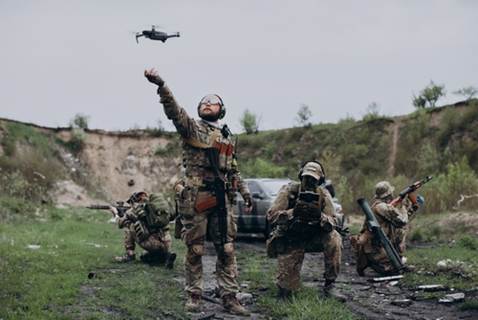
Drone Warfare And Officer Training: Lessons From The War In Ukraine
Abstract: The war in Ukraine demonstrates that drone warfare is a potential catalyst for profound transformation. Unmanned aerial systems have reshaped battlefield awareness, accelerated decision-making, and redistributed authority to lower tactical levels. This shift challenges traditional hierarchical command structures and exposes tensions between doctrine and operational reality within NATO and EU armed forces. Despite ongoing… Read More
Written by
-
Are You REDy? Using Red AI Tactics And The Defence Metaverse To Augment Future Force Design
Abstract: Force designers face demanding methodological challenges when considering how best to adapt concepts, successfully adopt new technologies, and overhaul existing structures and processes amid a fundamentally changing geostrategic environment. The Defence Metaverse, an ultra-realistic virtual twin of the battlefield, and powerful new red AI tactics offer sovereign European solutions to tackle these challenges by… Read More
Written by

-
Bias Vs. Bots: Training Officers For Cognitive Warfare
Abstract: Emerging technologies increasingly accelerate intelligence and decision cycles, yet the officer as human-in-the-loop remains cognitively vulnerable within contested information environments. Artificial intelligence may both mitigate and amplify these vulnerabilities. This article conceptualises Cognitive Resilience as the systematic integration of cognitive control loops into military decision-making. It proposes a training framework—Countering Cognitive Warfare Training (CCW… Read More
Written by

-
An Austrian Perspective On Training First-Person-View-Drone-Builders And Operators
Abstract: Unmanned Aerial Vehicles (UAVs) and, especially, First Person View (FPV)-drones have fundamentally altered conventional and asymmetric warfare. With their rapid development since 2022 in the Russian-Ukrainian war, the Austrian Armed Forces recognised the need to develop methods to train future leaders in the intricacies of warfare with a heavy UAV presence and in integrating… Read More
Written by

-
“Analogue” And “Digital” Reserve Forces
Abstract: Specialised digital-reserve functions are becoming increasingly important in how states conceptualise reserves in national and allied security. Alongside traditional reserve roles, digitally-specialised reservists can mobilise scarce expertise in cyber defence, data, cloud systems, and AI. Drawing on civilian and academic professionals, they may strengthen resilience against hybrid threats while raising questions of interoperability, legality,… Read More
Written by

-
Assessing Algorithmic Influence In Military Education
Abstract: This article argues that AI-mediated cadet/officer training is not ethically neutral but functions as a normative training environment that shapes attention, incentives, and moral reasoning. Drawing on a virtue-ethics distinction between simulated virtue (ethically correct-looking outputs and rule compliance) and internalised virtue (phronesis-based judgment under pressure), it describes how AI training ecosystems pre-structure ethical… Read More
Written by

-
Emerging Technologies And The Enduring Principles Of War In European Officer Education
Abstract: While emerging technologies are transforming the character of war and officer education, the core principles of war remain constant. Focusing on European military academies, AI-enabled decision support systems, unmanned platforms, and cyber capabilities can be integrated into the basic education of future officers. These tools will reshape the teaching of the enduring principles of… Read More
Written by

-
Designing A Generative AI Platform For Tactical Training Of Junior Officers
Abstract: Tactical decision-making lies at the core of officer education, yet current training methods remain constrained by structural and pedagogical limitations. Traditional wargames offer valuable experience but are organisationally difficult, time-intensive, and often emphasise flows of play over cognitive decision-making. Tactical Decision Games (TDGs) partially address this gap, but their effectiveness is limited by instructor… Read More
Written by

-
Embracing Emerging Tech To Educate Tomorrow’s Officers
Abstract: Cognitive warfare targets perception and decision-making, yet officer training lacks the operational constructs that structure kinetic or cyber operations. This doctrinal gap leads to fragmented detection, weak attribution, and curricula that prioritise procedural certainty over adaptive judgment in the face of ambiguity. This article introduces the Cognitive Defence Cycle (CDC), an operational model mapping… Read More
Written by

-
Framework And Elemental Training Approaches For Military Operations
Abstract: Extended Reality (XR) is increasingly used for training in military and emergency response contexts, yet its pedagogical application to high-risk and cognitively demanding environments remains underdeveloped. This paper argues that XR’s primary value lies in its ability to regulate cognitive load through staged, elemental training rather than holistic simulation. Problem statement: How can Extended… Read More
Written by
