
Abstract: The integration of artificial intelligence (AI) into strategic command reconstitutes rather than augments command judgement, placing systematic pressure on what Clausewitz identified as the essential intelligence of command: coup d’œil, the cultivated capacity for rapid holistic synthesis that distinguishes the formed commander from the competent administrator. This article argues that command intuition develops through practice and is sustained through experience, yet three compounding pathologies in AI-augmented environments progressively erode its development and exercise. Drawing on Clausewitz’s analytical framework, the article identifies these pathologies as automation bias, which substitutes deference for judgement; algorithmic monoculture, which collapses cognitive diversity through which actors recognise what shared models cannot perceive; and delegated infopolitik, which embeds consequential political choices within system architecture, rendering them invisible to commanders and severing the accountability chain that war as an act of policy requires.
Problem statement: How can Western defence institutions preserve the individual commander’s sovereign judgement, and the political accountability it underwrites, when AI-enabled decision-support systems progressively replace the conditions in which that judgement is formed and exercised?
So what?: Defence doctrine must treat AI as a powerful instrument requiring active human governance, not as a neutral accelerator of existing decision-making processes. Because the primary institutions responsible for turning doctrine into practice are those that form the next generation of officers, this imperative is pedagogical as well as doctrinal. Military academies must deliberately cultivate the cognitive and moral architecture that automation bias corrodes: through mandated narrative audits that convert command reasoning into accountable records; cognitive red-teaming under mission command that institutionalises the habit of contestation; and bias-logged command records with analogue fallback that preserve epistemic transparency and operational resilience.
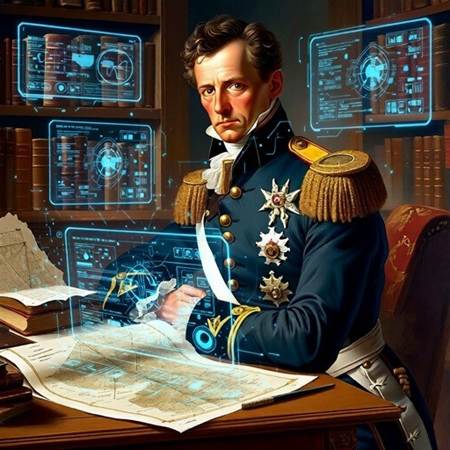
Introduction
Artificial intelligence (AI) is transforming military command, yet most defence doctrine continues to treat AI primarily as a force multiplier that accelerates planning, expands situational awareness, and improves decision support. This instrumental view assumes that command judgement remains fundamentally unchanged while the quantity and speed of available information increase. This article argues instead that AI reconstitutes rather than merely augments command judgement by progressively altering the conditions under which judgement is formed and exercised.
Clausewitz recognised that war cannot be reduced to technical calculation. It remains “an act of policy” in which “the political object is the goal, war is the means of reaching it, and means can never be considered in isolation from their purpose.”[1] The commander’s essential task is therefore not simply to process information more efficiently, but to exercise judgement under conditions of uncertainty, friction, and incomplete knowledge. Central to this capacity is what Clausewitz termed coup d’œil: the cultivated ability to synthesise complex and ambiguous situations into decisive action. Although often associated with military genius, coup d’œil is not merely exercised in command; it is developed through education, operational experience, and the repeated practice of independent judgement.
AI places systematic pressure on this faculty through three mutually reinforcing pathologies. The first is automation bias, whereby repeated deference to algorithmic recommendations substitutes compliance for independent judgement. The second is algorithmic monoculture, through which common AI architectures reduce the cognitive diversity necessary to recognise novelty, deception, and strategic surprise. The third is delegated infopolitik, whereby consequential political and ethical choices become embedded within AI systems, obscuring their provenance and weakening the accountability that Clausewitz regarded as essential to war as an instrument of policy.[2]
These developments suggest that the principal challenge posed by AI is not whether machines can make better operational recommendations than humans in particular contexts. It is whether sustained reliance upon AI alters the development and exercise of the human judgement on which command ultimately depends. The question is therefore as much pedagogical and doctrinal as technological.
The Inward Eye Under Siege
Automation bias has a precise clinical definition: the tendency of human operators to defer to automated recommendations even when those recommendations are demonstrably wrong. A 2024 systematic review and meta-analysis confirmed that human-AI combinations can outperform humans alone, but this benefit is conditional: it degrades the moment operators accept AI outputs without active verification.[3] In high-stakes operational environments, empirical research indicates that humans accept automated recommendations between 60 and 80 per cent of the time, even when those recommendations are demonstrably incorrect.[4]
Automation bias is not a momentary lapse in judgement. It is habituated compliance, applied systematically across every decision cycle, in which a commander accepts, without active scrutiny, what an algorithm has already decided. The intelligence under attack is specific. Clausewitz, in On War, termed it coup d’œil, the commander’s “inward eye”: “the rapid discovery of a truth which to the ordinary mind is either not visible at all or only becomes so after long examination and reflection.” It is “not only the physical, but more frequently the mental eye.” In the darkest hours of war, amid friction, fog, and uncertainty, the commander requires “an intellect that… retains some glimmering of inner light which leads to truth,” which must then be followed with determination.[5] Coup d’œil, or operational discernment, is more than tactical acuity. It is the capacity for synthesis, the holistic, intuitive recognition of the decisive point and the moment for action, that makes command possible when data are incomplete, contradictory, or actively deceptive.
Clausewitz emphasised that this intelligence, while containing an element of innate talent, is cultivated through experience, education, and the repeated exercise of judgement under conditions of uncertainty: a point Frederick the Great anticipated operationally, warning that its absence produces ‘errors of the greatest consequence.'[6] Modern cognitive research on expert decision-making closely parallels this account. Klein’s recognition-primed decision (RPD) model establishes that an experienced commander does not enumerate options analytically under pressure.[7] Drawing on accumulated pattern recognition, they identify the situation as sufficiently familiar to generate a workable course of action, run it mentally to check for problems, and act or adjust. This generative, self-correcting process, not analytical comparison, is the cognitive signature of genuine expertise under time pressure. A commander who habitually defers to algorithmic recommendations practises deference, not synthesis. The inward eye, unused, dims.
Clausewitz identified this genius as rare and not imitable. Education and training alone do not yield brilliant command; it is the careful cultivation of intellectual and psychological attributes, specifically intuition, creativity, and resilience, developed through deliberate formation and sustained experience that produces exceptional command outcomes.[8], [9] Automation bias reaches further than inconveniencing commanders who already possess command intuition. It removes the conditions under which the capacity can develop at all.[10]
Two reinforcing processes drive the erosion. Automation bias describes over-reliance on a capability that remains intact; deskilling, in Bainbridge’s foundational analysis, describes its atrophy: when operators are removed from active decision-making, the competence required to intervene if the system fails does not merely go unused; it disappears.[11] The two compounds: automation bias reduces the occasions on which coup d’œil is exercised; deskilling reduces the faculty itself, leaving a commander who has deferred for a career without either the habit or the underlying architecture at exactly the moment both are required.
Cognitive science establishes that expert pattern recognition, whether in chess, surgery, or command, is maintained through deliberate practice under conditions of genuine uncertainty and degrades through routines that substitute procedural compliance for judgement.[12] Recent experimental evidence adds nuance to the formation question. Lushenko and Sparrow’s survey experiment among ROTC cadets, which provides the first experimental evidence of cadets’ trust in AI-enhanced military technologies, found that cadets are more trusting of AI than senior officers, but that their trust reflects a more conservative understanding of appropriate use and oversight, shaped by professional enculturation alongside ongoing cognitive and moral development.[13] Kahn, Horowitz, and Samotin’s subsequent West Point study found that cadets display significantly lower susceptibility to automation bias and better-calibrated trust in algorithmic decision support than demographically similar civilians.[14] Formation, then, develops more thoughtful oversight habits than the general population, and operational experience builds deeper scepticism still, consistent with the argument that the inward eye is cultivated through years of practice, not only in academy classrooms.
One counter-argument deserves direct acknowledgement. Johnson (2023) contends that AI integration may, counterintuitively, increase the importance of human decision-makers: as systems become more capable, the quality of the command reasoning that governs them becomes more consequential, not less.[15] This article accepts that proposition and extends it: Johnson identifies what is at stake in AI-augmented command; this article identifies the mechanism by which the inward eye on which that stake depends is formed and lost.
This pattern recurs across levels of war: at Kyiv, Ukrainian units repelled Russia’s advance with improvisational clarity no algorithm could have anticipated;[16] at the political-strategic level, Western policymakers and Putin alike misread Zelenskyy’s psychobiographical character, exposing the limits of frameworks unable to interpret singular human agency;[17] and at the tactical level, eight Marines defeated a 2019 DARPA computer-vision system using tactics no training dataset anticipated, among them disguising themselves as trees.[18] In each case, formulaic or algorithmic anticipation failed precisely where abductive, improvisational human reasoning succeeded.
AI excels at rapidly processing large volumes of data for target identification, prioritisation, and tactical simulation in current combat operations.[19] However, the creation of operational design and the broader concept of operations, encompassing the integration of political objectives, the sequencing of effects across domains, and the exercise of judgement under conditions of radical uncertainty, remain fundamentally human, abductive tasks. Dario Amodei, CEO of Anthropic, which held the primary contract to deploy Claude on classified DoW networks, grounded this assessment in the technology’s demonstrated limitations. His formal position was direct: “Without proper oversight, fully autonomous weapons cannot be relied upon to exercise the critical judgement that our highly trained, professional troops exhibit every day.”[20] In subsequent testimony, he was more specific still: “It doesn’t show the judgement that a human soldier would show — friendly fire or shooting a civilian, or just the wrong kind of thing. We don’t want to sell something that we don’t think is reliable.”[21] Current systems can augment and accelerate elements of planning but do not supplant the commander’s integrative synthesis of passion, reason, and chance.
Algorithmic Monoculture and the Fragility of Allied Command
This erosion does not stop at the individual level: when it operates across an alliance that shares the same algorithmic architectures, a second pathology compounds it: algorithmic monoculture. The U.S. has been the dominant architect of allied networked security, and the Joint Intelligence, Surveillance and Reconnaissance (JISR) network and Project Maven’s machine-learning targeting now underpin command decisions across multiple allied headquarters, creating structural efficiency and, in the same stroke, structural fragility: a single shared way of knowing and interpreting the battlefield is also a single point of failure.
Military organisations periodically reconstitute their cognitive foundations around the dominant paradigm of their era, and today’s algorithmic architectures were built for permissive environments: stable connectivity, single-truth data integrity, reliable infrastructure. Soldaat’s own empirical fieldwork during NATO exercises documents what happens when these assumptions meet the non-permissive theatre, where each fails.[22]
The accelerating pace of AI-assisted decision-making has been confirmed at the highest levels of NATO command. Admiral Pierre Vandier, NATO Supreme Allied Commander Transformation, confirmed in 2025 that alliance members are “now using AI in the decision-making loop of observe, orient, decide and act,” with analysis that once took hours or days “now done in a matter of seconds.”[23] This risk is structural to the alliance, not specific to American command: NATO’s 2021 AI Principles and the UK’s 2023 Defence Command Paper both commit member states to the same architectural interoperability that generates monoculture risk.[24] When every major headquarters interprets the battlefield through the same algorithmic lens, built on the same design assumptions, optimised against the same training data, operating on the same architecture, the conditions for genuine strategic dissent disappear. Reynolds’s (2025) analysis of temporal compression confirms the mechanism: as AI shortens decision cycles, the window for human contestation of machine consensus contracts, making monoculture most dangerous precisely when correction is most urgent.[25]
The operational scale of this integration is no longer notional. General Erik Kurilla, Commander of U.S. Central Command during the 2025 bombing campaign against Iran, testified that his command had “built a system that allowed us to dynamically prosecute over a thousand targets every 24 hours, with the capacity to do even more.”[26] At such processing velocities, the window in which a human commander can contest, interrogate, or override a machine recommendation has become exceedingly narrow, a structural condition that monoculture renders maximally dangerous.
This monocultural pull is reinforced by a deeper civilisational imaginary. As Neil Renic (2026) argues, Western military technology has long been framed as the embodiment of “civilised warfare”, understood to be precise, restrained, and morally superior. This imaginary creates powerful cultural and institutional incentives to embrace common architectures, even when doing so concentrates risk and reduces cognitive diversity across allied forces.[27]
Algorithmic monoculture fails differently from ordinary intelligence failure, where flawed analysis is eventually corrected by competing assessments, dissenting analysts, or the friction of events. In this context, three properties of normal error-correction disappear at once: the error is synchronous, with every affected headquarters reaching the same wrong assessment simultaneously and no temporal offset left for one actor to catch another’s mistake; it is internally invisible, since no actor sees a different picture to dissent from; and it concentrates precisely where independent reassessment is most needed, in the novel and deceptive conditions where training data is least representative and monoculture ensures human judgement is least available. The formal result supporting this analysis is established in complexity science: cognitively diverse groups demonstrably outperform homogeneous high-ability groups on novel problems, the category that monoculture is least equipped to handle.[28]
On any battlefield, as the authors’ experience from NATO exercises confirms and as documented operational patterns establish, roughly 50 per cent of information arrives too late, and 25 per cent is false, induced by the enemy, inaccurate reporting, or rumour.[29] A commander must therefore develop an intuitive feel for what information is reliable and what must be discarded; they must sense when something anomalous suggests enemy deception. An AI cannot reliably make this distinction; it is rapidly poisoned or misled by environmental noise, adversary deception, or the simple absence of precedent in its training data for the condition it is being asked to evaluate.[30]
The Invisible Political Choice
The third pathology has a precise conceptual antecedent. De Gouveia and Plumridge’s concept of infopolitik, understood as the shaping of information environments through which other actors must operate, finds its contemporary parallel in the architecture of AI targeting systems.[31] The extension is not analogical; it is structural. AI targeting and recommendation models do not just process reality; they constitute it. The datasets on which they are trained, the objectives for which they are optimised, and the thresholds at which they generate recommendations are all political choices. Those choices are typically invisible to the commander who acts on their outputs.
Clausewitz’s insistence that officers gather information and interpret it correctly, filtering cognitive noise, rumour, and misinformation, applies here with particular force:[33] a commander who cannot scrutinise an AI recommendation’s data lineage is navigating a fog of their own making.
The same mechanism governs command structures when AI constitutes the decisional frame, posing concerns a principal-agent analysis cannot adequately capture: that framework describes deviation from intent once intent is formed, while infopolitik operates at a prior level, shaping the epistemic conditions under which the principal forms intent in the first place.[34] The commander who acts on an AI recommendation is not unaware that political choices have shaped it; she is unaware of what those choices were, who made them, and on what basis.
This accountability gap has an established literature in the autonomous weapons debate. Sparrow’s “responsibility gap”, the argument that when a machine selects a target, moral responsibility falls between the programmer, the commander, and the system itself, identifies the same structural problem this article analyses under this infopolitik.[35] Unlike a landmine, which executes a human’s prior decision without judgement of its own, an AI targeting system performs an inferential act of classification and recommendation that more closely resembles delegated judgement than a mechanical trigger. The resulting gap arises from this judgement-like function rather than technological complexity alone, locating accountability more precisely in the prior constitutive architecture than in the moment of lethal execution: political choices embedded before the commander ever acts, and therefore difficult to contest.
Delegated infopolitik is most consequential when the AI system constituting the decisional frame has been deployed through an intermediary arrangement that structurally prevents the primary developer from exercising oversight of its own technology, particularly when that architecture spans multiple combatant commands. The Anthropic-Department of War dispute of February-March 2026 offers the most fully documented contemporary case of this condition, not because the structural problem is American, but because the dispute’s public record is unusually complete; any state procuring military AI through an intermediary architecture it does not control faces the same constitutive risk. Its analytical value lies in what it reveals about how infopolitik becomes structurally embedded in military AI: contracting arrangements whose opacity is a design feature; intermediary organisations whose institutional loyalties run to government clients over technology vendors; and an accountability chain so attenuated that the primary vendor learned of its technology’s operational use through media reporting rather than direct disclosure.
Anthropic held a $200 million contract to deploy Claude across classified DoW networks via Palantir’s AIP platform, an arrangement that structurally insulated Anthropic from visibility into specific operational uses. In February 2026, reports indicated Claude had been deployed during the operation that captured Venezuelan President Nicolás Maduro, exceeding the pre-operational planning scope the contract contemplated. When an Anthropic executive’s inquiry about this was relayed to the Pentagon, the DoW read it as vendor disapproval of a military success and, citing Anthropic’s refusal to remove exclusions on autonomous lethal weapons and mass surveillance, designated the company a supply-chain risk.[36] Amodei’s response named the structural paradox directly: ‘We do not believe…that it is the role of Anthropic or any private company to be involved in operational decision-making.'[37] Confirmation came from within the DoW itself when, reviewing inherited contracts, Under Secretary Emil Michael found AI systems ‘baked into some of the most sensitive and important places in the US military’ without being visible to incoming leadership.[38] The embedded capability itself constituted a structural power, in Strange’s sense, that no political designation could dislodge.[39]
What the Anthropic case demonstrates in miniature is the same structural condition already visible at the alliance level: a vendor relationship in which the political choices governing lethal force are made by parties outside the chain of command, with the state discovering the architecture’s limits only after the fact. Western governance frameworks have attempted to codify this requirement: the United States’ DODD 3000.09, for instance, mandates ‘appropriate levels of human judgment over the use of force,'[40] language not unique to AI, since commanders have always exercised graduated judgement under ambiguous orders, though it is now the vendor, not the commander, who sets the threshold. The resulting accountability problem is corporate, regulatory, and doctrinal at once,[41] compounded by international humanitarian law’s continued failure to adapt to AI-in-the-loop targeting.[42]
The problem is not only doctrinal and legal; it is, at its deepest level, cognitive and political. The agent-actor framework developed by Hudson and Day provides a useful diagnostic instrument here.[43] When a commander approves an AI-generated recommendation derived from unrepresentative training data, the connection between motives, values, and objectives is severed. Moral agency is delegated to an opaque process; accountability, in legal, political, and ethical terms, becomes impossible to assign. AI-mediated error need not differ in kind from error introduced by flawed human intelligence; a commander who acts on either retains accountability for the decision. What differs is scale and traceability: a flawed intelligence report can be traced to a named source and a documented chain of judgement, while the political and technical choices embedded in an AI system’s design are made by parties absent from the operational chain of command, often before the unit deploying the system exists.
That a sitting Secretary of War felt compelled to assure Congress, mid-campaign, that ‘humans are kept in the loop when artificial intelligence is involved in military decisions,'[44] an assurance promptly repeated by the Joint Chiefs Chairman,[45] illustrates the disparity between formal commitment and operational reality this article identifies, a disparity Wallace’s modelling helps explain: speed-optimised systems are structurally poorly suited to the kind of accountability such assurances promise.[46]
The Clausewitzian Trinity in the Algorithmic Age
Each pathology targets a different element of the same Clausewitzian structure, operating at the individual, alliance, and systemic levels respectively. Mapping their interaction within the trinity reveals both the threat’s coherence and what a counter-strategy must address.
Clausewitz’s trinity remains the most robust conceptual architecture for understanding war as a human and political phenomenon. This article’s position, argued against the revisionist view,[47] is that the trinity already describes cognitive warfare. What contemporary theorists name as a new domain is the systematic targeting of the moral forces, friction, and passion that Clausewitz identified as the essential character of war two centuries ago. The trinity needs no adaptation for the algorithmic age. It needs to be read more carefully. The commander’s inward eye is the operational microcosm of the trinity itself. When automation bias, algorithmic monoculture, and delegated infopolitik erode it, both the capacity to conduct cognitive operations effectively and the resilience to withstand adversary cognitive attacks are compromised.
Clausewitz’s analysis ranged from individual commanders to the totality of national power. Geography, alliances, and material resources all enter his strategic reckoning. He consistently argued that while material and numerical superiority are necessary conditions, the moral factors, encompassing quality of leadership, troop morale, and national spirit, can prove decisive against superior material odds.[48], [49] Automation bias works against precisely these moral factors, consistent with the deskilling mechanism described above: sustained deference dulls the will to act independently and habituates the commander to defer rather than to lead.[50]
At the strategic level, what is now termed cognitive warfare operates upon the moral forces and perceptual structures that Clausewitz identified as central to war’s outcome, making it a Clausewitzian phenomenon in new technological clothing rather than a distinct strategic domain. Schmidle (2026) and Brittain-Hale (2023) both confirm this continuity directly: their analyses of cognitive warfare are, at root, applications of the trinity to contemporary conditions.[51], [52]
Hunter and Bowen (2024) underscore that war’s fundamental logic is abductive: it demands creative inference under radical uncertainty.[53], [54] Machine learning systems, by contrast, operate inductively on historical patterns. The mismatch is ontological. Machine learning systems are designed to identify regularities across a domain of similar past cases and extrapolate their patterns to new instances of the same class; coup d’œil is the faculty required for the singular event that has no precedent to recognise. This is not a difference in processing speed or data volume. It is a difference in the kind of object being reasoned about: the algorithm operates on a population of instances; the commander must act on a singular event. Clausewitz understood, from his study of the Napoleonic Wars, that a totality of context and information can only be grasped in retrospect, its significance visible after the fact rather than in the moment of decision.[55] AI systems share this constraint but cannot reliably compensate for it: their inductive processing is bounded by what was captured during training, not by what will matter when the engagement is decided. A human commander can at least sense that the situation is new. An AI cannot know what it does not know. When commanders are encouraged or required to defer to inductive outputs, the abductive core of contextual synthesis atrophies.[56], [57]
Command in the Algorithmic Age
As the present article’s co-author, in his capacity as NATO’s AJP-3 custodian, has observed: with AI, an army becomes a sharper tool. How that tool is used remains a human responsibility, subject to human judgement and decision. Formation operates at two levels, preserving both the cognitive conditions under which autonomous assessment remains possible and the accountability chain that makes commanders’ judgements documented, contestable, and exercised by officers capable of independent assessment when the AI architecture fails or misleads. Clausewitz cautioned that blind adherence to theory, producing rigidity of response, is fraught in the variable environment of war, which encompasses “human emotion, chance events, and the unpredictable actions of the enemy.”[58] A doctrine that mandates nominal oversight without cultivating the discernment to exercise it commits precisely the error Clausewitz identified. Boldness, presence of mind, and intelligence cannot be feigned. In modern military decision-making, resolution, boldness, and daring risk are quietly being diluted by conformity to algorithmic consensus, with no single moment marking the loss.[59]
The three mechanisms proposed here are not a refinement of standard ‘human oversight’ requirements. Every AI governance framework, from NATO’s 2021 AI Principles to DODD 3000.09, mandates human approval of AI outputs, yet none has prevented the accountability failure this paper documents: nominal oversight, a human signature on an AI-generated recommendation, preserves the form of accountability while eliminating its substance. They are designed to preserve the human’s actual capacity for judgement, not just their formal presence in the process. That is a formational task, not a governance one.
Coup d’œil is not a procedure that can be mandated or a threshold that can be enforced by directive. It is, as Klein’s research on expert decision-making establishes, a form of embodied professional knowledge acquired through sustained deliberate practice under conditions of genuine uncertainty, conditions in which the practitioner receives feedback that builds, tests, and refines pattern recognition over time.[60] No governance framework can mandate that a human be capable of genuine judgement at a decision point; it can only mandate that a human be present. The difference between presence and capability is built, or not built, in the years of formation before the commander ever encounters an AI-supported command environment. The three mechanisms that follow are formational practices rather than constraints on AI systems, each targeting a different level of the threat: narrative audits target automation bias at the point of individual command decision; cognitive red-teaming targets monoculture at the level of collective alliance intelligence; and bias-logged records with analogue fallback target delegated infopolitik at the level of systemic epistemic architecture.
This convergence between cognitive attack resilience and automation bias resistance at the level of officer formation is confirmed by concurrent work in this journal: Schulyok, Grangl, and Gruber argue that cognitive warfare’s decisive vulnerabilities are epistemological, requiring the same shift from procedural compliance to adaptive reasoning that this article proposes as the defence against AI-induced deskilling.[61]
Command as Accountable Record
Commanders already provide formal rationale during the problem-analysis phase of planning and in the Commander’s Assessment section of an operations plan, explaining why they accept or reject particular facts and assumptions. The narrative audit extends this established practice specifically to AI-influenced decisions. Commanders must provide a formal, documented rationale whenever they accept, modify, or deviate from an AI recommendation of consequence. This converts judgement from an implicit act into an auditable record, preserving the motives-values-objectives chain that Clausewitz identifies as the non-negotiable link between political ends and military means, while generating an institutional corpus for evaluating human-machine decision dynamics over time. The audit record is not merely institutional memory; it is the evidentiary foundation of political accountability, the documentation that makes a commander’s exercise of sovereign assessment traceable to the chain of civilian authority that war as an act of policy requires.
The principal objection to narrative audits in operational settings is the aggregate volume of AI-influenced decisions across the command structure: General Kurilla’s account of processing over 1,000 targets per day, even when distributed across staff at every echelon, illustrates a throughput that leaves no institutional capacity for individual real-time justification. The audit requirement is therefore not proposed as a real-time procedure but as a formation practice and a post-event institutional record, building on existing mechanisms such as nightly commander interviews by the war diarist or embedded historian. Its primary purpose is not to slow individual decisions but to create, over time, an institutional corpus that makes the patterns of human-machine interaction visible. Nuclear release authorisation protocols provide the established precedent: the documentation burden is proportionate to consequence, not to tempo. Clausewitz’s insistence on the historiography of military campaigns as the instrument for developing command intelligence retains its full force here. AI now enables historical examples, past stratagems, and wargame outcomes to be processed and compared instantaneously, with predictive models applied to modern scenarios.[62] This is a legitimate and bounded role for AI in command education: accelerating the processing of historical patterns while recognising that any such corpus reflects the selection biases of what was documented and what was taught. The development of command discernment, however, remains the practitioner’s own task. The narrative audit is how that practice is documented. In officer formation, this practice must be trained, not assumed: cadets require structured exposure to decision scenarios in which they must articulate the reasoning behind their departures from algorithmic consensus.
Cognitive Red-Teaming
The Prussian-German tradition of Auftragstaktik, the tradition of mission command, was designed to develop commanders capable of exercising independent judgement at the edge of the network. In an algorithmic age, this principle must be explicitly extended. While red-teaming already exists to counter conventional groupthink, the perceived infallibility of algorithmic outputs creates a more seductive and harder-to-challenge form of consensus. Standing “dissenter” roles should therefore be institutionalised with the specific mandate to challenge machine consensus and reintroduce the healthy friction of human strategic debate.
The principal objection to institutionalised dissenter roles is cultural: military organisations reward decisiveness and may interpret documented hesitation as unreliability. This objection confirms rather than undermines the argument. If the culture currently penalises the cognitive habits that mission command requires, including independent assessment, willingness to diverge from consensus, and moral courage under conditions of certainty pressure, then the culture itself, rather than the mechanism, is the problem. The standing dissenter role is not merely a procedural intervention; it is a cultural signal that contesting machine consensus constitutes an exercise of command authority rather than a deviation from it.
Using the Command-Leadership-Management framework developed by Hofstetter, Geller, and Gerster (2025), this reform works across three levels: doctrine (formalising contestation procedures in C2 processes), culture (forming the habit of challenge before deployment), and management (institutionalising the standing dissenter role as a staff function with defined accountability).[63] Simonetti and Tripodi (2020) identified this risk directly: that technological acceleration produces systemic overcentralisation of command through the path of least resistance when no formation has built the counter-habit.[64]
Vandergriff’s observation that mission command culture cannot be built in the hot state applies with equal force here. This role must be modelled by senior officers before deployment, not introduced as a crisis response. The British Army’s Leadership Doctrine articulates an equivalent formation imperative, requiring that commanders at all levels be capable of acting on understood intent without direct orders, a standard that this article argues must be extended, in the algorithmic age, to the capacity to act without algorithmic consensus.[65] Officers must be educated, trained, and experienced enough to override AI when necessary, knowing two levels up and down, capable of the cognitive wargaming Boyd describes in “Patterns of Conflict” as the key to Auftragstaktik superiority: operating inside the adversary’s decision cycle by anticipating their next move before they have made it.[66]
Accountability and Operational Resilience
Every AI-generated recommendation of operational consequence should carry embedded provenance traces: training data sources, optimisation objectives, confidence intervals, and known dataset limitations. Such records provide commanders with the epistemic transparency necessary to exercise substantive rather than merely nominal assessment, while preserving the accountability chain linking political authority to military action.
Communications infrastructure in non-permissive environments cannot be assumed. Digital systems emit detectable electrical and thermal signatures; command posts, therefore, become targets.[67] The author’s operational experience from NATO exercises confirms this directly: during an exercise in Norway, satellite dishes were pointed into the ground due to horizon constraints, radio signals were attenuated by wet forest terrain, and command posts reverted to motorcycles and USB sticks to transmit messages.[68] Analogue fallback doctrine is therefore not a nostalgic redundancy but a standing operational requirement for continuity of command under degraded conditions. Officer formation must accordingly cultivate what this article terms “digital–analogue fluidity”: the trained capacity to sustain command effectiveness when AI systems are unavailable, compromised, degraded, or deliberately denied.
Amodei stated explicitly that operational decisions belong to the military rather than to private companies.[69] This was both a statement of principle and an acknowledgement that the boundary between operational authority and commercial system architecture had not, in practice, been securely established. In the absence of officers capable of evaluating, contesting, and governing AI recommendations, the commercial and political assumptions embedded by those who build the systems will inevitably fill the vacuum.
Consistent with the ‘sharper tool’ framing established earlier, AI accelerates warfare sub-processes, particularly where human reaction times are insufficient. Yet the design and direction of operations remain fundamentally human responsibilities because war incorporates political reasoning, moral consequence, ambiguity, deception, and contextual interpretation in ways no integrated cross-process automation can fully reconcile.
This reality carries institutional implications for officer education. Commanders must be formed in military staff colleges oriented towards strategic and operational reasoning rather than educated primarily through civilian-derived management techniques, as increasingly occurs in contemporary professional military education. The issue is not technical proficiency alone but the preservation of the inward eye: the capacity for independent synthesis amid uncertainty and friction.
Preserving the inward eye is therefore the central pedagogical task of officer formation in the algorithmic age. The United States’ FY2027 defence budget hearings, conducted alongside ongoing operations in Iran, underscored both the operational promise of AI-enabled autonomy and the continuing requirement for human decisional authority in lethal decisions. Secretary of War Pete Hegseth’s assurance that “humans are kept in the loop,” offered in response to questioning regarding civilian casualties, simultaneously revealed the disparity between doctrinal commitment and institutional formation: the loop can only hold if commanders possess the cognitive authority, moral architecture, and operational confidence necessary to exercise sovereign discernment within it.[70]
Commanders must be exercised repeatedly in scenarios where AI outputs are incomplete, misleading, or operationally misaligned, so that the inward eye remains the final arbiter rather than the default deferrer. Human discernment can endure under extreme cognitive and kinetic pressure. The architectural and pedagogical task is to ensure that it remains possible when the pressure originates not only from the enemy but from allied AI systems themselves.
Conclusion
Coup d’œil does not survive neglect. Automation bias removes the practice through which it develops; algorithmic monoculture removes the diversity through which its failures become visible; delegated infopolitik removes the accountability that makes preserving it a political necessity. A doctrine that treats AI as a neutral accelerant produces only the appearance of command
The remedy is formational rather than technological. Narrative audits, cognitive red-teaming, and analogue fallback preserve the conditions under which sovereign judgement remains possible. They are not adjuncts to officer education but its central purpose.
The choice is institutional. Western defence establishments can permit algorithmic architectures to reconstitute command judgement through incremental and largely invisible shifts in practice, or they can reaffirm the Clausewitzian principle that war remains an act of policy, directed by human beings who bear responsibility for its moral and political consequences. AI may accelerate analysis, but it cannot assume that responsibility.
The wars of the algorithmic age will still be decided by the commander’s inward eye. Whether that eye remains capable of discerning the decisive moment will depend less on the sophistication of the machine than on the quality of the officers entrusted to govern it.
[1] Carl von Clausewitz, On War, trans. Michael Howard and Peter Paret (Princeton, NJ: Princeton University Press, 1976), Book I, Chapter 1, “What Is War?,” 75–89. The Howard/Paret translation is used throughout this article. The direct quotation in the Introduction and the absolute war/real war divergence are both drawn from this location.
[2] Congressional Research Service, “Pentagon-Anthropic Dispute over Autonomous Weapon Systems: Potential Issues for Congress,” CRS In Focus IF12669, updated April 2026, https://crsreports.congress.gov/product/details?prodcode=IF12669. Dario Amodei, “Statement from Dario Amodei on Our Discussions with the Department of War,” Anthropic, 26 February 2026, https://www.anthropic.com/news/statement-department-of-war. Anthropic filed a civil complaint on 9 March 2026; on 26 March, Judge Rita Lin (N.D. Cal.) issued a preliminary injunction finding the designation likely constituted illegal First Amendment retaliation. The dispute’s legal status remained unresolved at publication.
[3] Michael Vaccaro, Abdullah Almaatouq, and Thomas Malone, “When Combinations of Humans and AI Are Useful: A Systematic Review and Meta-Analysis,” Nature Human Behaviour 8 (2024): 2293–2303, https://doi.org/10.1038/s41562-024-02024-1.
[4] Raja Parasuraman and Dietrich Manzey, “Complacency and Bias in Human Use of Automation: An Attentional Integration Perspective,” Human Factors 52, no. 3 (2010): 381–410, https://doi.org/10.1177/0018720810376055. See also Yudha Pranata, Yanif Hadi, and Arman Arman, “Use of Artificial Intelligence Based Applications in Decision Making in Order to Win Modern Warfare,” Formosa Journal of Applied Sciences 4, no. 7 (2025), https://doi.org/10.55927/fjas.v4i7.239.
[5] Clausewitz, On War, Book I, Chapter 3, “On Military Genius” (see note 1 for full publication details). The definition of coup d’œil is drawn from this chapter. The concept predates Clausewitz in the vocabulary of military practice: Napoleon observed, “There is a gift of being able to see at a glance the possibilities offered by the terrain … One can call it the coup d’œil militaire and it is inborn in great generals” (Napoleon I, Mémoires, 1821). Napoleon’s emphasis on intelligence as “inborn” reflects a talent-centred view that Clausewitz deliberately qualified: while acknowledging the innate element, Clausewitz insisted that coup d’œil is cultivated through experience, education, and the repeated exercise of discernment under uncertainty.
[6] Frederick II (Frederick the Great), Military Instruction from the Late King of Prussia to His Generals, trans. Lt. Col. T. Foster (Sherborne: Simmons, 1797). Frederick’s definition captures the operational stakes of this intelligence: its absence produces “errors of the greatest consequence,” anticipating the formational argument advanced in the mechanisms section.
[7] Gary Klein, Sources of Power: How People Make Decisions (Cambridge, MA: MIT Press, 1998). The RPD model establishes that expert decision-making under time pressure is a pattern-recognition process rather than an analytical comparison process, paralleling Clausewitz’s account of coup d’œil as trained synthesis rather than deliberative calculation. For the application to military command contexts specifically, see Gary Klein, The Power of Intuition (New York: Currency/Doubleday, 2003).
[8] Clausewitz, On War, Book I, Chapter 3, “On Military Genius” (see note 1). The cultivation of genius as rare and not imitable is drawn from this chapter.
[9] Christopher Comsta, On War: The Complete Text and Analysis of Clausewitz’s Work (2023), Library of Congress Control Number 2018675309. Comsta’s commentary is cited throughout for its analysis of genius, friction, operational ambiguity, retrospective comprehension, and the cultivated attributes of command in Clausewitzian warfare.
[10] Lisanne Bainbridge, “Ironies of Automation,” Automatica 19, no. 6 (1983): 775–779. Bainbridge’s central finding is that automation’s reliability creates the conditions for its own catastrophic failure: the more reliable the system, the less operators practise the manual competence required when it fails. For the application to high-stakes decision environments, see also Raja Parasuraman and Victor Riley, “Humans and Automation: Use, Misuse, Disuse, Abuse,” Human Factors 39, no. 2 (1997): 230–253.
[11] Bainbridge, “Ironies of Automation” (see note 10).
[12] Klein, Sources of Power (see note 7).
[13] Paul Lushenko and Robert Sparrow, “Artificial Intelligence and U.S. Military Cadets’ Attitudes About Future War,” Armed Forces & Society (2024), https://doi.org/10.1177/0095327X241284264. The study reports a survey experiment among ROTC cadets, finding that cadets are more trusting of AI-enhanced military technologies than senior officers while retaining a more conservative understanding of appropriate oversight shaped by professional enculturation, education, and ongoing cognitive development.
[14] Lauren Kahn, Michael C. Horowitz, and Laura Resnick Samotin, “What Is Human in Judgement? Testing Automation Bias and Algorithm Aversion Among United States Military Academy Cadets,” arXiv:2604.04333 (April 2026), https://arxiv.org/abs/2604.04333.
[15] James Johnson, “Automating the OODA Loop in the Age of Intelligent Machines: Reaffirming the Role of Humans in Command-and-Control Decision-Making in the Digital Age,” Defence Studies 23, no. 1 (2023): 43–67. Johnson identifies what is at stake; the analysis advanced here identifies what is being lost. The two analyses are sequential: Johnson’s finding that AI raises the stakes of command discernment makes the formational imperative more urgent, not less.
[16] James Marson, “The Ragtag Army That Won the Battle of Kyiv and Saved Ukraine,” Wall Street Journal, 20 September 2022, https://www.wsj.com/articles/russian-invasion-ukraine-battle-of-kyiv-ragtag-army-11663683336. The characterisation of these conditions as exceeding algorithmic anticipation represents the authors’ analytical inference from the operational record and the irreducibly contingent character of combat under real conditions.
[17] Amber Brittain-Hale, “Slava Ukraini: A Psychobiographical Case Study of Volodymyr Zelenskyy’s Public Diplomacy Discourse” (PhD diss., Pepperdine University, 2023), 30, https://digitalcommons.pepperdine.edu/etd/1367. [Disclosure: Dr Brittain-Hale is a co-author of the present article.]
[18] Paul Scharre, Four Battlegrounds: Power in the Age of Artificial Intelligence (New York: W.W. Norton, 2023), drawing in part on accounts from DARPA Deputy Director Phil Root. The exercise formed part of the Squad X programme at Marine Corps Air Ground Combat Center, Twentynine Palms, California. See also Haley Britzky, “Marines Outwitted an AI Security Camera by Hiding in a Cardboard Box and Pretending to Be Trees,” Task & Purpose, 24 January 2023, https://taskandpurpose.com/news/marines-ai-security-camera-cardboard-box/.
[19] Tyler Pager, “U.S. Captures Venezuelan Leader, Trump Says,” New York Times, 3 January 2026, https://www.nytimes.com/2026/01/03/us/politics/trump-capture-maduro-venezuela.html; see also Idrees Ali and Jasper Ward, “Trump Says Venezuela’s Maduro Captured After Strikes,” Reuters, 3 January 2026, https://www.reuters.com/world/americas/trump-says-venezuelas-maduro-captured-after-strikes-2026-01-03/. On the broader Anthropic dispute, see note 2.
[20] Dario Amodei, “Statement from Dario Amodei on Our Discussions with the Department of War,” Anthropic, 26 February 2026, https://www.anthropic.com/news/statement-department-of-war.
[21] Dario Amodei, interview with Jo Ling Kent, CBS News, 1 March 2026. Conducted hours after Secretary Hegseth’s social media announcement of the supply-chain designation, this interview constitutes the most complete primary source of Anthropic’s position under operational conditions. The reliability framing, grounding Anthropic’s objections in technical performance limitations rather than ethical principle, is cited here for that specificity.
[22] Antoine Bousquet, The Scientific Way of Warfare: Order and Chaos on the Battlefields of Modernity (London: Hurst, 2009), https://www.hurstpublishers.com/book/the-scientific-way-of-warfare/; Paul C. van Fenema and Pieter Soldaat, “Restrategizing Digitalization in the Military,” Air & Space Operations Review 2, no. 1 (Spring 2023): 26–44, https://www.airuniversity.af.edu/Portals/10/ASOR/Journals/Volume-2_Number-1/van%20Fenema.pdf.
[23] Admiral Pierre Vandier, NATO Supreme Allied Commander Transformation, press briefing at the AI Action Summit, Paris, 10 February 2025, reported in Rudy Ruitenberg, “Survival of the Quickest: Military Leaders Aim to Unleash, Control AI,” Defense News, 13 February 2025, https://www.defensenews.com/global/europe/2025/02/13/survival-of-the-quickest-military-leaders-aim-to-unleash-control-ai/.
[24] NATO, “Principles of Responsible Use of Artificial Intelligence in Defence” (Brussels: NATO, October 2021), https://www.nato.int/cps/en/natohq/official_texts_187617.htm. For the UK commitment to AI-enabled interoperability within the alliance framework, see UK Ministry of Defence, Defence Command Paper Refresh 2023: Defence’s Response to a More Contested and Volatile World (London: HMSO, 2023), https://www.gov.uk/government/publications/defence-command-paper-refresh-2023-defences-response-to-a-more-contested-and-volatile-world.
[25] Iain Reynolds, “Speed and War in US Military Thought: Mapping the Conditions for AI-Enabled Decision-Making,” Millennium: Journal of International Studies (2025), https://doi.org/10.1177/03058298251317205.
[26] General Erik Kurilla, Commander, U.S. Central Command, quoted in Haley Britzky and Natasha Bertrand, “The Pentagon Keeps Promising to Follow the Law When Using AI, But What Are the Limits?,” CNN, 7 May 2026, https://www.cnn.com/2026/05/07/politics/pentagon-ai-law-autonomous-weapons/.
[27] Neil Renic, “A Civilizational Imaginary of Western Military Technology,” Contemporary Security Policy (2026), https://doi.org/10.1080/13523260.2026.2625869.
[28] Lu Hong and Scott E. Page, “Groups of Diverse Problem Solvers Can Outperform Groups of High-Ability Problem Solvers,” Proceedings of the National Academy of Sciences 101, no. 46 (2004): 16385–16389, https://doi.org/10.1073/pnas.0403723101. See also Scott E. Page, The Diversity Bonus: How Great Teams Pay Off in the Knowledge Economy (Princeton, NJ: Princeton University Press, 2017).
[29] The 50 per cent/25 per cent figures derive from the authors’ aggregated observations across multiple NATO exercises (2018–2024) and are consistent with the operational patterns documented by van Fenema and Soldaat (see note 22). Exact percentages vary by theatre and classification level.
[30] Julia Struck-Feshchenko, “Ukraine Slams Costly US Tactics: Millions Spent to Down Cheap Drones,” Kyiv Post, 20 March 2026, https://www.kyivpost.com/post/72300.
[31] Philip Fiske de Gouveia and Hester Plumridge, European Infopolitik: Developing EU Public Diplomacy Strategy (London: Foreign Policy Centre, November 2005), https://fpc.org.uk/european-infopolitik-developing-eu-public-diplomacy-strategy/. The concept of infopolitik describes a form of interstate influence that differs from Joseph S. Nye Jr. ‘s formulation of soft power. Soft power persuades through attraction and credibility, with the target aware of being persuaded; infopolitik instead shapes the informational environment within which perceptions and decisions form. See Joseph S. Nye Jr., Soft Power: The Means to Success in World Politics (New York: PublicAffairs, 2004), for the foundational account of attraction-based influence. The present analysis extends de Gouveia and Plumridge’s interstate framework to the internal epistemic architecture of military command. For a related but distinct principal-agent interpretation of civil-military relations, see note 34.
[32] Clausewitz, On War, Book I, Chapter 7, “Friction in War” (see note 1).
[33] Comsta, On War: The Complete Text and Analysis (see note 9).
[34] Peter D. Feaver, Armed Servants: Agency, Oversight, and Civil-Military Relations (Cambridge, MA: Harvard University Press, 2003), https://www.hup.harvard.edu/books/9780674017610. Feaver describes deviation from intent once intent is formed; the present analysis identifies what occurs at a prior stage, when the conditions for genuine intent-formation are removed.
[35] Robert Sparrow, “Killer Robots,” Journal of Applied Philosophy 24, no. 1 (2007): 62–77; and Robert Sparrow, “Robots and Respect: Assessing the Case Against Autonomous Weapon Systems,” Ethics & International Affairs 30, no. 1 (2016): 93–116, https://doi.org/10.1017/S0892679415000647. See also International Committee of the Red Cross, “Autonomous Weapon Systems and the Limits of Analogy” (Geneva: ICRC, 2021), https://www.icrc.org/en/document/icrc-position-autonomous-weapon-systems.
[36] Amodei, “Statement from Dario Amodei” (see note 20).
[37] Dario Amodei, quoted in “What the Anthropic Lawsuit Means for the Future of AI in Warfare,” Rolling Stone, 11 March 2026.
[38] Emil Michael, interview by Jason Calacanis, David Friedberg, and Chamath Palihapitiya, “Inside the Iran War and the Pentagon’s Feud with Anthropic with Under Secretary of War Emil Michael,” All-In with Chamath, Jason, Sacks & Friedberg, podcast audio, 6 March 2026, https://podcasts.apple.com/us/podcast/inside-the-iran-war-and-the-pentagons-feud/id1502871393?i=1000753534584. The ‘Holy Cow moment’ characterisation and the CENTCOM, INDOPACOM, and SOUTHCOM detail are drawn from this interview.
[39] Susan Strange, States and Markets (London: Pinter, 1988), https://bloomsbury.com/us/states-and-markets-9780826473899/. Strange’s theory of structural power identifies control over knowledge frameworks as generating the most durable form of power because it becomes embedded within systems and routines that no single political decision can rapidly override.
[40] U.S. Department of Defense, Directive 3000.09: Autonomy in Weapon Systems, revised January 2023, https://www.esd.whs.mil/Portals/54/Documents/DD/issuances/dodd/300009p.pdf.
[41] Carmen Marsh, “Cybersecurity, Ethical Governance, and the Risks of AI Integration in Countering Hybrid Threats,” The Defence Horizon Journal, 15 January 2026, https://tdhj.org/blog/post/cybersecurity-ethical-governance/.
[42] Dustin Lewis, Natural and Artificial Intelligence in Armed Conflict: Exploring Settled and Open Legal Questions (The Hague: Asser Institute, 2024), https://www.asser.nl. The Geneva Conventions and the Law of Armed Conflict presuppose an identifiable and accountable human decision-maker at the point of lethal force; AI-in-the-loop targeting scenarios do not yet have a settled legal answer to that requirement.
[43] Valerie M. Hudson and Benjamin S. Day, Foreign Policy Analysis: Classic and Contemporary Theory (Lanham, MD: Rowman & Littlefield, 2020). The agent-actor framework identifies the motives-values-objectives chain as the connective tissue between individual decision and political consequence, the same chain that delegated infopolitik severs.
[44] U.S. Congress, Senate, Committee on Armed Services, Department of Defense Budget Posture Hearing, 119th Cong., 2nd sess., 1 May 2026 (statement of Pete Hegseth, Secretary of Defense [designated Secretary of War per E.O. 14347, 5 September 2025], responding to questioning by Senator Mike Rounds), reported in PBS NewsHour, 1 May 2026, https://www.pbs.org/newshour/.
[45] U.S. Congress, House, Committee on Armed Services, FY2027 National Defense Authorization Budget Request Hearing, 119th Cong., 2nd sess., 29 April 2026 (statement of Pete Hegseth and General Dan Caine, Chairman of the Joint Chiefs of Staff), https://armedservices.house.gov/hearings.
[46] Rodrick Wallace, “Command and Its Discontents: Instabilities of Institutional Anytime Algorithms on a Clausewitz Landscape,” Journal of Defense Modeling and Simulation 19, no. 3 (2020): 239–244, https://doi.org/10.1177/1548512920931597.
[47] Christopher Coker, Rebooting Clausewitz: On War in the Twenty-First Century (London: Hurst, 2017). Coker argues that Clausewitz’s framework requires updating for the cognitive and algorithmic dimensions of contemporary conflict. The analysis advanced here argues the opposite position: the trinity already describes the mechanisms by which AI reconstitutes command, and what appears novel in the contemporary operational environment is the familiar character of war in an unfamiliar technological form. Extension is not required; careful re-reading is. The article’s 2023 predecessor posed the question of whether Clausewitz required extension; the present analysis answers it.
[48] Clausewitz, On War, Book III, Chapter 3, “Moral Factors” (see note 1).
[49] Amber Brittain-Hale, “Clausewitzian Theory of War in the Age of Cognitive Warfare,” The Defence Horizon Journal, 14 December 2023, https://tdhj.org/blog/post/clausewitz-cognitive-warfare/. [Disclosure: Dr Brittain-Hale is a co-author of the present article.]
[50] Bainbridge, “Ironies of Automation” (see note 10).
[51] Robert Schmidle, “Understanding Cognitive Warfare,” PRISM 11, no. 2 (2026): 46–63, https://cco.ndu.edu/PRISM/.
[52] Brittain-Hale, “Clausewitzian Theory of War” (see note 49).
[53] Cameron Hunter and Bleddyn E. Bowen, “We’ll Never Have a Model of an AI Major-General: Artificial Intelligence, Command Decisions, and Kitsch Visions of War,” Journal of Strategic Studies 47, no. 1 (2024): 116–146, https://doi.org/10.1080/01402390.2023.2241648.
[54] Foreign Policy Analysis (FPA) grounds the claim advanced here regarding the irreplaceability of human discernment: unlike Waltz’s neorealism or Wendt’s constructivism, FPA treats human beings as the only genuine agents in international relations, a framework Hudson calls ‘human beings all the way down.’ See Amber Brittain-Hale, ‘Slava Ukraini’ (see note 17), 30–35, table 1 (‘Theoretical Approaches to FPA’).
[55] Comsta, On War: The Complete Text and Analysis (see note 9).
[56] Brittain-Hale, “Clausewitzian Theory of War” (see note 49).
[57] Schmidle, “Understanding Cognitive Warfare” (see note 51).
[58] Comsta, On War: The Complete Text and Analysis (see note 9).
[59] Clausewitz, On War, Book II, Chapter 2, “On the Theory of War” (see note 1).
[60] Klein, Sources of Power (see note 7).
[61] Bernhard Schulyok, Lukas Grangl, and Markus Gruber, “Embracing Emerging Tech To Educate Tomorrow’s Officers,” The Defence Horizon Journal, 21 May 2026, https://tdhj.org/blog/post/emerging-tech-educate-officers/.
[62] Clausewitz, On War, Book II, Chapter 6, “On Historical Examples” (see note 1).
[63] Patrick Hofstetter, Marius Geller, and Florian Gerster, “The Impact of Artificial Intelligence on the Military Decision-Making Process and Mission Command,” The Defence Horizon Journal, 11 September 2025, https://tdhj.org/blog/post/ai-military-decision-making-2/.
[64] Rosario M. Simonetti and Paolo Tripodi, “Automation and the Future of Command and Control: The End of Auftragstaktik?,” Journal of Advanced Military Studies 11, no. 1 (Spring 2020): 127–146, https://doi.org/10.21140/mcuj.2020110106. See also Donald E. Vandergriff, Adopting Mission Command: Developing Leaders for a Superior Command Culture (Minneapolis: Mission Command Press, 2018); and British Army, Army Leadership Doctrine (Camberley: Centre for Army Leadership, 2021), https://www.army.mod.uk/media/24335/20210923_army-leadership-doctrine-web_final.pdf.
[65] Simonetti and Tripodi, “Automation and the Future of Command and Control” (see note 64).
[66] John Richard Boyd, “Patterns of Conflict,” unpublished briefing slides (1986), https://www.ausairpower.net/JRB/poc.pdf, slides 76–79.
[67] David Miller, “Command Posts: Surviving the Future Fight,” DVIDS (Defense Visual Information Distribution Service), 27 May 2020, https://www.dvidshub.net/news/369285/command-posts-surviving-future-fight; 3rd Brigade, “Expanding the Scope of Emissions Control to Enhance Command-and-Control Node Survivability within 3rd Combat Brigade,” The Cove (Australian Army), https://cove.army.gov.au/article/expanding-scope-emissions-control-enhance-command-and-control-node-survivability-within-3rd-combat-brigade.
[68] van Fenema and Soldaat, “Restrategizing Digitalization in the Military” (see note 22).
[69] Amodei, “Statement from Dario Amodei” (see note 20).
[70] U.S. Congress, Senate, Department of Defense Budget Posture Hearing (see note 44).
Disclosure: Endnotes 17 and 49 cite prior published work by the respective co-authors, in accordance with Defence Horizon Journal editorial policy. Endnotes 49, 56, 61, and 63 cross-cite Defence Horizon Journal articles published in the same journal.


