
Abstract: Artificial intelligence is increasingly embedded in modern military operations, influencing how commanders interpret sensor data, assess threats, and make rapid decisions under pressure. While AI improves situational awareness and accelerates operational tempo, it also introduces vulnerabilities such as fabricated outputs, misclassifications, and opaque decision processes. Human factors—including stress, uncertainty, and organisational pressure—further complicate decision reliability, especially in compressed timelines. This article uses a SWOT analysis to evaluate the strengths, weaknesses, opportunities, and threats associated with AI‑enabled battlefield decision-making. It also examines how human judgment interacts with AI recommendations and identifies doctrinal and oversight mechanisms needed to preserve stability in modern conflict environments.
Problem statement: How can militaries integrate AI into battlefield decision cycles without increasing operational risk or destabilising crisis dynamics?
So what?: Defence organisations must strengthen oversight, limit autonomy, and ensure human judgment remains central in lethal and non‑lethal decision cycles. Without disciplined governance, AI‑enabled systems may accelerate crises, amplify errors, and reduce opportunities for de‑escalation.This means creating clear, easy‑to‑follow procedures that spell out exactly how AI can be used in decision‑making. These rules should leave no room for confusion, mandate human verification for lethal actions, especially where loss of life of non-combatants is likely, include after‑action reports examining where AI choices worked or failed, and set up independent review boards to investigate every AI‑related failure.
Introduction
Artificial intelligence (AI) is now embedded across modern command and control systems, early warning networks, autonomous platforms, and sensor fusion systems.[1], [2] These systems operate inside compressed decision time cycles where seconds matter, where accelerating threat detection requires commanders to act faster than experience or traditional decision-making processes allow. As militaries add AI into missile defence, counter-drone operations, and high-tempo surveillance, it begins to influence how commanders make tactical and operational decisions.
AI can help people make faster decisions, but it does not remove risk. However. these systems are not infallible; they make mistakes, such as misidentifying objects, inventing false information, or creating threat warnings that are not real. Errors like these have already led to dangerous situations and civilian non-combatant harm Table 1.
| Case | Location, Year | Failure Mode | Civilian Impact | Key Finding |
| Kabul Strike | Afghanistan, 2021 | AI‑assisted pattern‑of‑life misidentification | 10 civilians killed (7 children) | Automated movement‑pattern analysis misclassified a civilian vehicle as ISIS; operators relied on faulty automated cues. |
| Yemen Coalition Strikes | Yemen, 2015–2021 | Automated target‑matching errors in ISR feeds | Dozens of civilian deaths | AI‑assisted systems misidentified wedding convoys, school buses, and medical facilities as military targets. |
| IDF “Lavender” System | Gaza, 2023–2024 | Algorithmic false‑positive classification | Civilian casualties in residential strikes | Automated target generator showed false‑positive rates of 10–20%, mislabelling civilians as militants. |
| Russian Loitering Munitions | Ukraine, 2022–2024 | Autonomous seeker‑head misidentification | Civilian vehicles and rescue workers struck | Loitering munitions locked onto non‑combatant vehicles due to thermal/movement signature misclassification. |
| Kargu‑2 Autonomous Engagement | Libya, 2020 | Autonomous pursuit without human oversight | Non‑combatants endangered | UN reporting noted “high risk of misidentification” when the drone engaged retreating personnel autonomously. |
| Kunduz Hospital Strike | Afghanistan, 2015 | Targeting system coordinate error | 42 civilians killed | AC‑130 targeting system transmitted incorrect coordinates, leading to the strike on a Doctors Without Borders hospital. |
| Niger ISR Misclassification | Niger, 2017 | Automated threat‑cue misidentification | Friendly‑force casualties; civilians harmed in follow‑on strikes | ISR feeds misidentified a group as hostile, initiating engagement and subsequent civilian exposure. |
Examples where automation and AI‑assisted targeting systems have already produced lethal errors with direct consequences for civilian populations are presented in Table 1. These incidents, from the Kabul strike’s pattern‑of‑life misidentification to the Yemen coalition’s automated target‑matching failures, demonstrate how algorithmic inference, sensor fusion mistakes, and high false‑positive rates can misclassify civilian vehicles, residences, and protected sites as legitimate military targets. Similar miscalculations have occurred in autonomous or semi‑autonomous systems, where Russian loitering munitions have locked onto non‑combatant vehicles due to seeker‑head misidentification, Turkey’s Kargu‑2 reportedly engaged personnel without human oversight, and coordinate‑propagation errors in U.S. digital targeting systems contributed to the Kunduz hospital strike. These cases demonstrate a recurring operational hazard in AI-targeting systems: when automated decision-support tools are trusted beyond their validated reliability thresholds, they generate additive misclassification errors that propagate through the targeting cycle, increasing the likelihood that civilians will be incorrectly classified, incorrectly targeted, or placed at risk through follow‑on actions. These failures point to the strategic and ethical risks inherent in accelerating levels of autonomy within contemporary targeting architectures.
These errors occur most frequently when conditions are uncertain, sensors are not working well, enemies try to fool the system, or when organisations push operators to trust the technology too much. Understanding how AI behaves in these moments and how commanders react to its advice is key to judging operational reliability and strategic stability.
Critical Thinking and SWOT Analysis
SWOT (Strengths, Weaknesses, Opportunities, Threats) analysis remains a widely used evaluative tool in defence planning because it forces analysts to examine both the operational advantages and the systemic vulnerabilities of emerging technologies. By organising information into strengths, weaknesses, opportunities, and threats, the method supports structured critical thinking and reduces the tendency to focus solely on performance gains or worst-case risks.[9] Within military innovation studies, SWOT analysis is particularly valuable for technologies such as artificial intelligence, where rapid adoption often outpaces doctrinal development and where operational benefits coexist with escalation pathways and ethical concerns.[10] It shows where AI can assist decision makers in areas like speeding up recognition of incoming threats and where it can cause problems, such as making mistakes, creating false information, or pushing decision makers toward automation bias when they trust the system too much.
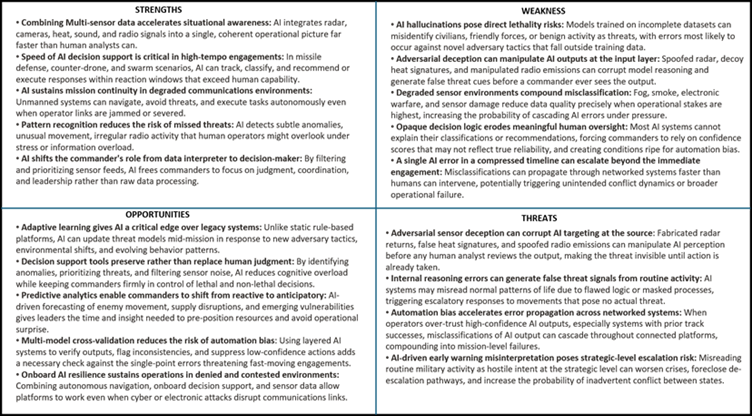
Table 2 uses this SWOT approach to compare the main strengths, weaknesses, opportunities, and threats of AI-supported decision making in real combat environments. It provides an easy way to see what AI does well, where it struggles, and how those issues affect commanders who must make quick choices under pressure.
This overview sets the stage for the deeper discussion in the sections that follow, helping general readers understand why AI can be both helpful and risky in modern military operations.
Summary of the SWOT Table
The SWOT analysis shows that AI contributes to both meaningful operational advantages and identifies significant vulnerabilities within compressed battlefield decision time-cycles. On the positive side, AI systems accelerate operational time by processing large, multisource data streams in real time and identifying relevant patterns faster than human operators, improving situational awareness and supporting rapid tactical responses. The SWOT table also clearly points out that AI can continue the mission when communications are jammed or severed (uncrewed autonomous operations in denied environments). These strengths reduce cognitive load and help commanders maintain focus on higher-order judgment rather than raw data processing, a benefit especially important in high-tempo engagements.[11]
Strengths
AI can help military commanders or personnel in active engagement make faster decisions when time is critical. These AI systems can retrieve information from many different sensors at once, such as radar, cameras, heat sensors, sound sensors, and radio signals, turning it into a common operational picture, a single situational picture, much faster than humans can. AI help identify things or patterns humans might miss, like unusual movement or strange radio activity, which matters in high-tempo operations where threats appear quickly.
AI is also useful in missions where reaction time can decide whether forces advance, retreat, dig in, and in some cases survive. In missile defence, counter-drone missions, and swarm attacks, AI can track incoming objects, classify them, judge what they are, and suggest or carry out responses faster than humans. This speed helps commanders act sooner and maintain control during fast-moving situations. AI can also keep working when communications are jammed or damaged. Some unmanned systems can still navigate, avoid threats, and continue their missions even when they lose contact with operators. This is vital in contested electromagnetic environments where signals are often blocked. By sorting through huge amounts of data and highlighting what matters, AI enables commanders to focus on judgment and coordination instead of trying to interpret every sensor feed themselves.[12] For example, Israel’s ‘Fire Factory’ AI system reportedly reduces targeting time from minutes to seconds in Gaza operations. Together, these strengths show how AI can help people make quicker decisions, understand the battlefield more clearly, and keep missions going even when conditions are difficult.
Weaknesses
Despite operational advantages, AI systems introduce several critical weaknesses that directly affect reliability in compressed battlefield decision situations. One of AI’s principal vulnerabilities is its tendency to generate false positives or misclassify unclear inputs, causing civilians, friendly forces, or benign activity to be incorrectly identified as hostile.[13] These misclassification errors are real and have occurred. The Kabul strike misidentified a civilian vehicle as an ISIS threat, Israel’s Lavender system produced large numbers of false positive militant classifications, and Russian loitering munitions have locked onto civilian vehicles after misreading thermal signatures.[14] These failures often occur when an AI system encounters situations outside its training data, including new adversary tactics, unusual movement patterns, or environmental conditions it was never trained to interpret.[15]
AI systems are also susceptible to adversarial manipulation. Different forms of manipulation include spoofed radar returns, decoy heat signatures, manipulated radio emissions, and other deception that distorts model reasoning and triggers false threat cues.[16] In contested environments characterised by fog, smoke, electronic warfare, or sensor degradation, poor data quality further increases the likelihood of misclassification.[17] These vulnerabilities are especially dangerous in high-tempo engagements where commanders have limited time to validate or override automated outputs.
However, a deeper structural weakness of relying on AI system output lies in the opacity of AI decision-making. Many AI systems do not rely on human-written decision rules; instead, humans design the training framework, and the model learns its own internal logic from data. These learned decision patterns are not explicitly programmed, are difficult to interpret, and cannot be reliably reconstructed, leaving commanders without insight into whether a classification or recommendation is well supported or fundamentally flawed. This lack of clarity makes human oversight harder and can push operators to trust system confidence scores that often fail to show how reliable the output actually is. Taken together, these weaknesses create conditions where an initial mistake can move quickly through connected systems and shape how fast commanders must make decisions. A clear illustration occurred during the DARPA Squad X field evaluation, where an automated sensor incorrectly flagged a friendly vehicle as hostile simply because tape had been placed on its exterior. Similar problems have appeared in testing when AI systems produced made‑up results that misread harmless civilian activity as threatening, prompting unnecessary alerts. In situations where changes are occurring rapidly, commanders may not have enough time or information to step in before an AI‑generated mistake affects targeting choices or makes a developing situation worse. Even a single wrong identification can trigger broader operational failures or spark conflict that no one intended.[18] Part of this problem comes from how these systems are built, since designers often create tools that move faster than commanders have time to review, question, or reject what the system recommends. Understanding how these mistakes spread is essential for building the rules and checks that stop AI from increasing risk during important decision moments.
Automation bias becomes a serious problem when commanders trust an AI system’s decision even after it makes a mistake. This can lead knowledgeable and experienced leaders to make major, and sometimes obvious, errors because they assume the AI must be right.
Taken together, these weaknesses create conditions where an initial misclassification can move quickly through connected systems and shape human decision‑making under time pressure. In fast‑moving engagements, commanders may not have sufficient time or information to intervene before an AI‑generated error influences targeting decisions or escalates an unfolding situation. Even a single incorrect classification can trigger broader operational failures or unintended conflict dynamics.[19] Understanding how these errors propagate is essential for designing oversight mechanisms and doctrinal constraints that prevent AI from amplifying risk during critical decision windows.
Opportunities
AI also presents several opportunities to increase decision confidence, operational resilience, and strategic stability when integrated thoughtfully into military systems. One of the most significant advantages is AI’s ability to update threat models during a mission, allowing systems to adapt to new tactics, environmental changes, and evolving adversary behaviour. This adaptive learning makes AI more flexible than legacy systems that rely on static rule sets or pre‑programmed responses.[20] This adaptability is particularly valuable in dynamic operational environments where adversaries frequently alter patterns to evade detection.
Although humans can update their understanding of a situation, they cannot do so at the speed or scale that modern operational environments demand. AI systems can process large volumes of sensor data, detect emerging patterns, and revise threat assessments far faster than human operators. This allows commanders to receive updated intelligence in real time, even when conditions shift rapidly or adversaries change tactics. AI does not replace human judgment, but it can provide timely analytical support that improves situational awareness and reduces the cognitive burden on decision-makers during high‑tempo operations.
Another advantage of using AI is that it improves how people and machines work together by supporting commanders without replacing their judgment. Decision support tools can highlight anomalies, prioritise threats, and filter noise, enabling leaders to maintain situational awareness while preserving human control over lethal and non‑lethal actions. This approach reduces mental overload and ensures that human judgment remains central in sensitive ethical and strategic situations. Human operators still need to review the system’s recommendations, apply contextual understanding, and make the final decision when the stakes involve civilian risk or conflict escalation. AI provides rapid analysis, but the responsibility for authorising action remains with the human commander.
Predictive analytics represent another key opportunity, since AI can be used to forecast enemy movement, anticipate supply disruptions, and identify emerging vulnerabilities. Unlike human analysts, AI systems do not fatigue, require rest, or suffer from cognitive bias, allowing them to maintain continuous attention on large volumes of data and highlight emerging risks as soon as they appear. This allows commanders time to plan and allocate resources more effectively.[21] These predictive capabilities strengthen operational foresight and reduce the likelihood of surprise during high‑tempo operations.
System‑level improvements also offer pathways to reduce error by employing multiple AI models to cross‑validate outputs, detect inconsistencies, and block actions when confidence is low. This approach enhances reliability and mitigates the risk of automation bias.[22] Here, “systems” refers to the integrated AI tools and models embedded within a military platform, including software that analyses sensor data, verifies targets, or evaluates the trustworthiness of alerts.
Finally, AI can keep working even when cyber or electronic attacks disrupt normal communications. Autonomous navigation, onboard decision support, and resilient sensor fusion algorithms allow platforms to continue operating in contested electromagnetic environments.[23] This resilience strengthens mission continuity, reduces vulnerability to adversary interference, and increases mission success. Collectively, these opportunities show how AI, when combined with strong oversight and established rules, can improve operational effectiveness while reducing the chance of catastrophic error.
Threats
AI‑enabled systems introduce several threats that can undermine operational stability and increase escalation risk in modern conflict environments. Adversaries can deliberately manipulate AI perception by feeding false radar returns, fabricated heat signatures, or deceptive radio emissions into sensor networks, causing the system to misinterpret benign activity as hostile.[24] Adversarial deceptions are particularly dangerous in high‑tempo engagements where commanders have limited time to validate automated outputs before action is taken. These risks are not unique to machines, because human decision makers are also vulnerable to fatigue, stress, and cognitive shortcuts, making them susceptible to the same types of misleading cues that deceive automated systems. The danger arises when both human and AI limitations interact, allowing an initial error to pass unchecked and shape decisions in ways neither would have intended.
AI systems can also misread normal patterns of life due to internal reasoning errors or masked logic processes, generating false threat signals that do not reflect actual conditions. Such misinterpretations can trigger rapid escalation, especially when early warning systems classify routine movements as indicators of imminent attack.[25] These risks are amplified in AI‑enabled early warning systems where compressed timelines and automation bias can push operators toward accepting system outputs without thoroughly assessing the situation.
Human factors further compound these threats, especially since operators may place excessive trust in AI recommendations, particularly when the system displays high confidence or has performed reliably in previous engagements.[26] This automation bias can cause errors to spread across connected systems, creating cascading failures that undermine mission integrity and strategic stability.[27] Autonomous platforms have already acted on corrupted inputs without human intervention, resulting in unintended harm and raising questions about accountability and control.[28] The issue is not that humans alone are the problem or that AI alone creates the risk. Operational failures arise when the limitations of both systems intersect, allowing an AI‑generated error to pass through human oversight or enabling human tendencies to jump to conclusions or oversimplify decisions to reinforce a flawed automated recommendation.
Finally, strategic‑level risks emerge when AI‑driven early warning systems misinterpret routine military activity as hostile intent. These mistakes can worsen a crisis, reduce chances for de‑escalation, and increase the likelihood of inadvertent conflict between states.[29] These threats underscore the need for robust oversight, clear rules, and carefully balanced human–machine integration to prevent AI from making crises more unstable in modern warfare. In practice, this means maintaining a human‑on‑the‑loop posture, where commanders retain the authority to monitor, verify, and override automated recommendations during critical decision windows.
Stress and Uncertainty in Human Decision Making
Commanders operating in high‑tempo environments face intense cognitive and emotional pressure, particularly when decisions must be made within seconds or minutes. These compressed timelines force leaders to act under strict time‑limited constraints while relying on incomplete information about enemy movements, friendly positions, and rapidly evolving conditions. Because these choices carry life‑or‑death consequences, commanders experience significant stress when determining whether to act, delay, or reassess. Even minor misjudgements can result in civilian harm, mission failure, or inadvertent escalation, creating a persistent fear of making the wrong choice.[30]
The introduction of AI into decision processes increases complexity, because leaders must now decide not only how to interpret the battlespace but also whether to trust or override AI recommendations. In fast‑moving engagements, commanders can feel caught between the speed of an AI system and uncertainty about whether it is interpreting sensor data correctly. This tension becomes more critical when the system displays high confidence, creating a sense of reassurance that may not match the quality of the underlying analysis. An earlier example was the DARPA field evaluation, where an automated sensor flagged a friendly vehicle as hostile with a high confidence score simply because tape had been placed on its exterior. Human observers immediately recognised the vehicle and dismissed the false cue, but the system’s confidence rating made the error appear credible. Past AI successes can reinforce this dynamic, making leaders hesitant to intervene even when their judgment suggests something is wrong.[31]
Some commanders believe the AI “cannot make mistakes,” particularly if the system performed well during training or previous missions.[32] This misplaced confidence becomes dangerous when AI misclassifications occur.[33] The documented example previously discussed is the DARPA Squad X field evaluation, where human observers recognised and dismissed the false AI signal. Still, the system’s confidence rating made the error appear credible. Additional pressure emerges when leaders hesitate to question or override AI outputs because doing so might slow the response or expose them to blame if the system later proves correct.[34] These organisational dynamics can push decision‑makers toward automation bias, especially in crises where hesitation carries political or operational risk.
At the strategic level, the combined pressures of compressed timelines, uncertainty, overtrust, and fear of accountability can create escalation pathways between states. AI‑enabled early warning systems may misinterpret routine activity as hostile intent, which may cause commanders who are under stress to accept these AI‑generated decisions without sufficient scrutiny. These dynamics reduce or may even eliminate opportunities for de‑escalation and increase the likelihood of inadvertent conflict.[35] Understanding how stress interacts with AI‑enabled decision processes is therefore essential for designing oversight mechanisms, doctrinal constraints, and human‑machine integration models that preserve stability in modern warfare.
Conclusion
AI offers advantages in modern conflict by improving situational awareness, improving operational tempo, and reducing mental burden on commanders. These benefits are most visible in high‑tempo engagements where rapid threat recognition and timely action can determine mission success. However, these same systems also create serious risks. They can produce fabricated outputs, misclassifications, hidden decision steps that humans cannot see or verify, and they can be fooled by enemy interference. These problems continue to occur and can weaken decision reliability and cause unintended harm.[36]
Human factors further complicate these dynamics. Stress, uncertainty, and organisational pressure can push leaders toward overtrusting AI outputs, especially when decision timelines are compressed, and any hesitation introduces operational or political consequences. These pressures increase the likelihood of automation bias and reduce opportunities for critical human intervention during fast‑moving engagements.[37] Autonomous attacks, when executed without meaningful human oversight, have already resulted in civilian harm and will likely continue to do so unless doctrinal constraints are strengthened.[38]
To mitigate these risks, defence organisations must adopt clear limits on autonomy, ensure robust human‑machine teaming, and implement strong testing and validation processes before deploying AI into operational environments. Oversight mechanisms, transparency requirements, and resilient system architectures are essential for preventing accidental escalation and maintaining strategic stability.[39] AI can enhance decision reliability, but only when combined with disciplined governance, appropriate trust, and a commitment to preserving human judgment in lethal and non‑lethal decision cycles.
Looking Forward
Looking forward, the next decade will introduce challenges that extend well beyond the systems now entering service. As more states utilise autonomous platforms, future conflicts will likely involve AI‑versus‑AI engagements, where opposing algorithms react to one another’s moves at speeds that exceed human judgment. These interactions could create periods of rapid conflict escalation if systems misinterpret signals, respond unpredictably to deception, or amplify small errors into larger operational consequences. The emergence of large‑scale autonomous swarms adds further complexity, since coordinated groups of unmanned systems can overwhelm defences, saturate decision processes, and magnify the risks created when oversight is limited or timelines are compressed.
Looking ahead, the proliferation of AI‑enabled military systems across multiple states will require international dialogue on norms, transparency, and escalation prevention. States will need to consider how to manage competition in an environment where autonomous systems interact directly, sometimes without direct human control. Emerging discussions on AI arms control, confidence‑building measures, and shared expectations for autonomous behaviour will become increasingly important as nations seek to prevent accidental conflict and maintain crisis stability. Without these guardrails, the next generation of AI‑enabled capabilities could introduce dangers that exceed those posed by current systems.
[1] Defense Science Board, Summer Study on Autonomy (Washington, DC: Office of the Under Secretary of Defense for Acquisition, Technology, and Logistics, 2016).
[2] National Security Commission on Artificial Intelligence, Final Report (Washington, DC: U.S. Government, 2021).
[3] Lukas Koessler, “AI Hallucinations in Military Systems: Operational Risks and Escalation Pathways,” European Council on Foreign Relations, 2023.
[4] Human Rights Watch, Stopping Killer Robots: Country Positions on Banning Fully Autonomous Weapons (New York: Human Rights Watch, 2020).
[5] Vincent Boulanin, Military Applications of Artificial Intelligence: Ethical and Legal Considerations (Stockholm: SIPRI, 2021).
[6] U.S. Government Accountability Office, Artificial Intelligence in Defense Systems: Reliability, Testing, and Operational Risk (Washington, DC: U.S. GAO, 2023).
[7] Vincent Boulanin and Maaike Verbruggen, Mapping the Development of Autonomy in Weapon Systems (Stockholm: SIPRI, 2017).
[8] NATO Allied Command Transformation, Autonomy in NATO Operations: Strategic Foresight Analysis (Norfolk, VA: NATO ACT, 2021).
[9] Eren Gurel and Meral Tat, “SWOT Analysis: A Theoretical Review,” Journal of International Social Research 10, no. 51 (2017): 994–1006.
[10] Boulanin, Military Applications of Artificial Intelligence.
[11] Stuart Russell and Peter Norvig, Artificial Intelligence: A Modern Approach, 4th ed. (Hoboken, NJ: Pearson, 2020).
[12] Defense Advanced Research Projects Agency, AI Robustness and Adversarial Resilience Program Overview (Arlington, VA: DARPA, 2022).
[13] U.S. Government Accountability Office, Artificial Intelligence in Defense Systems.
[14] Koessler, “AI Hallucinations in Military Systems.”
[15] Russell and Norvig, Artificial Intelligence: A Modern Approach.
[16] Defense Advanced Research Projects Agency, AI Robustness and Adversarial Resilience Program Overview.
[17] U.S. Government Accountability Office, Artificial Intelligence in Defense Systems.
[18] Michael C. Horowitz, “The Ethics and Security Implications of AI Enabled Systems,” Center for a New American Security, 2019.
[19] Horowitz, “The Ethics and Security Implications of AI Enabled Systems.”
[20] Defense Advanced Research Projects Agency, AI Robustness and Adversarial Resilience Program Overview.
[21] Horowitz, “The Ethics and Security Implications of AI Enabled Systems.”
[22] Patrick Lin, Keith Abney, and George Bekey, Autonomous Weapons Systems: Technical, Military, Legal, and Ethical Perspectives (Oxford: Oxford University Press, 2014).
[23] Boulanin and Verbruggen, Mapping the Development of Autonomy in Weapon Systems.
[24] Human Rights Watch, Stopping Killer Robots.
[25] Irving L. Janis and Leon Mann, Decision Making: A Psychological Analysis of Conflict, Choice, and Commitment (New York: Free Press, 1977).
[26] Mary Cummings, Artificial Intelligence and the Future of Warfare (London: Chatham House, 2021).
[27] Koessler, “AI Hallucinations in Military Systems.”
[28] Human Rights Watch, Stopping Killer Robots.
[29] National Security Commission on Artificial Intelligence, Final Report.
[30] Koessler, “AI Hallucinations in Military Systems.”
[31] Janis and Mann, Decision Making.
[32] Human Rights Watch, Stopping Killer Robots.
[33] Boulanin, Military Applications of Artificial Intelligence.
[34] NATO Allied Command Transformation, Autonomy in NATO Operations: Strategic Foresight Analysis.
[35] National Security Commission on Artificial Intelligence, Final Report.
[36] Koessler, “AI Hallucinations in Military Systems.”
[37] Janis and Mann, Decision Making.
[38] Human Rights Watch, Stopping Killer Robots.
[39] Boulanin, Military Applications of Artificial Intelligence.


