
Abstract: This article examines how emerging disruptive technologies during 1989–1993 affected the execution and doctrinal understanding of mission command principles in the U.S. Armed Forces. The analysis builds on an event-based cumulative coding process in which a selection of specific doctrines, technological advancements, and named operations are treated as key events and coded on a stepped scale (-1, 0, +1) over two dimensions: doctrine (d) and practical implementation in operations (p). The codes are cumulatively summed and visualised using an iterative model. Technologies are treated in two tracks: as inhibitors of MC principles and as facilitators of MC principles. Tactical-level technologies are mostly supportive of such principles, whereas network-level implementations show degraded trust between command levels. The doctrinal revision of FM 100-5 in 1993 is consistent with the patterns identified in the model.
Problem statement: How did emerging disruptive technologies in the period of 1989-1993 affect the execution and doctrinal understanding of mission command principles in the U.S. Armed Forces?
So what?: The paper puts emphasis on which terms affect when and if technologies inhibit or push forward decentralised command. On the one hand, information superiority and digital surveillance often expanded operational awareness at higher command levels, but simultaneously risked an asymmetry of understanding between echelons. On the other hand, it showed that subordinate initiative remained decisive whenever technology enhanced competence and autonomy. Further developments in training reveal that there is no magic solution that can replace soldiers’ competencies, and that for mission command principles to remain relevant, one must subordinate technologies to human control.
Introduction
Emerging disruptive technologies are a recurring feature of military innovation. In some cases, they lead to structural changes in warfare (revolutions in military affairs), in others, they change details of existing doctrine without a complete upending.[1] This article aims to investigate the latter. With a focus on troops in the U.S. armed forces at the battalion level and below during 1989-1993, this study analyses how GPS SINCGARS, JSTARS, and night-fighting capabilities affect the practical and doctrinal use of mission command principles.[2]
Theoretical Background
Emerging and Disruptive Technologies
Traditionally, these sorts of technologies have been combined with doctrinal and organisational advancements during cyclical periods referred to as revolutions in military affairs (RMAs). An RMA is an upheaval of the normal course of warfighting brought in by these combined elements. An RMA does not occur simply from the introduction of new technologies, but rather from their integration into doctrine and organisation, changing the roots of how military power is projected.[3] While the technologies here did not necessarily constitute a revolution in military affairs, there is a clear correlation between their use and changes in the conduct of warfare.
Four technologies are included:
- GPS: Satellite-based navigation facilitated precise manoeuvres in an environment without large and easily spotable landmarks;
- Improved communication devices: Communications systems with frequency hopping and increased encryption, such as Single channel ground and air radio systems (SINCGARS), increased the possibility for continuous contact between units but also increased the expectation of availability and response;
- Sensors and surveillance: Sensors (JSTARS) gave commanders a near-live feed of enemy positioning, reducing friction within their own forces;[4] and
- Night capabilities: Widespread distribution of thermal and night-vision optics created a 24-hour operational window.[5]
Mission Command
Mission Command is the foundational leadership philosophy in the United States Army, codified in ADP 6-0.[6], [7] It is defined as the implementation of local authority over decisions and leadership through mission-oriented tactics, making it possible to employ disciplined initiative in accordance with the intention of a higher-level leader. The philosophy consists of seven equal principles: Competence, mutual trust, shared understanding, commander’s intent, mission orders, disciplined initiative, and risk acceptance.[8] Although the term “mission command” was first introduced in a doctrinal setting in the U.S. Army in 2003, the groundwork for the pivot towards mission-style tactics has been a constant.[9] While not a fully set philosophy by the Gulf War, multiple of the building blocks exist in the intent behind “Airland Battle”, especially its focus on speed and decentralisation.[10] While the state of MC in the U.S. armed forces was not fully codified during this time, this article uses the seven principles as shown in the ADP 6-0.
Doctrine Evolution
In the decades prior to the 1st Gulf War, the elements that make up mission command were scattered across various publications, often under different names, and were synchronised as “mission-oriented command and control” or “mission type tactics”. The consolidative effort started in 1993, with FM 100-5 defining commanders’ intent as a concise expression that clarifies the big-picture intent and desired end state of operations, with the absolute requirement that every soldier should know the intent of their commanders two levels above them.[11], [12], [13] The reason for the implementation is a need for each individual to be able to work autonomously towards a common goal, even when lines of communication are disrupted. The main thesis being that an eventual war would lead to friction that, when ushered by one’s own forces using disciplined initiative, would destabilise an enemy and their commanders who experienced the same friction.[14] The doctrine also emphasised the mission command principle of “competence”, stating that “decentralisation demands well–trained subordinates”, where technical competencies stand as the foundation of trust-based leadership, and without mutual trust, the system would lead to fragmentation rather than flexibility. Mutual trust can therefore be considered the bargain commanders have to make to ensure increased tempo.[15]
In parallel with the internal doctrinal developments, there has historically existed and still exists considerable academic and professional discourse surrounding the traditionally Prussian concept of Auftragstaktik. Although the term was not used in any official settings, it served as an ideal in certain professional environments, with effort put into translating German decentralisation into an American context.[16] The discrepancy between the Prussian flexibility suggested by Auftragstaktik and the detailed control required to exert force with advanced, complex weaponry continues to challenge contemporary understanding of doctrine.
Despite doctrinal ambitions for decentralised leadership, implementation during the period was severely hindered by institutional blowback. As the Cold War was winding down, the U.S. Army, as an institution, needed wide-scale downsizing, creating an unintentional “zero defects culture” for career officers.[17] The professional environment increased their reliance on quantitative evaluation criteria, in which even marginal tactical errors could stop or severely hinder an officer’s career progression. An institutional culture of risk aversion developed in response, standing in direct contrast to the stated objectives of willingness to take risks and disciplined initiative, leading officers to choose passivity and detailed control over trust in subordinates. Further developments like the Military Decision Making Process (MDMP) in 1997 led to arguments stating that the U.S Army suffers from “synchronisation warfare” where overconfidence in centralised coordination through increased technology, such as communications and sensors, gives commanders the opportunity to micromanage tactical details in real-time and thereby interrupts the proposed autonomous units within the hierarchy’s decision-making cycles.[18], [19] While the doctrine, already in place before the first Gulf War and to this day, has placed increasing emphasis on mission command principles, there seem to be institutional developments that have gone in the opposite direction. These developments must be seen as moderating factors in the relationship between EDT and mission command principles.
Mission Command under Tech-Enabled C2
“The most essential dynamic of combat power is competent and confident officer and non-commissioned officer leadership”.[20] This argues that leadership is achieved by applying mission command principles, while mission command principles are, on the one hand, enabled by and, on the other hand, existentially threatened by emerging and disruptive technologies.
Technology as an Enabler
The framework of network-centric warfare (NCW) posits that robust information technology can and will remove friction, which has traditionally created the need for strong hierarchies in militaries. With a fully shared understanding among all actors, one would no longer need these hierarchical ties.[21] The explanation is that when subordinates gain the same complete and updated picture of the battlefield as the top command, the need for explicit control evaporates. It is replaced by “self-synchronisation,” where each unit automatically aligns its actions with a commander’s intent without waiting for detailed orders. From an NCW perspective, technologies such as GPS and JSTARS may support mission command by reducing uncertainty, accelerating decision-making processes, and enabling greater autonomy across command levels.
Technology as an Existential Threat
In contrast to the optimism expressed by proponents of NSW, a significant part of the literature problematises information technologies and their apparent tendency to create more centralised systems. Increased information flow without proper system adjustments has historically resulted in information overload on strategic levels and decision paralysis on lower levels.[22] Widespread use of recent technologies might be antithetical to the concept of mission command, as many of the technological advancements are in sensors, comms, and satellite tracking, giving commanders the ability to observe and micro-manage units in real time, a phenomenon described as “the tactical general”.[23] Recent technologies have torn down the barriers that forced commanders to delegate work rather than do it themselves. Creating an environment of constant surveillance where subordinates might abstain from showing initiative for fear of reprimand.[24] In other words, instead of creating a culture of mutual trust, EDTs might create a technology-dependent force, in which trust has been all but eroded, leaving the organisation at risk of collapse if the technologies it relies on fail.
Methods
This paper employs a semi-structured qualitative content analysis using a pre-established codebook based on mission command principles. The coding is done on an event-by-event basis, organised as a timeline of time-limited “events” within specific time slots, and supported by two or more literary pieces of evidence each.
Design, Scope and Subject of Analysis
The scope of the research is limited to the timeframe of 1989 – 1993.[25] The subject of analysis is “events” defined as either (a) a specific military operation, skirmish, or battle. Or (b) a dated doctrine that explicitly mentions or can be assumed to be connected to experiences or frictions from the period of the war.[26], [27]
Data- and Event Selection
The data is compiled from open source and scholarly materials, in two tracks:
- Praxis (P): Primary, secondary, and tertiary sources describing performances; and
- Doctrine (D): Formal doctrine documents and other official documents codifying changes.
Inclusion Criteria
The data is split into different events, with the events needing to fulfil four inclusion criteria to be relevant. (1) dated in the period of 1989-1993, (2) relevant for soldiers on lower tactical levels (battalion and below), (3) containing evidence of use or hindrance of at least one mission command principle, (4) explicit or inferential connection to at least one of the 4 EDT categories (GPS, improved comms, sensors, night capabilities). Events deemed not to fulfil the criteria are excluded to minimise the risk of event inflation. Sources were identified by focusing on specific events that contained information on predefined theoretical and doctrinal values. For each event, there are at least two independent data points in the form of textual evidence.[28]
Codebook and Operationalisation
Mission Command is operationalised through the principles presented in ADP 6-0: competence, mutual trust, shared understanding, commander’s intent, mission orders, disciplined initiative, and risk taking. To limit complexity, not all principles are coded for each event. Where not deemed relevant, they will be excluded in accordance with the principles of event-based timeline coding.[29] The aim is to code each event with 1-3 principles deemed diagnostic for the specific event. For each chosen principle, a delta score is given based on an ordinal three-point scale (-1, 0, +1).
The specific technologies deemed EDT during the Gulf War were operationalised through four categories:
- GPS: Navigational aid and positional tracking;
- SINCGARS/ communications: Robust tactical radios, frequency jumping, and secure speech;
- JSTARS/ISR: Wide ground surveillance and sensors; and
- NIGHT: Night vision optics and thermal optics.
For each category of technological innovation, a three-point scale (0, 1, 2) is used to assess the presence and importance of that technology for the specific event. Zero being irrelevant, one being inferred to be of importance. Two are vital to the observed delta. To reduce post-hoc attribution, the evidence for the technologies is also coded on four levels: X (explicitly mentioned and of direct influence), S (strong influence but not mentioned), I (plausible inference), and N (no evidence). The degree of evidence must be consistent, i.e., role = 2 cannot be combined with a N not mentioned influence or an I plausible inference.
Aggregation and Analysis
The visualisation is heuristic. It is used to identify patterns of alignment, tension, and discontinuity across events, not to draw statistical inferences or measure causality.
Limitations
This study is based on a small number of events (N=10) from open sources between 1989 and 1993 at the battalion level or below; therefore, risks of selection bias and incomplete coverage exist. The design is intentionally narrow and period-bound. The objective is analytic clarity within a tightly defined historical window, not broad generalizable claims about technology and Mission Command across eras. The coding scheme is ordinal (-1, 0, +1) and is used for structured evaluation rather than as a precise quantitative measure. In particular, the attribution of importance to technology is vulnerable and should be treated as a plausible mechanism supported by anecdotal evidence from the corpus, rather than as a causal estimate.
Event Corpus
The dataset consists of ten dated events between 1989 and 1993, covering operational praxis and doctrine:
| Event | Period | Name | Principle1 | Principle2 | Principle3 |
| E0 | 1989-12-20 1990-01-31 | Operation Just Cause | Shared understanding | Competence | Commander’s intent |
| E1 | 1991-01-17 1991-02-28 | Operation Desert Storm | Commander’s intent | Shared understanding | Mutual trust |
| E2 | 1991-01-17 | Task Force Normandy | Competence | Shared understanding | Commander’s intent |
| E3 | 1991-02-24 1991-02-28 | Operation Desert Sabre | Disciplined initiative | Commander’s intent | Mission orders |
| E4 | 1991-01-18 1991-02-25 | Scud missile attacks | Shared understanding | Commander’s intent | Mutual trust |
| E5 | 1991-02-26 | Battle of 73 Easting | Competence | Shared understanding | Disciplined initiative |
| E6 | 1991-01-29 1991-02-01 | Khafji | Shared understanding | Disciplined initiative | Competence |
| E7 | 1991-02-27 | Battle of Medina Ridge | Competence | Disciplined initiative | shared understanding |
| E8 | 1991-02-24 1991-02-27 | Western flank manoeuvre (“Hail Mary”) and night movement | Commander’s intent | Mutual trust | |
| E9 | 1991-02-28 1991-03-03 | Ceasefire and boundary control | Shared understanding | Mission orders | |
| E10 | 1993-06-14 | Post-war doctrine capture: FM 100-5 (Operations) | Mission orders | Commander’s intent | Shared understanding |
Discussion
Tension exists in the dichotomy between emerging disruptive technologies (EDT) as a facilitator and as an inhibitor, and their relation to mission command.[30] The analysis of events done in this paper, such as Just Cause (E0) and Al-Khafji (E6), uncovers a deeper, meaningful paradox. EDT strengthened the execution of tactical tasks.[31] However, the same technologies created new dependencies on communication and control systems that struggled to function under real conditions.[32] The period’s doctrinal transition from FM 100-5 (1986) to FM 100-5 (1993) is influenced by the problems identified in this discrepancy, as technology simply did not function as envisioned. The enthusiasm for new technologies as useful for synchronisation (detailed command) in the 1986 doctrine was quelled in the 1993 version, with an attempt to keep command human and executable as information volume rises and communications reliability falls.[33]
The level of EDT use is effective. On one hand, SINCGARS and JSTARS, both network-level EDTs, can be classified as services. On the other hand, night-vision goggles (NVGs) and GPS can be classified as tactical-level equipment. These (NVG and GPS) functioned as clear facilitators of the principles of competence and risk acceptance. Unlike communications systems, which created new dependencies, these technologies increased autonomy at the tactical level. During Operation Just Cause (E0), nighttime capabilities provided U.S. forces with a decisive advantage, enabling them to operate at levels of risk that would previously have been unacceptable.[34] On the night of 16 to 17 January 1991, Task Force Normandy (E2) conducted Operation Eager Anvil, a joint operation that required mutual trust. Two AH-64A Apache attack helicopter teams, each led by an MH-53J PAVE LOW, destroyed Iraqi Early Warning Radar Sites close to the Saudi Arabian border.[35] By doing so, the Task Force created a blind spot in Iraq’s integrated air defence system, which opened an aerial corridor for coalition strike aircraft.[36] In an operation where mission command principles were directly enabled by EDT, aircrews were briefed not only on ingress routes and target coordinates, but also on their operational role within the larger operation, reflecting the principle of commander’s intent.[37] The operation did not rely on micromanagement. Instead, crews were empowered to execute and plan within the commander’s given framework.[38] The operation could not have been performed without EDT’s help, as the flying was technically difficult.[39] The pilots relied on satellite navigation due to a lack of geographical reference points in the desert.[40]
The criticality of the GPS is emphasised sufficiently in Berg & Tilley’s chapter in Deep Manoeuvre, where it is stated that only a year or two prior to the mission, an undertaking like that would not have been possible.[41] While only the two MH-53s were equipped with precision GPS, their presence served as a force multiplier for the entire task force.[42] In effect, GPS served as an enabler, overcoming existing capability thresholds. It did not substitute for competence but helped already existing competence.
Competence played a further role in the Battle of 73 Easting (E5), where reports emphasise the importance of shared understanding. Competence was aided by NVG and GPS, attributing the dominant victory over Iraqi forces to the troops’ surprise momentum, enabled by disciplined initiative, mutual trust, and a shared understanding.[43] When one of the platoons encountered dug-in Iraqi positions, leaders pressed the attack without hesitation with “armoured sections employing thermal sights to detect and engage Iraqi forces before being effectively spotted and targeted in return, creating asymmetry under low vis conditions”.[44] Instead of inducing hesitation, the friction of contact appears to have reinforced the authority to make forward decisions. Eagle Troop relied on continuous radio coordination to synchronise fire and manoeuvre across the partially dispersed platoons during the engagement. In greater measure, radio communication was used to verify reconnaissance intelligence and to prevent fratricide.[45] Bohannon emphasises that real-time radio communication sustained tempo and mutual support during contact. As seen in the figure above, EDT played an important role in 73 Easting, enabling shared understanding, competence, and initiative at the tactical level.
GPS was of great value, with equipment distributed throughout the troops, enabling higher echelons to exercise control and reducing the cognitive load on tactical commanders without devolving into micro-control.[46] There is no evidence that sensor integration led to confusion or centralisation during this operation. 73 Easting shows that increasing technological integration does not necessarily centralise control, nor inhibit subordinate initiative. Despite the presence of advanced navigation, night-vision capability, and communication systems, decision-making authority remained decentralised.[47] Technology enhanced execution capacity rather than expanding supervision control. There is no observable evidence of over-centralisation, digital paralysis, or command hesitation. The figure above reflects this pattern through a cumulative strengthening of competence and disciplined initiative during this phase, without degrading shared understanding. Radio communication functioned as a supportive enabler. Continuous radio communication between companies and platoons simplified execution and reduced coordination errors.[48]
McMaster’s reference to communicating on another platoon’s net to prevent misidentification further illustrates how reliable communications maintain formation integrity during contact.[49] During Operation Just Cause, the presumption of synchronisation as the best way to lead was challenged. Decentralised leadership was not seen as an ideal form of leadership, but it was forced into use due to limitations in existing technologies.[50] When the intensity of the operation increased, the possibility of centralised control crashed. The RAND analysis of the operation clearly states that the technological systems for communication, and especially so the single channel ground and airborne radio system (SINCGARS) and satellite based systems, could not handle the burden of the immense simultaneous informational flow: “Dedicated liaison officers were helpful in overcoming the problems of overloaded communications networks and inattention to SOPs, but there were not enough of them and they had not been integrated into training exercises”.[51] In the figure, this disruption corresponds with a negative delta shown in shared understanding, marking the clearest tension between network dependence and MC execution.
Technology, therefore, worked as a disruptor for mutual understanding; the reliance on working communications meant that proper contingencies were not made for when it did not work. The consequence was that the entire operation changed on an ad hoc basis to a decentralised form of leadership, primarily led at the platoon level.[52] As this development was not foreseen, it places extreme strain on the commander’s intent, which previously had no priority.[53]
Al-Khafji (E6) highlighted the divergence between what higher management can see and what lower-level units can convey. JSTARS provided coalition leadership with the capability to monitor enemy movements in real time. As described by Head, “JSTARS aircraft generated a near-continuous picture of Iraqi manoeuvre activity in southern Kuwait”.[54] At the operational level, improved sensors facilitated shared understanding, enabling commanders to achieve a degree of situational awareness previously unattainable; reports confirmed that JSTARS provided “near real-time information on various targets, including moving targets, in all weather conditions”.[55] The paradox emerged when this information had to be translated into tactical action on the ground.
On the other hand, at 73 Easting, the situation improved when commanders granted autonomy to lower levels. McMaster recalls: “Lieutenant Gifford called me from the command post to remind me that the 70 easting was the limit of advance. We were already beyond it. I told him, ‘I can’t stop. We’re still in contact. Tell them I’m sorry.’ Gifford explained the situation to the squadron headquarters on the radio”.[56] At the tactical level, communications systems remained vulnerable to electronic warfare and interference, creating a gap between observation and execution. During the fighting, reconnaissance units experienced repeated communication disruptions, creating a critical breakdown in mutual trust between soldiers and command.[57] Highlighting the tensions existent in these EDT, while JSTARS offered commanders an impression of oversight, jamming and communications failure deprived tactical leaders of the ability to report their own situation. Headquarters believed they possessed an accurate understanding of the battlefield, while units on the ground were increasingly isolated from the command network. In practice, this disconnect forced a regression to pre-digital methods, in which units were compelled to rely on runners to reestablish contact and transmit information manually.[58]
The constant need for adaptations reinforces the argument that technology during this period functioned as a fragile enabler. When systems operated as intended, they increased operational tempo and coordination. When they failed, Mission Command could no longer rely on technical connectivity; it had to rely on human ingenuity.[59]
These contradictory experiences of technology as both enabling and vulnerable form the backdrop against which the 1993 doctrinal revision (E10) must be read. The figure clearly shows that this cumulative aggregation across principles increased all the way up to the doctrinal update in 1993, suggesting it was a consolidative effort that combined practical experience. General Frederick Franks, one of the architects of the 93 doctrines, characterises the shift as a move toward “Full-Dimensional Operations,” reflecting an acceptance that the linear predictability associated with the Cold War had eroded.[60] FM 100-5 (1993) can be understood as an attempt to protect a proto-Mission Command from the centralising tendencies introduced by emerging information technologies, effectively codifying competence and mutual trust as the only reliable safeguards when technological systems break down.[61] “Command is more of an art than a science. In battle, it is often guided by intuition and feel gained from years of practice and study”.[62] Franks acknowledges emerging disruptive technologies as the catalyst for change.[63] However, rather than concluding that technology enables greater centralised control, a position later associated with Network Centric Warfare theories, the doctrine moves in the opposite direction. The doctrine explicitly acknowledges that modern systems allow for faster information flow and states that technology enables “almost real-time intelligence and information sharing, distributed decision making, and rapid execution of orders”.[64] At the same time, the text contains a clear warning against allowing this informational abundance to translate into micromanagement. This is signified, amongst others, by an explicit critique of long narrative orders. In this formulation, technology is deliberately repositioned from a driver of operations to a support function for human decision-making. Articulating a principle that directly counters technologically enabled overcontrol: “Long, narrative descriptions of how the commander sees the fight tend to inhibit the initiative of subordinates”.[65] The doctrine reasserts discipline in communication by emphasising mission orders that specify what is to be achieved, rather than how it is to be executed.[66] In addition, the introduction of versatility as a core principle represents a direct response to the operational unpredictability encountered in Panama and the 1st Gulf War.[67] This shift can be interpreted as an institutional acknowledgement that technology alone cannot eliminate the fog of war. Effective adaptation requires organisations and leaders who can adjust when technology or circumstances change.
Beyond the technological dynamics, the period also exposed operational demands that neither doctrine nor technology could fully anticipate. Operation Just Cause (E0) demonstrated the need for rapid transitions between conventional combat and stability operations, often with short warning.[68] While technologies such as NVG and precision munitions increased lethality, they did not automatically confer adaptability. That adaptability depended on cognitive flexibility at both the individual and organisational levels. In response, the 1993 doctrine introduced versatility as a core principle, placed alongside initiative and agility: “Versatility is the ability of tactical units to adapt to different missions and tasks, some of which may not be on unit mission-essential task lists (METL). … Operations Just Cause, Desert Shield, Desert Storm, and Provide Comfort introduced Army forces to dynamic environments that called for quick, successful action across a wide range of war and operations other than war”.[69] The shift reflects an institutional recognition that emerging technologies alone cannot address the complexity of modern operations, even when they enable MC.
Versatility formalises the expectation that leaders and units must operate autonomously, adapt rapidly, and continue to function effectively when technologies or plans fail.[70] In this sense, the doctrine reinforces Mission Command by lowering the threshold for disciplined initiative and by explicitly accepting uncertainty as a permanent feature of modern warfare. The introduction of versatility as a core principle in E10 formalises the requirement that leaders and units must be capable of operating autonomously and of shifting modes of action without detailed control from higher echelons.[71] In this respect, the doctrine facilitates Mission Command by lowering the threshold and explicitly advocating disciplined initiative.[72] Subordinate commanders are explicitly expected to adapt to unforeseen circumstances, as demonstrated in Panama, rather than waiting for new or revised orders.[73] The doctrine further discusses the use of time, stating that “greater quickness permits the rapid concentration of friendly strength against enemy vulnerabilities”.[74] In this sense, EDT, including GPS and digital communications, clearly functions as an enabler of tempo and responsiveness.
Altogether, the analysis of the period shows that the relationship between EDT and mission command is, in its foundation, ambivalent. On a tactical level, technologies such as night capability and GPS led to increased precision, reduced uncertainty, and quicker decision-making, thereby empowering mission command principles such as competence, risk acceptance, and disciplined initiative.[75] At the same time, networks and sensors created significant vulnerabilities, including electronic jamming, system failures, and information overload, which undermined shared understanding and eroded mutual trust due to differing conceptions of reality across levels of command.[76] When technology failed, operative coherence was upheld by an ad hoc natural pivot towards decentralised command structures that placed greater emphasis on principles such as commanders’ intent, mutual trust, and competence.[77] As seen in the model, the use of MC principles did aggregate upwards. This is shared in what is seen in the doctrinal revision made in the 1993 version of FM100-5, underpinning the realities that were found during the active missions at the time and showcasing how the armed forces as a whole turned towards a more mission command-centric type of warfare in response to the challenges faced in the previous years.[78]
Doctrinal and Innovative Thinkers
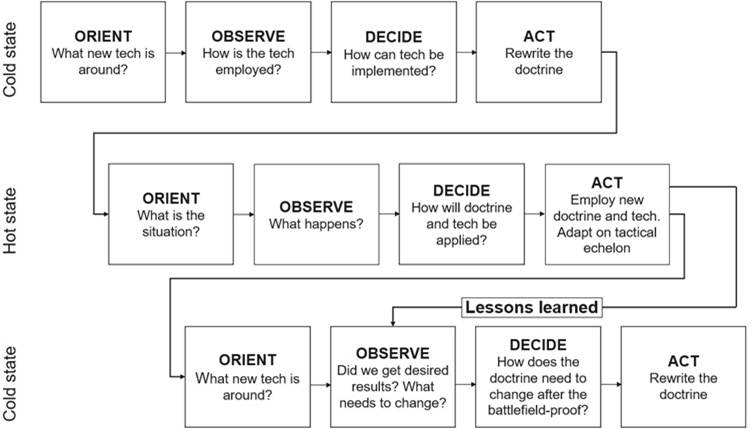
Officers, as the operating factor of any emerging technology, need certain capabilities. These capabilities might differ between hot and cold states, but are equally relevant. Regardless of their level of engagement or competence, officers must be taught the skills needed to apply emerging and disruptive technologies. Firstly, they have to be taught how to be doctrinal and innovative thinkers. They must learn to recognise new technologies, assess their employability, and, at the same time, apply existing doctrine within a cold state. As a consequence, they must learn to understand new technology to assess its potential during their officer education. As preparation for hot-state engagements, future officers must be taught resilience and how to lead through mission command during officer education, so they can be adaptive decision-makers in combat. Furthermore, anticipating possible outcomes of hot state conflicts, officers’ education has to prepare young officers how to be institutional learners by teaching them how to analyse intel and reports, how to identify and deduce correct lessons learned of an engagement or the application of an emerging and disruptive technology and how to derive specific consequences of the lessons learned.
Following John Boyd’s OODA loop, which posits that the decision-making process comprises observation, orientation, decision, and action, the same framework can be applied to implementing emerging and disruptive technologies in both cold and hot states. Officers must observe emerging technologies in a cold state and be able to analyse whether and how the technology could be utilised. After the orientation, officers must decide how to apply the merged technology and then act upon said decision. During hot phases of conflict, the conflict must be observed, and, as a consequence, decisions must be made on how to apply emerging and disruptive technologies within the ever-changing environment of conflict. The cold state following every hot state provides time to reflect on lessons learned and to consider the application of emerging and disruptive technologies in future hot states and education cycles.
[1] Andrew W. Marshall, Some Thoughts on Military Revolutions (Office of Net Assessment, 1993), 2.
[2] Stephen Biddle, Military Power: Explaining Victory and Defeat in Modern Battle (Princeton University Press, 2004), 192–95.
[3] R. S. Panwar, Disruptive Military Technologies: An Overview. Part I: Classification, AI & Robotics and Quantum Technologies (n.p., 2020), 1–2.
[4] Eliot A. Cohen and Thomas A. Keaney, Gulf War Air Power Survey, Volume II (U.S. Government Printing Office, 1993), 231–35.
[5] Williamson Murray and Robert H. Scales, The Iraq War: A Military History (Harvard University Press, 2003), 102–5.
[6] While we look at a joint operation in Desert Storm, we use Army doctrine as doctrinal data.
[7] Department of the Army, ADP 6-0: Mission Command – Command and Control of Army Forces (Department of the Army, 2019).
[8] Department of the Army, ADP 6-0: Mission Command – Command and Control of Army Forces, 2–3.
[9] Department of the Army, Mission Command: Command and Control of Army Forces (FM 6-0) (U.S. Government Printing Office, 2003), 1–1, 1–5.
[10] Carl J. Ancker, ‘The Evolution of Mission Command in U.S. Army Doctrine, 1905 to the Present’, Military Review 93, no. 2 (2013): 46–53.
[11] Ancker, ‘The Evolution of Mission Command in U.S. Army Doctrine, 1905 to the Present’, 49.
[12] Department of the Army, Operations (FM 100-5) (Department of the Army, 1993).
[13] Department of the Army, Operations (FM 100-5) (1993), 2-6,2-7,2-15, 6–6.
[14] Department of the Army, Operations (FM 100-5) (1993), 2–3.
[15] Department of the Army, Operations (FM 100-5) (1993), 2–15.
[16] Ricardo A. Herrera, ‘History, Mission Command, and the Auftragstaktik Infatuation’, Military Review 102, no. 4 (2022): 79–87.
[17] Donald Vandergriff, Misinterpreting Mission Command: The Overreliance on Micro-Management (Association of the U.S. Army, 2019), 12.
[18] Department of the Army, Staff Organization and Operations (FM 101-5) (Department of the Army, 1997).
[19] Vandergriff, Misinterpreting Mission Command: The Overreliance on Micro-Management.
[20] Department of the Army, Operations (FM 100-5) (1993), 2–11.
[21] David S. Alberts and Richard E. Hayes, Power to the Edge: Command and Control in the Information Age (CCRP Publication Series, 2003), 2–5.
[22] Martin van Creveld, Command in War (Harvard University Press, 1985), 265–68.
[23] P. W. Singer, ‘Tactical Generals: Leaders, Technology, and the Perils of Micromanagement’, Air & Space Power Journal 23, no. 2 (2009): 78–87.
[24] Eitan Shamir, Transforming Command: The Pursuit of Mission Command in the U.S., British, and Israeli Armies (Stanford University Press, 2011), 164–66.
[25] Department of the Army, Operations (FM 100-5) (1986).
[26] Gene I. Rochlin and Chris C. Demchak, ‘The Gulf War: Technological and Organizational Implications’, Survival 33, no. 3 (1991): 263, https://doi.org/10.1080/00396339108442594
[27] James W. Wright, The Challenges of Adopting a Culture of Mission Command in the US Army (2015), 68, https://apps.dtic.mil/sti/html/tr/AD1001931/.
[28]Department of the Army, ADP 6-0: Mission Command – Command and Control of Army Forces (Department of the Army, 2019).
[29] Department of the Army, ADP 6-0: Mission Command – Command and Control of Army Forces, 2–3
[30] Max Boot, ‘The Paradox of Military Technology’, The New Atlantis, no. 14 (2006): 14, https://www.jstor.org/stable/43152281; Rochlin and Demchak, ‘The Gulf War’, 263.
[31] Michael Russell Rip and David P. Lusch, ‘The Precision Revolution: The Navstar Global Positioning System in the Second Gulf War’, Intelligence and National Security 9, no. 2 (1994): 237, https://doi.org/10.1080/02684529408432248; Matthew E. Skeen, The Global Positioning System: A Case Study in the Challenges of Transformation, 2008, 92.
[32] Stanley M. Halpin and S. Delane Keene, Desert Storm Challenges: An Overview of Desert Storm Survey Responses, 1993, 11, https://apps.dtic.mil/sti/html/tr/ADA260289/; John T. Quinn, Marine Communications in Desert Shield and Desert Storm (History and Museums Division, Headquarters, U.S. Marine Corps, 1996), 1; Jennifer Morrison Taw, Operation Just Cause: Lessons for Operations Other Then War (Rand, 1996), 16.
[33] Department of the Army, Operations (FM 100-5) (1986), 17; Department of the Army, Operations (FM 100-5) (1993), 13; Fred M. Franks, ‘Full-Dimensional Operations: A Doctrine for an Era of Change’, Military Review 73, no. 12 (1993): 7.
[34] Taw, Operation Just Cause, 20.
[35] Peter E. Berg and Kevin E. Tilley, Task Force Normandy: The Deep Operation That Started Operation Desert Storm (Army University Press, 2018), 141, https://www.armyupress.army.mil/Books/Browse-Books/iBooks-and-EPUBs/Task_Force_Normandy/; Robert H. Scales, Certain Victory: The U.S. Army in the Gulf War (Office of the Chief of Staff, United States Army, 1993), 157.
[36] Berg and Tilley, Task Force Normandy: The Deep Operation That Started Operation Desert Storm; Scales, Certain Victory: The U.S. Army in the Gulf War.
[37] Berg and Tilley, Task Force Normandy: The Deep Operation That Started Operation Desert Storm, 145.
[38] Berg and Tilley, Task Force Normandy: The Deep Operation That Started Operation Desert Storm, 143; Darrel Whitcomb, ‘Flying the First Mission of Desert Storm’, Air Power History 59, no. 1 (2012): 296, https://www.jstor.org/stable/26276142.
[39] Berg and Tilley, Task Force Normandy: The Deep Operation That Started Operation Desert Storm, 151.
[40] Berg and Tilley, Task Force Normandy: The Deep Operation That Started Operation Desert Storm, 142; Rip and Lusch, ‘The Precision Revolution’, 171.
[41] Berg and Tilley, Task Force Normandy: The Deep Operation That Started Operation Desert Storm, 151.
[42] Berg and Tilley, Task Force Normandy: The Deep Operation That Started Operation Desert Storm, 142; Darrel D. Whitcomb, On a Steel Horse I Ride: A History of the MH-53 Pave Low Helicopters in War and Peace (Air University Press, Air Force Research Institute, 2012), 307.
[43] Michael D. Krause, The Battle of 73 Easting, 26 February 1991: A Historical Introduction to a Simulation (Center of Military History, 1991), 20; Scales, Certain Victory: The U.S. Army in the Gulf War, 261.
[44] Richard Winship Stewart, War in the Persian Gulf: Operations Desert Shield and Desert Storm: August 1990-March 1991 (Government Printing Office, 2010), 70:66, https://books.google.com/books?hl=de&lr=&id=2x8IhLAITN4C&oi=fnd&pg=PR5&dq=gulf+war+technology+AND+gps+AND+medina+ridge&ots=bNI6vn1w8-&sig=JtQ8FG6cmu2D4xkZlefZ4WyTSYo.
[45] Robert M. Bohannon, ‘Dragon’s Roar: 1-37 Armor in the Battle of 73 Easting’, Armor 101, no. 3 (1992): 17.
[46] Rip and Lusch, ‘The Precision Revolution’, 231; Scales, Certain Victory: The U.S. Army in the Gulf War, 235.
[47] Bohannon, ‘Dragon’s Roar: 1-37 Armor in the Battle of 73 Easting’, 13; Krause, The Battle of 73 Easting, 26 February 1991: A Historical Introduction to a Simulation, 20.
[48] Bohannon, ‘Dragon’s Roar: 1-37 Armor in the Battle of 73 Easting’, 13.
[49] H. R. McMaster, Battle of 73 Easting (Donovan Research Library, 1991), 23.
[50] Taw, Operation Just Cause, 11.
[51] Taw, Operation Just Cause, 16.
[52] Taw, Operation Just Cause, 9.
[53] Halpin and Keene, Desert Storm Challenges, 14; Taw, Operation Just Cause, 15.
[54] William P. Head, ‘The Battle for Ra’s Al-Khafji and the Effects of Air Power’, Air Power History 60, no. 1 (2013): 28.
[55] U.S. House of Representatives Committee on Armed Services, Intelligence Successes and Failures in Operations Desert Shield/Storm (U.S. Government Printing Office, 1993), 8.
[56] McMaster, Battle of 73 Easting, 24.
[57] Paul W. Westermeyer, U.S. Marines in Battle: Al-Khafji, 28 January–1 February 1991 (U.S. Marine Corps History Division, 2008), 19.
[58] Westermeyer, U.S. Marines in Battle: Al-Khafji, 28 January–1 February 1991, 19.
[59] Stephen A. Bourque, Jayhawk! The VII Corps in the Persian Gulf War (Department of the Army, 2002), 205, https://history.army.mil/Publications/Publications-Catalog/Jayhawk/.
[60] Franks, ‘Full-Dimensional Operations: A Doctrine for an Era of Change’, 5.
[61] Department of the Army, Operations (FM 100-5) (1993), 6–6.
[62] Department of the Army, Operations (FM 100-5) (1993), 14.
[63] Franks, ‘Full-Dimensional Operations: A Doctrine for an Era of Change’, 5.
[64] Department of the Army, Operations (FM 100-5) (1993), 1–5.
[65] Department of the Army, Operations (FM 100-5) (1993), 6–6.
[66] Department of the Army, Operations (FM 100-5) (1993), 6–6.
[67] Franks, ‘Full-Dimensional Operations: A Doctrine for an Era of Change’, 7.
[68] Taw, Operation Just Cause, VIII.
[69] Department of the Army, Operations (FM 100-5) (1993), 2–9.
[70] Department of the Army, Operations (FM 100-5) (1993), 2–9.
[71] Franks, ‘Full-Dimensional Operations: A Doctrine for an Era of Change’, 7.
[72] Department of the Army, Operations (FM 100-5) (1993), 2–6.
[73] Taw, Operation Just Cause, 33.
[74] Department of the Army, Operations (FM 100-5) (1993), 2–7.
[75] Rip and Lusch, ‘The Precision Revolution’, 231; Scales, Certain Victory: The U.S. Army in the Gulf War, 239.
[76] Halpin and Keene, Desert Storm Challenges, 11; Rochlin and Demchak, ‘The Gulf War’, 263.
[77] Bourque, Jayhawk! The VII Corps in the Persian Gulf War, 205; Taw, Operation Just Cause, 16.
[78] Department of the Army, Operations (FM 100-5) (1993); Franks, ‘Full-Dimensional Operations: A Doctrine for an Era of Change’.


